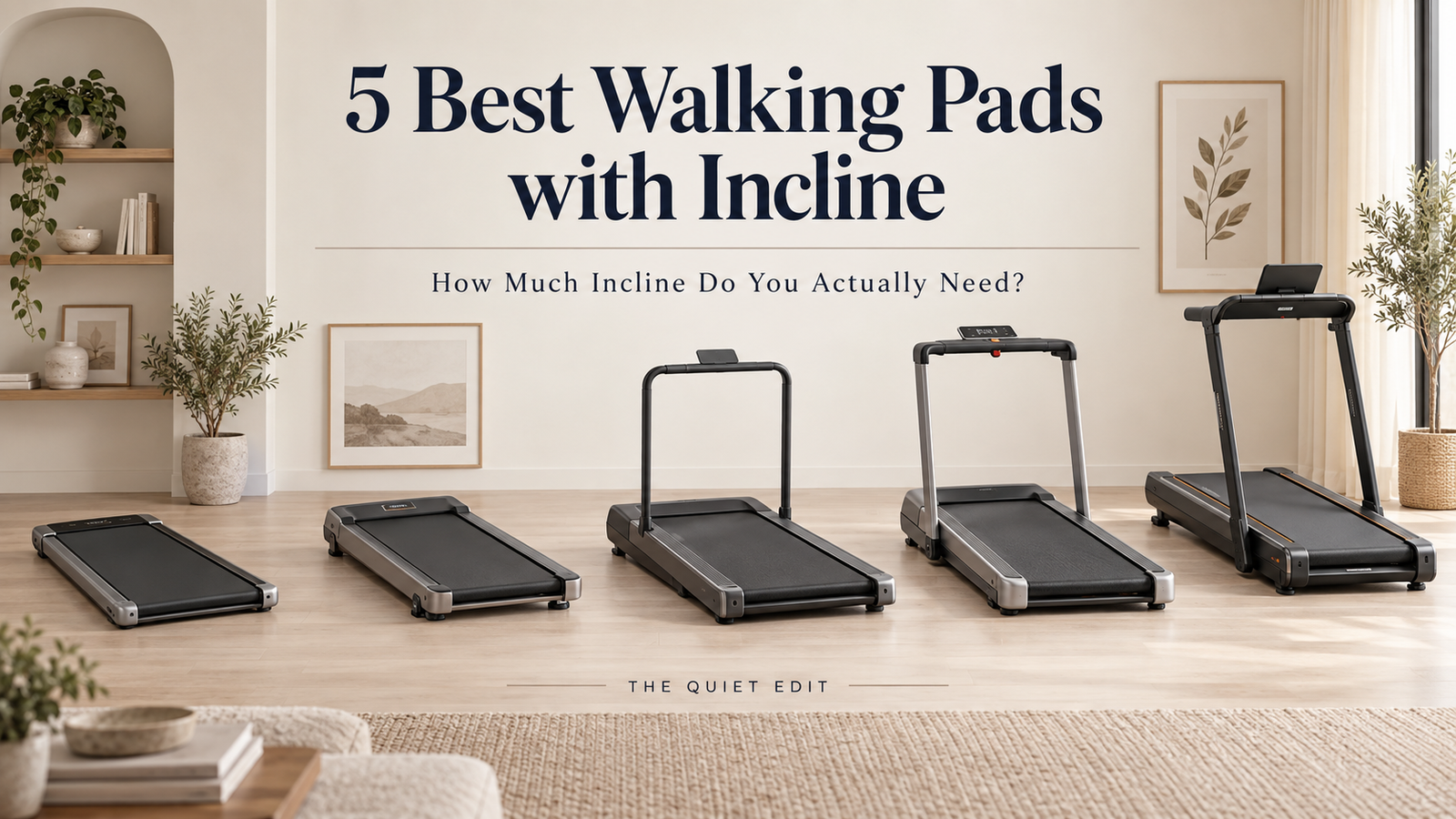
Incline can make a walking pad more useful without forcing you to walk faster.
But not all incline systems are equally practical.
Some walking pads use a manual fixed incline that you set before the workout. Others use automatic incline, letting you raise or lower the deck from the remote or app. And the newest models now reach incline levels that used to belong almost exclusively to full-size treadmills.
That means the best incline walking pad isn’t necessarily the one with the steepest number.
A 14% incline may be impressive, but it matters less if the machine is too heavy to move, too tall to store, or far outside your budget.
For this guide, we looked at incline range, incline type, footprint, weight, capacity, price, and how each design changes everyday usability.
Quick answer: The UREVO CyberPad for Home is our best overall pick because it combines a 14% automatic incline with a roomy 43.3 × 16.5-inch walking area and 350-pound published capacity. The UREVO SpaceWalk E1L Pro is the better compact value option, while the DeerRun Q2 Urban is the budget pick if you’re happy with a manual 7% incline. The WalkingPad G5i offers the steepest incline here at 18%, but it’s much closer to a premium foldable treadmill than a traditional under-desk walking pad.
Disclosure: This article contains affiliate links. If you purchase through these links, we may earn a commission at no additional cost to you. As an Amazon Associate I earn from qualifying purchases.
How we chose: We have not personally tested these walking pads. Our selections are based on current manufacturer specifications, pricing, incline type, product dimensions, weight, published capacity, and the practical implications of those differences. Prices and availability were checked in October 2026 and may change.
The Best Walking Pads with Incline at a Glance
| Model | Best for | Incline | Type | Weight | Capacity | Current price* |
|---|---|---|---|---|---|---|
| UREVO CyberPad for Home | Best overall | 14% | Auto | 70.6 lb | 350 lb | $399.99 checkout |
| UREVO SpaceWalk E1L Pro | Best compact value | 12% | Incline system | 35.5 lb | 350 lb | $189.99 |
| UREVO SpaceWalk 3S | Best midrange auto-incline | 9% | Auto | 56.65 lb | 265 lb | $249.99 |
| DeerRun Q2 Urban | Best budget manual incline | 7% | Manual | 35.05 lb | 300 lb | $119–139 |
| WalkingPad G5i | Best premium / steepest incline | 18% | Auto | — | — | $1,899 |
*Manufacturer pricing checked October, 2026. Promotions and availability may change. The G5i is currently listed for pre-order.
1. UREVO CyberPad for Home
Best Overall Incline Walking Pad
The UREVO CyberPad for Home gives you one of the strongest combinations of incline, walking space, and published capacity in a machine that still belongs in the walking-pad category.
UREVO rates it for 0–14% automatic incline with a 43.3 × 16.5-inch running area and a 350-pound maximum load. Current US pricing is $499.99, with a $399.99 checkout price shown by UREVO at the time of writing.
The useful part isn’t just that it reaches 14%.
It’s that the incline is automatic.
That means you can change intensity without stopping the workout to physically reposition the deck.
UREVO also integrates incline changes into its app-based SmartCoach features, which is more useful if you actually plan to vary incline during a session rather than set one angle and forget it.
The CyberPad is not particularly light, though.
At 70.6 pounds and 8.7 inches high, this is not the machine we’d choose if you want something you can casually slide under a sofa every evening.
The catch: heavy, tall, and considerably less portable than ultra-compact walking pads.
Our take: If you want a serious automatic incline experience without moving all the way to a full-size treadmill, the CyberPad offers the best balance here.
If belt size matters as much as incline, see our guide to the best walking pads for tall users.
2. UREVO SpaceWalk E1L Pro
Best Compact Value
The SpaceWalk E1L Pro is probably the most interesting value proposition in this group.
It combines:
- up to 12% incline
- 350-pound published capacity
- 4 mph maximum speed
- app support
- a 35.5-pound frame
- 42.9 × 19.3 × 4.5-inch dimensions
for $189.99.
That combination is unusual.
Most higher-incline machines get heavier as the mechanism becomes more substantial. The E1L Pro keeps a low, lightweight walking-pad form while still offering a much steeper incline than many budget models.
Its main compromise is walking-area length.
UREVO lists the running area at 36.2 × 15.2 inches, which is much shorter than the CyberPad’s 43.3-inch belt.
So you gain compactness and portability, but give up stride room.
There’s also one timing wrinkle: UREVO currently lists the E1L Pro for pre-order, with estimated shipping on October 4, 2026.
The catch: shorter belt and current pre-order status.
Our take: If you want steep incline in the smallest, lightest package possible, the E1L Pro is arguably the most compelling option here.
Shopping on a tighter budget? See our guide to the best walking pads under $200.
3. UREVO SpaceWalk 3S
Best Midrange Auto-Incline Option
The SpaceWalk 3S sits between UREVO’s compact E1L Pro and much heavier CyberPad.
It offers a 0–9% automatic incline, a 42.5 × 16.54-inch walking area, and a 265-pound published capacity.
Current price is $249.99.
This one makes sense if you want more belt space than the E1L Pro but don’t need 12–14% incline.
The 42.5-inch walking area is substantially longer than the E1L Pro’s 36.2 inches, and at 16.54 inches wide it also gives you more lateral room.
The penalty is weight.
At 56.65 pounds, the 3S is over 20 pounds heavier than the E1L Pro.
That turns it into more of a semi-permanent home workout machine than something you casually move around every day.
The catch: heavier than the E1L Pro and less steep than the CyberPad.
Our take: The 3S is the middle-ground pick if you want automatic incline and a more generous belt without paying CyberPad money.
4. DeerRun Q2 Urban
Best Budget Manual Incline
The DeerRun Q2 Urban takes the simplest route.
It gives you a fixed 7% manual incline, not automatic adjustment.
That means you don’t change incline from the app or remote during the workout. You set the machine’s incline position manually.
The payoff is price and portability.
Current pricing is roughly $119–139, depending on color and promotion, and the machine weighs just 35.05 pounds.
It also measures only 42.62 × 19.69 × 3.94 inches and supports up to 300 pounds according to DeerRun.
That’s a very different proposition from the CyberPad.
You’re not buying dynamic incline workouts.
You’re buying a cheap, slim walking pad that happens to give you more resistance than flat walking.
For a lot of people, that may be enough.
The catch: fixed manual incline, shorter 35.43-inch belt, and highly promotional pricing.
Our take: If you want incline without paying much more than a basic flat walking pad, the Q2 Urban is the easiest budget recommendation.
5. WalkingPad G5i
Best Premium Incline Option
The WalkingPad G5i is technically the most capable incline machine in this guide.
WalkingPad rates it for up to 18% powered incline and 10 mph, placing it well beyond ordinary under-desk walking-pad territory.
It also folds for storage, which is the interesting part.
Traditional incline treadmills tend to be large, permanent objects. WalkingPad designed the G5i around combining steep incline training with a folding deck and both flat and upright storage.
WalkingPad currently lists it at $1,899 and marks it as pre-order.
So this is not a value pick.
It’s here because it answers a different question:
Can you get serious incline and running capability without dedicating permanent floor space to a traditional treadmill?
The G5i is WalkingPad’s answer.
The catch: dramatically more expensive and far more treadmill-like than the other four picks.
Our take: Overkill if you just want incline walking under a desk. Much more interesting if you want one foldable machine for incline walking, jogging, and running.
How Much Incline Do You Actually Need?
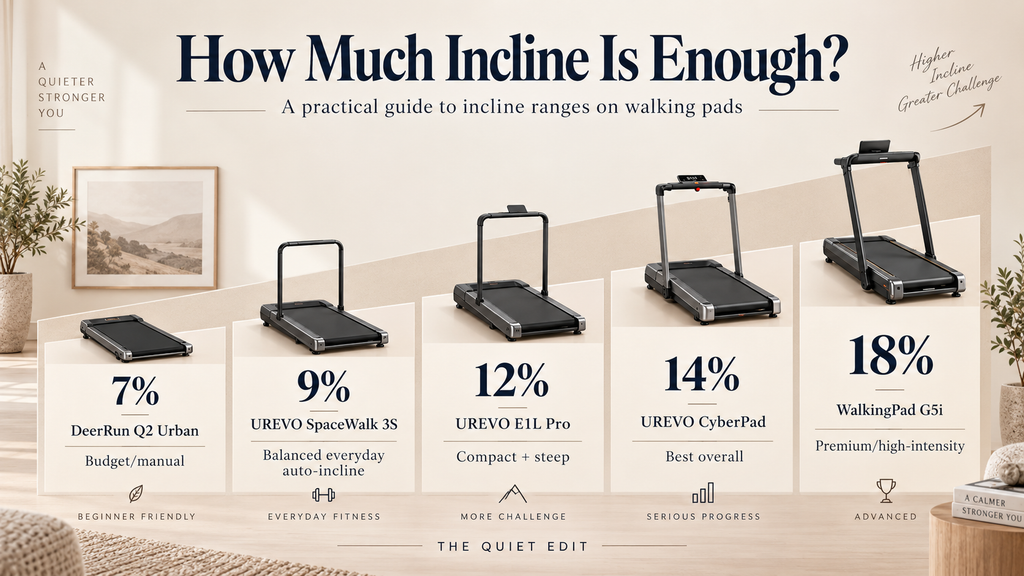
This is where the article gets more useful than a simple incline ranking.
A higher incline number is not automatically better.
Different incline ranges solve different workout goals.
WalkingPad’s own recent incline guidance suggests 3–5% can work well for steady walking, while 5–8% is useful for intervals. Higher ranges around 8–12% become more relevant for hill-style training and hiking preparation, while 12–18% is a much more demanding range.
That gives us a practical way to think about the five machines.
Around 7%
DeerRun Q2 Urban
Enough to make flat walking noticeably harder without turning the machine into a heavyweight treadmill.
Best if:
- you mainly want a simple intensity boost
- manual incline is fine
- budget matters
Around 9%
UREVO SpaceWalk 3S
This is the middle ground.
Enough range for ordinary incline walking and intervals, while keeping automatic adjustment.
Best if:
- you want automatic incline
- you don’t need extreme grades
- you value a longer belt
Around 12–14%
UREVO E1L Pro / CyberPad
This is where incline becomes a much bigger part of the workout.
Best if:
- incline training itself is a major reason you’re buying
- you want steeper hill-style walking
- automatic adjustment matters
Up to 18%
WalkingPad G5i
This is no longer just “a walking pad with a little slope.”
It’s closer to a full incline-training treadmill that happens to fold.
Best if:
- you want serious incline workouts
- you also want jogging or running
- budget is secondary
TQE Incline Decision Matrix
| Your priority | Start with |
|---|---|
| Lowest price | DeerRun Q2 Urban |
| Lightweight + steep incline | UREVO E1L Pro |
| Longer belt + auto incline | UREVO SpaceWalk 3S |
| Best balance of incline, belt size, and capacity | UREVO CyberPad for Home |
| Maximum incline + running capability | WalkingPad G5i |
This is the distinction manufacturers’ product pages don’t really give you.
Manual vs Automatic Incline: Which Is Better?
Neither is universally better.
A manual incline is simpler.
You physically set the deck before the workout and leave it there.
That works perfectly well if you always want the same incline and don’t care about changing intensity mid-session.
An automatic incline is more flexible.
You can raise or lower the deck without stopping, which makes intervals and progressive workouts easier.
That convenience becomes more valuable as incline becomes a bigger part of your training.
If you’re buying the machine mainly to walk while answering emails, though, automatic incline may be solving a problem you don’t have.
Which Incline Walking Pad Should You Buy?
For most buyers who specifically want incline as a major feature, we’d start with the UREVO CyberPad for Home.
Its 14% auto incline, roomy walking area, and 350-pound published capacity create the strongest overall package.
If you want something much lighter and cheaper, the UREVO SpaceWalk E1L Pro is the more attractive value option, provided its shorter belt works for you.
Choose the SpaceWalk 3S if you’d rather trade some maximum incline for a longer, wider walking area.
Choose the DeerRun Q2 Urban if you mostly want a basic walking pad with an inexpensive incline upgrade.
And choose the WalkingPad G5i if you’re really shopping for a foldable incline treadmill rather than a conventional under-desk walking pad.
The most useful question isn’t:
“Which one has the highest incline?”
It’s:
“How much incline will I actually use, and what am I giving up to get it?”
Frequently Asked Questions
What is the best walking pad with incline?
For the strongest overall balance, our current pick is the UREVO CyberPad for Home. It combines a 14% automatic incline, 43.3 × 16.5-inch walking area, and 350-pound published capacity.
What is the steepest incline walking pad?
Among the five models compared here, the WalkingPad G5i has the steepest published incline at up to 18%. It also reaches 10 mph, making it much closer to a full treadmill than a basic walking pad.
Is automatic incline worth it?
It can be if you want to change incline during workouts or use interval-style programs. If you simply want one fixed slope for daily walking, a cheaper manual-incline model may be enough.
Is 7% incline enough for walking?
For many users, yes. A 7% incline is already substantially steeper than flat walking and falls within the general range WalkingPad describes as useful for more challenging walking and interval work.
Can you use an incline walking pad under a standing desk?
Potentially, but check the machine’s height and your desk clearance first. Higher-incline models can raise the deck considerably, and bulky incline mechanisms may be less suitable for low-clearance desks.