
Being tall doesn’t automatically mean you need the biggest treadmill you can find.
But it does make one specification much harder to ignore: the size of the walking surface.
Compact walking pads often save space by shortening the belt. That’s useful in a small apartment, but less appealing if a longer natural stride leaves you constantly thinking about where your feet are landing.
For this guide, we therefore prioritized walking-area length and width first, then considered weight capacity, handrail options, storage, speed, and price.
Quick answer: The WalkingPad R3 is our best overall pick because its 47.2 × 17.3-inch walking area is both long and unusually wide for a foldable walking pad. The WalkingPad Z1 is the better-value choice, while the UREVO CyberPad for Home makes more sense if higher published weight capacity and incline matter alongside belt space.
Disclosure: This article contains affiliate links. If you purchase through these links, we may earn a commission at no additional cost to you. As an Amazon Associate I earn from qualifying purchases.
How we chose: We have not personally tested these walking pads. Our selections are based on current manufacturer specifications, pricing, walking-area dimensions, published weight capacity, control options, and the practical implications of those figures for taller users. We also found no standardized manufacturer height limit for these models, so we do not assign arbitrary “good up to 6’4″” style recommendations.
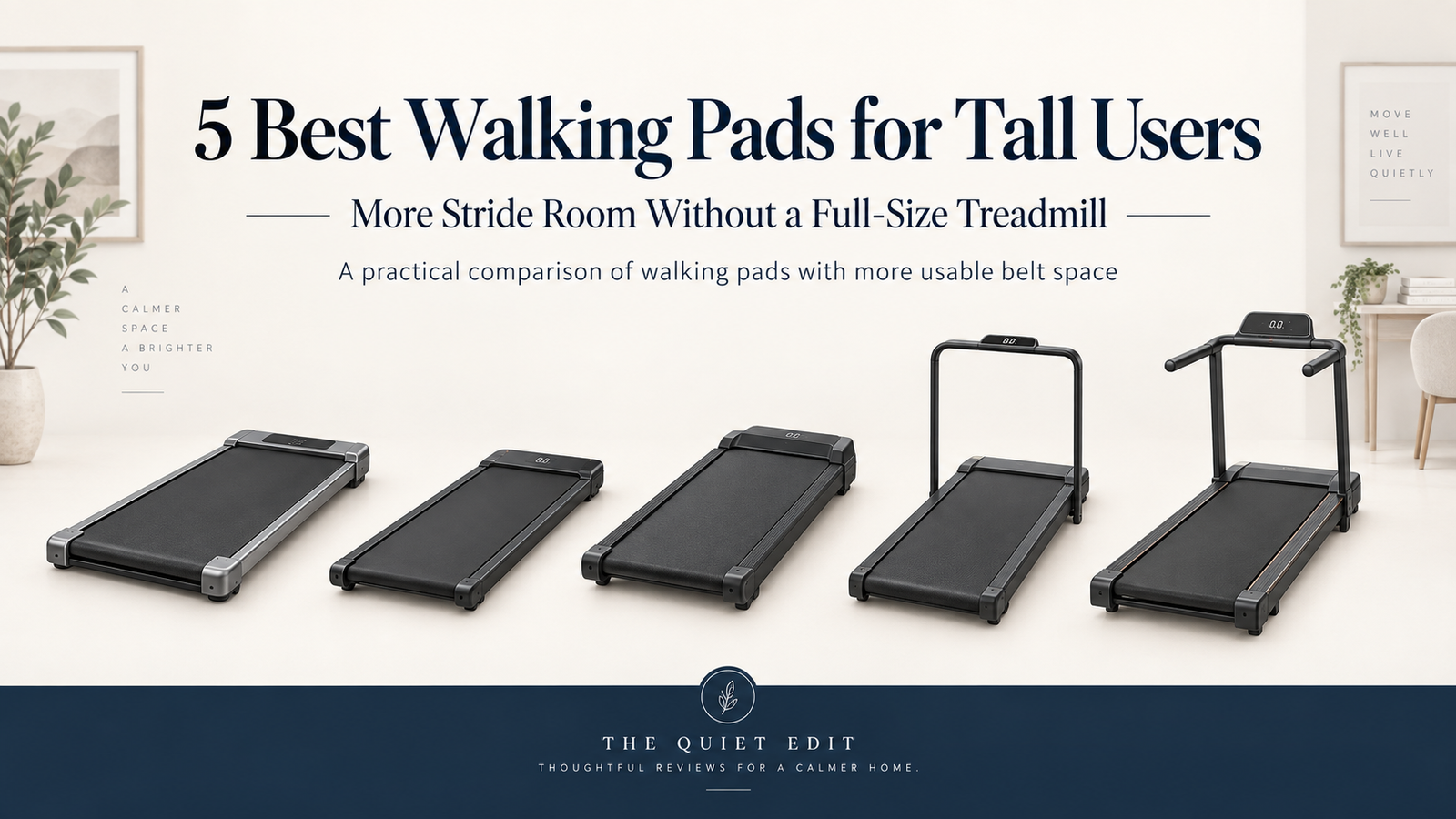
The Best Walking Pads for Tall Users at a Glance
| Model | Best for | Walking area | Capacity | Top speed | Current price* |
|---|---|---|---|---|---|
| WalkingPad R3 | Best overall | 47.2 × 17.3 in | Up to 330 lb | 4 mph | $849 |
| WalkingPad Z1 | Best value | 47.6 × 15.7 in | 242 lb | 4 mph | $299 |
| UREVO CyberPad for Home | Higher capacity + incline | 43.3 × 16.5 in | 350 lb | 4 mph | $399.99 |
| WalkingPad Z1R | Best with a handrail | 47.6 × 15.7 in | 242 lb | 5 mph | $359 |
| WalkingPad R3 Hybrid+ | Best for faster exercise | 47.2 × 17.3 in | 265 lb | 7.5 mph | $799 |
*US manufacturer pricing checked October 2026. Promotions and model variants can change.
The R3 is currently available in different published capacity variants, including a 330-pound option. The R3 Hybrid+ uses the same 47.2 × 17.3-inch running area but adds adjustable handrails and a 7.5 mph maximum speed.
1. WalkingPad R3
Best Overall for Tall Users
The WalkingPad R3 starts with the specification we’d care about most here: a 47.2 × 17.3-inch walking area.
Several walking pads offer a belt around 47 inches long. The R3 stands out because it also gives you 17.3 inches of width.
That matters because taller users don’t only have longer strides. Extra lateral room can also make a narrow walking pad feel less restrictive, particularly when you’re concentrating on work rather than staring at your feet.
Compared with a 15.7-inch-wide belt like the Z1’s, the R3 gives you about 10% more belt width.
WalkingPad also offers an R3 configuration with a published capacity of 330 pounds, while the machine folds to 33.5 inches long for storage. Current US pricing is $849.
The downside is weight.
At 66.3 pounds, the R3 is substantially heavier than the 51-pound Z1. Its unfolded body is also 26.5 inches wide.
So this is not the walking pad we’d choose simply because you want the smallest object possible.
The catch: expensive, heavy, and wider than the budget models.
Our take: If belt space is the priority, the R3 offers the strongest combination of length and width among the foldable walking pads in this comparison.
2. WalkingPad Z1
Best Value for a Longer Stride
The WalkingPad Z1 is much cheaper but gives up surprisingly little walking length.
Its belt measures 47.6 × 15.7 inches.
In fact, at 47.6 inches, it is fractionally longer than the R3’s belt.
The compromise is width.
At 15.7 inches, the Z1 gives you noticeably less side-to-side space than the R3. But for someone who mainly wants extra room in the direction of travel, the Z1 makes a very strong value argument.
It weighs 51 pounds, supports up to 242 pounds, tops out at 4 mph, and currently sells for $299 in grey.
Its folding design is another advantage.
The Z1 shrinks from 56.1 inches long to only 31.8 inches when folded, so getting a long walking belt does not necessarily mean storing a five-foot machine.
That’s especially useful if you’re tall and living in a small apartment.
The catch: the 15.7-inch belt is long but not particularly wide.
Our take: If you want maximum walking length without paying premium-model money, the Z1 is the easiest recommendation here.
3. UREVO CyberPad for Home
Best for Higher Capacity and Incline
The UREVO CyberPad for Home takes a different route.
Its running area is shorter than the WalkingPad models at 43.3 inches, but it is relatively wide at 16.5 inches.
More importantly, it combines that surface with a published 350-pound capacity and up to 14% automatic incline.
That makes it relevant for taller buyers who also have a larger frame or simply want more published load capacity than the Z1 or Z1R provide.
The CyberPad measures 47.6 × 23.6 × 8.7 inches overall and weighs 70.6 pounds.
So despite the word “Pad,” this is not the lightweight slide-it-under-the-sofa option of the group.
Its strength is workout capability rather than extreme portability.
At the time of writing, UREVO lists it at $399.99 after its current discount.
There is also a useful distinction here between body size and height.
A 350-pound capacity does not automatically make a treadmill better for someone who is tall. Capacity and belt dimensions solve different problems.
The CyberPad belongs here because it gives you both a reasonably wide belt and substantially higher published capacity, not because we’re treating those numbers as interchangeable.
The catch: the 43.3-inch belt is shorter than the R3, Z1, and Z1R, and the machine is heavy.
Our take: A good alternative if higher capacity and incline matter more to you than getting the absolute longest belt.
4. WalkingPad Z1R
Best for Tall Users Who Want a Handrail
The WalkingPad Z1R takes the basic Z1 formula and adds a removable handrail.
Its walking area remains 47.6 × 15.7 inches, and its published capacity remains 242 pounds.
Maximum speed increases to 5 mph, while product weight rises to 57.7 pounds.
For taller users, the handrail is interesting for a different reason than belt length.
Some people simply feel more comfortable having a physical reference point in front of them, particularly at faster walking speeds.
The Z1R gives you that without dropping down to a dramatically shorter walking surface.
Current US pricing is $359, only about $60 above the grey Z1 at the time of writing.
There is a storage penalty, though.
The Z1 without a rail folds to 31.8 inches long. The Z1R’s published folded dimensions are 49.2 × 23.2 × 5.5 inches.
So the handrail adds reassurance during use, but makes the package considerably less compact afterwards.
The catch: much less compact when stored than the standard Z1.
Our take: If you want the Z1’s long walking area but feel better with a rail in front of you, the relatively small price premium makes the Z1R worth considering.
5. WalkingPad R3 Hybrid+
Best for Walking Plus Faster Exercise
The R3 Hybrid+ uses the same generous 47.2 × 17.3-inch belt dimensions that make the regular R3 our overall pick.
But this one is not limited to walking-pad speeds.
With its handrails in use, WalkingPad rates the Hybrid+ for up to 7.5 mph, making it suitable for walking, jogging, and faster exercise. It also includes adjustable side handrails, FootSense control, app support, and remote control.
For a taller user who wants one machine instead of a walking pad plus a separate treadmill, that versatility is the reason to consider it.
The trade-off is mass.
The R3 Hybrid+ weighs roughly 90 pounds and measures 29.9 inches wide.
Folded dimensions are 40.3 × 29.9 × 7.7 inches, so while it technically folds, this is a much larger object to move and store than the standard Z1.
It currently costs $799, discounted from $999.
Interestingly, that’s currently less than the standard R3’s $849 listed price.
But these are different products for different jobs: the regular R3 is the cleaner under-desk walking design, while the Hybrid+ adds treadmill functionality and rails.
The catch: heavy and significantly bulkier.
Our take: The most versatile choice here if a large walking surface is important but you also want to move beyond walking pace.
What Actually Makes a Walking Pad Better for Tall Users?
This is where we’d put the original TQE comparison graphic.
A lot of guides treat weight capacity as shorthand for “good for tall people.”
We don’t think that’s very useful.
Three separate measurements matter for different reasons:
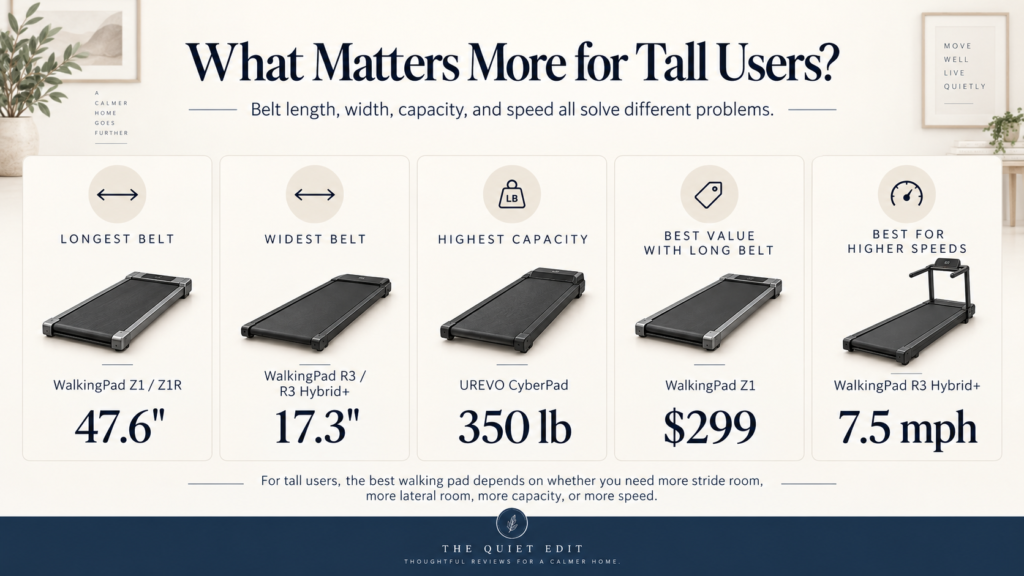
1. Belt length affects stride room
The longest belts in this group are:
- WalkingPad Z1 / Z1R: 47.6 inches
- WalkingPad R3 / R3 Hybrid+: 47.2 inches
- UREVO CyberPad: 43.3 inches
That gives the Z1 about 4.3 inches more walking length than the CyberPad.
2. Belt width affects lateral room
Here the R3 family wins:
- R3 / R3 Hybrid+: 17.3 inches
- CyberPad: 16.5 inches
- Z1 / Z1R: 15.7 inches
So although the Z1 technically has the longest belt, the R3 provides roughly 10% more belt width.
3. Weight capacity is a separate constraint
Capacity ranges from:
- Z1 / Z1R: 242 lb
- R3 Hybrid+: 265 lb
- R3: up to 330 lb depending on configuration
- CyberPad for Home: 350 lb
A tall person who weighs 190 pounds does not need a 350-pound treadmill just because they’re tall.
Likewise, a shorter user with a larger body may care far more about capacity than stride length.
That’s why we wouldn’t rank these machines using one “big and tall” number.
TQE Tall-User Decision Matrix
| Your main concern | Start with |
|---|---|
| I want the most belt room overall | WalkingPad R3 |
| I want a long belt without spending $800 | WalkingPad Z1 |
| I need higher published capacity | UREVO CyberPad for Home |
| I want a handrail without a short belt | WalkingPad Z1R |
| I want to jog or run too | WalkingPad R3 Hybrid+ |
| I need the easiest storage | WalkingPad Z1 |
This is the practical distinction manufacturers’ product pages don’t give you.
Should Tall Users Avoid Short Walking Pads?
Not automatically.
Walking at 1–2 mph under a standing desk is very different from running at 7 mph.
At slower speeds, many people naturally shorten their stride, so a compact belt may work perfectly well.
But the shorter the walking surface gets, the less margin you have for drifting forward or backward.
That’s particularly worth considering if you plan to:
- walk briskly
- take naturally long steps
- use the machine without constantly looking down
- transition from desk walking to dedicated exercise
We wouldn’t use height alone to predict whether a particular belt will feel comfortable.
If possible, compare the published walking-area length against a treadmill or walking pad you’ve already used comfortably.
Which Walking Pad Should a Tall User Buy?
For the strongest overall combination of belt length and width, we’d start with the WalkingPad R3.
Its 47.2 × 17.3-inch surface gives you more usable room than most compact walking pads without abandoning folding storage.
If $849 feels excessive, the WalkingPad Z1 is the smarter value play.
You lose 1.6 inches of belt width, but keep an exceptionally long 47.6-inch walking area for $299.
Choose the UREVO CyberPad for Home if higher published capacity and automatic incline are more important than maximum belt length.
Choose the Z1R if having a rail changes how comfortable you’ll feel using the machine.
And choose the R3 Hybrid+ if you want the roomy R3 belt but also intend to jog or run.
The key isn’t finding a walking pad marketed “for tall people.”
It’s finding one that gives your stride enough room without creating a storage problem you hate living with.
Frequently Asked Questions
What is the best walking pad for tall users?
Based on current manufacturer dimensions, our overall pick is the WalkingPad R3 because its 47.2 × 17.3-inch walking area combines strong length with the widest belt in this comparison.
How long should a walking pad be for a tall person?
There is no universal manufacturer-standard belt length tied to a specific user height. Taller users should generally pay closer attention to walking-area length, particularly if they have a longer stride, but walking speed and individual gait also matter.
Is a 40-inch walking belt long enough for a tall user?
It can be, especially for slower under-desk walking, but it provides less margin than a 47-inch belt. We would not guarantee comfort based on height alone.
Is belt width important for tall users?
It can be. Wider belts provide more side-to-side margin while walking. The WalkingPad R3 and R3 Hybrid+ use 17.3-inch-wide surfaces, compared with 15.7 inches on the Z1 and Z1R.
Does a higher weight capacity mean a walking pad is better for tall users?
No. Height and body weight are separate considerations. Weight capacity tells you the manufacturer’s published load limit, while belt dimensions are more directly relevant to available stride space.