
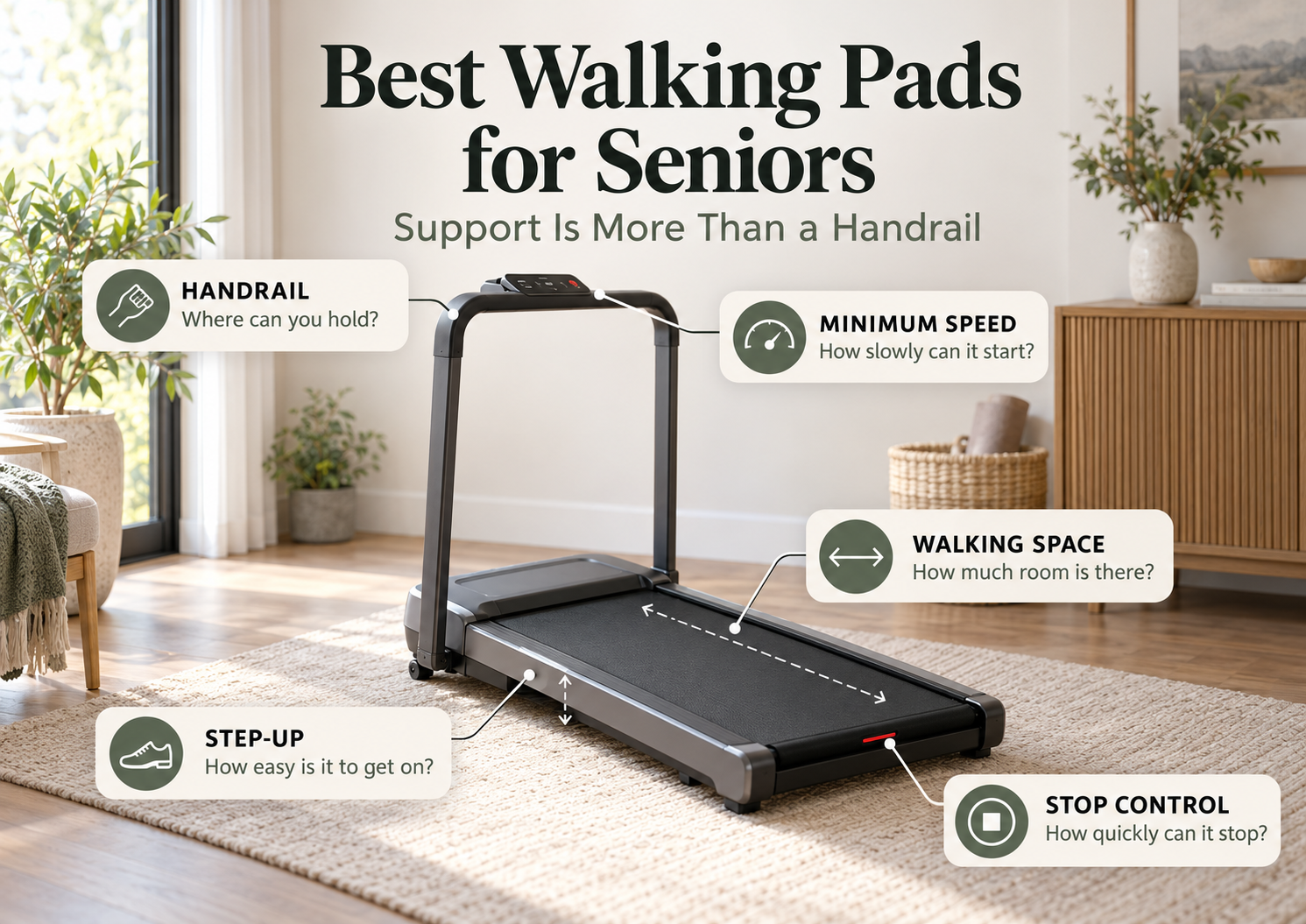
Shopping for a walking pad for an older adult often starts with a handrail. The details that make it practical to use also include the lowest speed, the room available on the belt, how the controls work, and the height of the walking surface. Those features deserve attention whether you’re buying for yourself or helping a parent choose a machine.
We compared five options using published manufacturer specifications. Our selections cover different needs, from a compact machine with a folding rail to a conventional treadmill with extended side rails. The Sunny SF-T722062 is our first choice within this group when rail coverage and walking room are the priorities; the smaller models suit different space and storage requirements.
About this guide: We have not personally tested these machines. Our recommendations are based on published manufacturer information and editorial comparison, so we cannot confirm their stability, comfort, or stopping performance in use. Consumer treadmill handrails are not medical mobility aids. Anyone with significant balance, mobility, cardiovascular, or rehabilitation concerns should seek appropriate professional guidance before use.
We may earn a commission if you buy through links on this page, at no additional cost to you.
The Five Options at a Glance
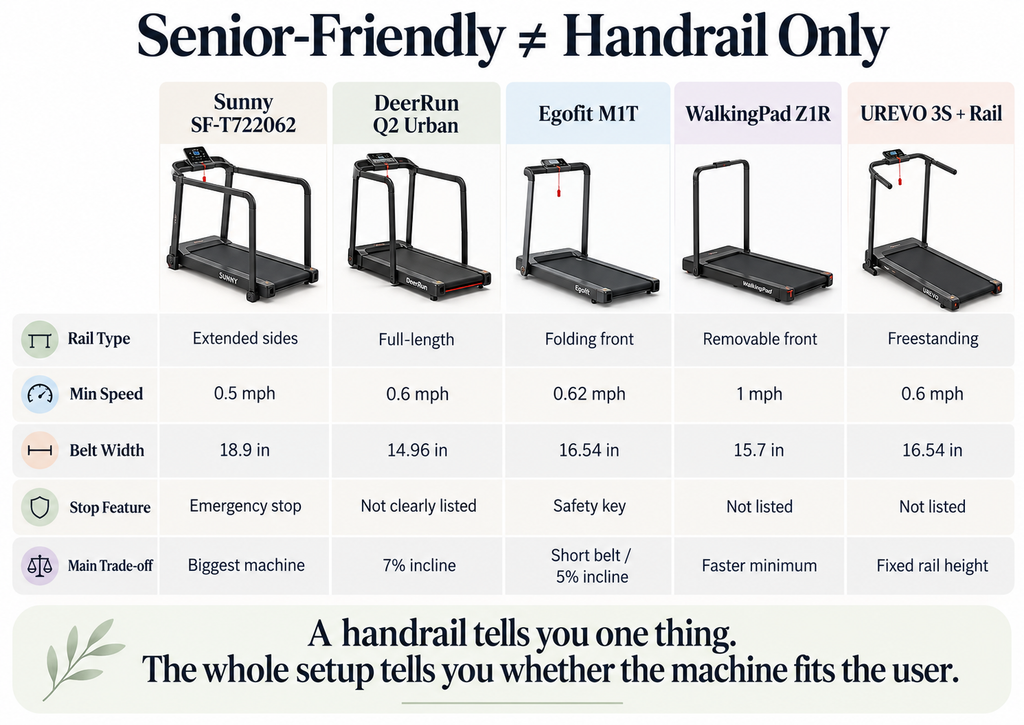
| Model | Best for | Min. speed | Walking area | Handrail | Safety stop/key |
|---|---|---|---|---|---|
| Sunny SF-T722062 | Maximum support | 0.5 mph | 47.2 × 18.9 in | Extended side rails | Yes |
| DeerRun Q2 Urban + Handrail | Compact full-length support | 0.6 mph | 35.43 × 14.96 in | Full-length | Not clearly listed |
| Egofit M1T | Compact + safety key | 0.62 mph | 34.25 × 16.54 in | Folding front rail | Yes |
| WalkingPad Z1R | Long belt + folding storage | 1 mph | 47.6 × 15.7 in | Removable rail | Not listed |
| UREVO SpaceWalk 3S + Handrail | Modular setup | 0.6 mph | 42.5 × 16.54 in | Freestanding rail | Not listed |
The Sunny offers the widest belt and the lowest minimum speed among these five, along with extended side rails and an emergency stop clip. It also needs considerably more floor space. The compact options are worth considering when storage matters, provided their belt dimensions, incline, and control arrangements suit the intended user. “Not listed” means the information reviewed did not identify a safety key; it should not be read as confirmation that a machine has no stopping controls.
What to Check Before Choosing a Walking Pad
If you’re buying for a parent, work through these details with them before ordering. Their usual walking pace, preferred hand position, and comfort with the controls will help narrow the choice more effectively than a “senior-friendly” label.
Starting Speed and Controls
The models in this guide have minimum speeds from 0.5 to 1 mph. At the lower end, a user has more scope to choose a slow pace; the Z1R’s 1 mph minimum is twice the Sunny’s 0.5 mph setting. That comparison describes belt speed, not an appropriate exercise pace for every person.
Other treadmills advertise starting speeds around 0.3 mph, so 0.5 mph should not be taken as the lowest available across the market. Those models fall outside this five-product comparison. A lower published starting speed alone does not establish suitability for an older adult; the exact model’s rail design, deck, controls, and manufacturer guidance still need checking.
Look at how the intended user would start the belt, change speed, and stop it. Egofit and WalkingPad use remotes, while the Sunny includes handrail controls. The SpaceWalk has its own control system and a separate optional rail. A readable display and accessible physical controls may matter more in daily use than app features. Before buying, review the instructions together and check whether everyday operation requires a phone.
Handrail Reach and Fit
A front bar provides a contact point ahead of the user, while extended side rails remain within reach farther along the deck. A freestanding rail surrounds the walking pad without attaching to it. Consider where the person naturally places their hands and whether the rail height will be comfortable, especially when the height is fixed.
Age alone does not determine whether someone needs a handrail. A confident walker may place more value on a low deck, suitable belt dimensions, and easy storage. Someone who needs substantial assistance with balance should get advice about suitable equipment before choosing a consumer walking pad. UREVO explicitly states that its accessory rail is not a medical mobility aid and cannot prevent every slip or fall.
Our best walking pads with handrails guide looks more closely at the different rail layouts.
Walking Room and Stopping Features
Published belt widths in this comparison range from 14.96 to 18.9 inches. The Sunny’s surface is about 26% wider than the DeerRun’s, giving more lateral walking room. Belt length also matters: a short deck may fit the room well while leaving less space for the user’s stride. Check both measurements rather than relying on the machine’s overall size.
A physical safety key or emergency stop clip is a separate feature from the rail. Sunny and Egofit explicitly list one in the information used for this guide. For the other models, confirm the stopping arrangements with the manufacturer, including how they work if the remote is dropped or out of reach. We have not tested stopping distances or response times on any of these machines.
Incline, Setup, and Storage
Incline changes the kind of walking a machine offers. The Egofit M1T has a fixed 5% incline, the DeerRun Q2 Urban listing specifies a 7% manual incline, and the UREVO SpaceWalk 3S offers 0–9% automatic incline. If level walking is a priority, confirm that the exact model and configuration can provide it. The M1T cannot be returned to a flat setting.
Our best walking pads with incline guide explains fixed and adjustable designs in more detail.
Measure the available floor space, the clearance required by the manual, doorways, and the route to storage. Decide who will unpack, position, and move the machine; several options here weigh over 50 pounds. A folding design can save storage space without being easy for its owner to lift or move. Compact models can also have shorter rails, narrower belts, fewer physical controls, or fixed incline, so check what accompanies the smaller footprint.
The height of the walking surface deserves a separate check before purchase. Overall product height is not a reliable substitute for this measurement; the Step-Up Height section below explains what to ask the manufacturer.
1. Sunny Health & Fitness SF-T722062: Best for Extended Rails and a Wider Deck
The Sunny SF-T722062 is a conventional motorized treadmill, and it earns its place here through its combination of extended non-slip handrails, a wide walking surface, and a 0.5 mph minimum speed. It is the option we’d consider first when those features take priority and there is room for a machine that will usually stay in place.
- Minimum speed: 0.5 mph
- Walking surface: 47.2 × 18.9 inches
- Rail and controls: extended non-slip side rails and handrail controls
- Stopping feature: emergency stop clip
- Deck-to-floor height: 4 inches
- Other features: shock absorption
- Published capacity: 245 pounds
- Machine weight and footprint: 115.5 pounds; 62.6 × 30.5 inches
Why We Included It
The rails run along both sides of the deck, providing more reach than a small front bar. Its 18.9-inch belt is the widest in this comparison, and Sunny publishes an actual 4-inch deck-to-floor measurement. Together, those specifications make it easier to assess walking room and access than a listing that gives only overall dimensions.
Sunny markets this model for uses that include older family members and recovery-oriented walking. That positioning is manufacturer information; it does not establish that the treadmill is suitable for an individual’s rehabilitation needs.
What to Consider Before Buying
At 115.5 pounds and 62.6 × 30.5 inches on the floor, the SF-T722062 requires a planned location and help with moving when needed. Choose it if the rail layout, belt width, and controls justify that commitment of space. For a household that needs to put the machine away after each use, one of the smaller options may be more manageable.
Our walking pad vs treadmill comparison explains the differences in space, features, and everyday use.
2. DeerRun Q2 Urban With Handrail: Best Compact Option for Full-Length Rails
The DeerRun Q2 Urban with Handrail pairs a full-length rail with a relatively small machine. Its published footprint is 42.62 × 19.69 inches and its weight is about 35.05 pounds, making it considerably smaller and lighter than the Sunny. The minimum speed is 0.6 mph, with a 35.43 × 14.96-inch belt and a published capacity of 300 pounds.
Why We Included It
DeerRun describes the rail as providing support while stepping on, establishing pace, and walking. Its position alongside the user makes it worth considering for someone who prefers a contact point beside them. The 300-pound rating is also the highest published capacity among these five machines, although that rating does not tell us how the rail or deck feels in use.
If capacity is a main requirement, our best walking pads for heavy users guide provides a broader comparison.
What to Consider Before Buying
The listing specifies a 7% manual incline. Confirm the available deck positions for the exact version before ordering, especially if the user wants level walking. Incline can make a session more demanding, so the rail layout should be considered alongside the walking angle.
The 14.96-inch belt is also the narrowest in this group. The Q2 is a reasonable shortlist option when full-length rails and a small footprint are priorities, provided the incline and belt dimensions suit the intended user. A safety key is not clearly identified in the information reviewed, so its stopping features need confirmation too.
3. Egofit M1T: Best Compact Option With a Listed Safety Key
The Egofit M1T combines a folding front rail and a physical safety key in a machine about 40 inches long. It suits a specific space requirement: someone considering a small walking pad who also wants those two features explicitly included.
- Normal speed range: 0.62–3.11 mph
- Maximum speed with the handlebar raised: 3.73 mph
- Walking area: 34.25 × 16.54 inches
- Published capacity: 220 pounds
- Machine weight: 59 pounds
- Incline: fixed 5%
Why We Included It
The 0.62 mph minimum provides a lower starting setting than the Z1R, and Egofit explicitly lists the rail and safety key. The manufacturer describes that combination as useful for elderly users. We consider it a reason to investigate the model further, with the understanding that a front rail offers less reach along the deck than the Sunny or DeerRun layouts.
What to Consider Before Buying
The 5% incline is fixed, so the M1T cannot offer a flat walking session. Its 34.25-inch belt is the shortest here, even though it is wider than the DeerRun belt. Those dimensions deserve careful attention if the intended user needs more room for their stride. The folding rail helps with storage, but the 59-pound machine still needs to be moved and positioned.
Our Egofit M1 vs M1T comparison explains what changes when you choose the version with a folding rail.
4. WalkingPad Z1R: Best for a Longer Belt and Folding Storage
The WalkingPad Z1R offers a 47.6 × 15.7-inch walking area with a folding deck. That belt is more than 13 inches longer than the Egofit’s, making it worth considering when stride space and storage both matter.
- Speed range: 1–5 mph
- Walking area: 47.6 × 15.7 inches
- Published capacity: 242 pounds
- Machine weight: 57.7 pounds
- Rail and controls: removable handrail; remote and app control
- Storage and setup: foldable deck; listed as delivered fully assembled
- Cushioning: WalkingPad SoftStep system
Why We Included It
The long walking surface gives the Z1R a useful place between very short walking pads and larger treadmills. The deck folds for storage, and the removable rail allows the setup to change when needed. Its cushioning is a listed feature; we have not assessed how it feels underfoot.
What to Consider Before Buying
The 1 mph minimum is the highest starting speed in this comparison. Someone comfortable at that pace may be happy with it, but a buyer specifically looking for a slower setting should consider the Sunny at 0.5 mph, DeerRun and UREVO at 0.6 mph, or Egofit at 0.62 mph.
The package and specification information reviewed lists a remote controller and wristband but does not list a safety key. Confirm the stop controls before buying, and account for the 57.7-pound weight when planning storage. Folding the deck reduces its stored size; moving it remains a separate practical consideration.
5. UREVO SpaceWalk 3S + Walking Pad Handrail: Best for a Separate Rail Setup
The UREVO SpaceWalk 3S can be paired with UREVO’s separate freestanding walking-pad handrail. This arrangement may suit a shared household where one person wants a rail and another prefers an open setup, or where the rail will be stored separately.
- Speed range: 0.6–4 mph
- Walking area: 42.5 × 16.54 inches
- Published capacity: 265 pounds
- Incline: 0–9% automatic incline
- Machine weight: 56.65 pounds
Why We Included It
UREVO lists the handrail as compatible with the SpaceWalk 3S. The accessory accommodates walking pads up to 23.62 inches wide, weighs 16.5 pounds, and folds for storage. It stands on its own anti-slip pads rather than attaching directly to the treadmill.
The SpaceWalk 3S can return to a 0% incline, which is useful when level walking is part of the intended routine. This flexibility distinguishes it from the fixed-incline Egofit; the DeerRun’s available positions should be confirmed for the exact model being purchased.
What to Consider Before Buying
The rail has a fixed height and is intended for low-speed walking. Check its height against the user’s natural hand position, and plan for the space occupied by both pieces. UREVO states that the rail is not a medical mobility aid and cannot prevent every slip or fall. Its freestanding design should be assessed on its own terms rather than assumed to behave like rails attached to a treadmill.
A safety key is not listed in the information used for this comparison. Confirm the SpaceWalk’s stopping controls and the contents of the listing before ordering: the walking pad and separate handrail are distinct items, so check whether both are included in the chosen purchase.
How the Five Options Compare by Priority
| Priority | Best fit |
|---|---|
| Longest, most substantial support | Sunny SF-T722062 |
| Full-length support without a huge treadmill | DeerRun Q2 Urban |
| Compact + physical safety key | Egofit M1T |
| Long walking belt + folding deck | WalkingPad Z1R |
| Rail only when you want it | UREVO SpaceWalk 3S + Handrail |
| Slowest starting speed | Sunny SF-T722062 |
| Highest published capacity | DeerRun Q2 Urban |
| Flat walking + optional incline | UREVO SpaceWalk 3S |
| Shortest walking belt | Egofit M1T |
| Widest walking area | Sunny SF-T722062 |
These comparisons apply to the five options in this guide. In particular, the Sunny’s 0.5 mph minimum is the lowest in this group, and the DeerRun’s 300-pound rating is the highest published capacity here.
Using the listed belt dimensions, the Egofit provides roughly 566 square inches of walking surface and the Sunny about 892 square inches, or around 58% more. The Sunny also weighs almost twice as much and occupies substantially more floor space. The DeerRun has the smallest total belt area at roughly 530 square inches; the Egofit has the shortest belt. Width and length are therefore more useful to compare separately when deciding whether a deck will suit someone’s stride.
Step-Up Height: Check the Walking Surface Measurement
The height from the floor to the walking surface can be important when getting on and off the machine. Sunny publishes a 4-inch deck-to-floor height for the SF-T722062. The other information used for this guide does not provide a consistently comparable measurement across all five models.
Manufacturers may list total body height, which can refer to the housing rather than the surface the user steps onto. A machine described as four inches tall does not necessarily have a four-inch step-up height. We have therefore avoided ranking the five machines using those different measurements.
If access to the deck is a concern, ask the manufacturer for the actual floor-to-walking-surface height at the intended entry point, with the machine in the configuration you plan to use. This is worth confirming before purchase, particularly for a model with incline. We have not measured any of these decks ourselves.
Why We Left Out the UREVO Strol 2E
The UREVO Strol 2E has several specifications that would otherwise put it in consideration: a 0.6 mph minimum speed, foldable handrail, safety key, 40.2 × 15-inch walking surface, and 265-pound capacity. However, the UREVO support information used for this guide gives a suggested age range of 14–60 years.
That published range is the reason we excluded it from a guide aimed specifically at older users. It does not establish that everyone over 60 would be unable to use the machine safely, but we cannot resolve the manufacturer’s age guidance from the specifications alone. Anyone considering it for an older adult should ask UREVO for clarification. The support documentation can contain limitations that are easy to miss on a sales page.
Which Option Fits Your Needs?
For someone who prioritizes extended rails, a wider deck, and a listed emergency stop, we’d start with the Sunny SF-T722062, provided its size and weight are manageable in the home. Its 0.5 mph minimum and published step-up measurement add useful detail to that decision.
The DeerRun Q2 Urban with Handrail deserves consideration when a compact footprint and full-length rails are the main requirements, after confirming that its incline arrangement suits the user. The Egofit M1T combines a compact body with a listed safety key, but its short belt and fixed 5% incline need to fit the intended routine.
The WalkingPad Z1R is a better match for someone who wants a longer belt and folding storage and is comfortable with a 1 mph starting speed. The UREVO SpaceWalk 3S with the separate handrail offers a removable surrounding rail setup and the option of level walking, with the extra space and positioning considerations of two separate pieces.
Before ordering, make sure the person who will use the machine is comfortable with its controls, available walking room, rail position, and access to the deck. Those details, along with a realistic setup and storage plan, are the basis for choosing among these five options.
FAQ
What Is the Best Walking Pad Speed for Seniors?
There is no single appropriate speed for every older adult. For product selection, a low minimum gives the user more choice over pace. The five models here start between 0.5 and 1 mph; other treadmills advertise lower settings, including around 0.3 mph. Starting speed is one part of the decision and does not by itself establish suitability.
Should a Walking Pad for Seniors Have a Handrail?
A handrail can provide an additional contact point, but the need for one depends on the user. Check its reach and height alongside the belt dimensions, controls, and stopping features. A consumer rail is not a medical mobility aid, and someone who needs substantial balance assistance should seek advice about appropriate equipment.
Is a Wider Walking Pad Better for Seniors?
A wider belt gives more lateral walking room, which may be useful for the intended user. It also generally requires a wider machine. The belts in this comparison range from 14.96 to 18.9 inches wide; consider that measurement together with belt length and the space available at home.
Is Incline Useful on a Walking Pad for Seniors?
It depends on the intended walking routine. Someone who wants level walking should check that the machine can provide it: the Egofit M1T has a fixed 5% incline, while the SpaceWalk 3S can return to 0%. Confirm the available positions on models described as having manual incline before ordering.
Are Walking Pads Safer Than Treadmills?
The category name alone cannot answer that. A larger treadmill may offer a wider deck, extended rails, and a physical emergency stop; a compact walking pad may be easier to accommodate at home. Compare the specific features and manufacturer guidance against the user’s needs. We have not performed safety or hands-on testing on the machines in this guide.