
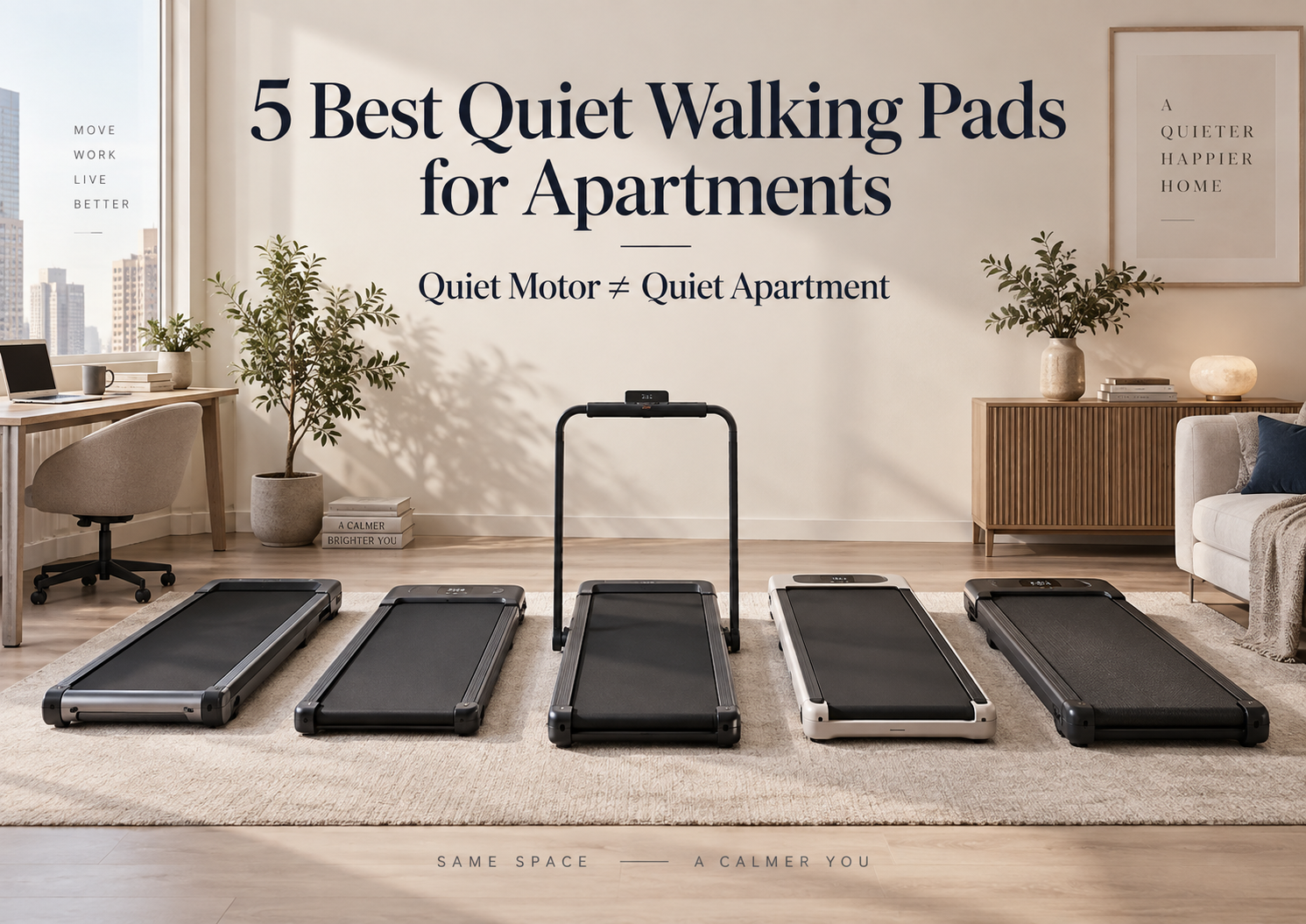
A walking pad can sound quiet when you’re standing next to it and still be annoying to someone living underneath you.
That’s because apartment noise isn’t just motor noise.
It can come from the motor, the belt, your footsteps hitting the deck, and vibration traveling through hard flooring into the structure below.
So when looking for the best quiet walking pads, we wouldn’t rank products purely by whichever manufacturer prints the lowest decibel number.
Those numbers can still be useful, but testing methods, speeds, flooring, and measurement distances aren’t standardized across brands.
Instead, we looked at published noise claims, motor type, cushioning, machine size and weight, portability, and how the machine is likely to be used in an apartment or shared workspace.
Quick answer: The UREVO CyberPad for Office has the strongest current published low-noise claim in this group at approximately 35 dB under UREVO’s specified laboratory conditions. The DeerRun Q2 Urban is the more affordable lightweight choice, while the WalkingPad R3 is the better option if you want a foldable design with a much larger walking area.
Disclosure: This article contains affiliate links. If you purchase through these links, we may earn a commission at no additional cost to you. As an Amazon Associate I earn from qualifying purchases.
How we chose: We have not personally measured the noise output of these walking pads. Noise figures in this guide are manufacturer claims and should not be treated as directly standardized cross-brand test results. Actual sound can vary with speed, user weight, footwear, flooring, maintenance, and room construction.
The Best Quiet Walking Pads at a Glance
| Model | Best for | Published noise claim | Weight | Key advantage |
|---|---|---|---|---|
| UREVO CyberPad for Office | Best overall | ~35 dB* | — | Very low published motor noise + 14% incline |
| DeerRun Q2 Urban | Best budget/lightweight | <45 dB* | 35.05 lb | Light, thin, inexpensive |
| UREVO FoldiMix 5L | Best for working while walking | 35 dB* | — | Built-in workstation + auto incline |
| DeerRun Q2 Urban Plus | Best for more stride room | <45 dB* | 39.24 lb | Longer 39.37-in walking belt |
| WalkingPad R3 | Best foldable spacious option | <65 dB* | 66.3 lb | 47.2 × 17.3-in walking area |
*Manufacturer-published figures. Test conditions differ and should not be read as a controlled apples-to-apples comparison.
That caveat is important enough that I’d leave it immediately below the table.
1. UREVO CyberPad for Office
Best Overall for Published Low-Noise Operation
The UREVO CyberPad for Office has the lowest explicit manufacturer noise figure among the machines in this comparison.
UREVO says its dual brushless motor system has achieved approximately 35 dB under specified laboratory testing conditions.
The company also notes that real-world noise varies with speed, footwear, flooring, and the surrounding workspace.
That’s exactly the distinction we’d want to see from a manufacturer.
The CyberPad is designed specifically around under-desk use, with dimensions of 42.9 × 22.8 inches and a 6.3-inch profile.
It also adds something unusual for a quiet office-focused model: up to 14% automatic incline.
At the time of writing, UREVO lists it at $479.99 with a $409.99 checkout price, although the black version is currently marked for pre-order with an estimated September 20, 2026 shipping date.
The catch: it’s not especially low-profile compared with simpler walking pads, and a 35 dB motor claim tells us nothing definitive about impact noise reaching the apartment below.
Our take: If your priority is minimizing audible machine noise while working, this is the strongest current paper specification in the group.
Internal link candidate:
If incline matters as much as noise, see our guide to the best walking pads with incline.
2. DeerRun Q2 Urban
Best Budget Quiet Walking Pad
The DeerRun Q2 Urban goes after a different buyer.
Rather than piling on premium features, it combines a compact body with a manufacturer-rated brushless motor under 45 dB.
It weighs only 35.05 pounds, measures 42.62 × 19.69 × 3.94 inches, and supports up to 300 pounds according to DeerRun.
That low weight matters in an apartment.
If the machine needs to move from under your desk to the edge of the room every day, a 35-pound walking pad is much easier to live with than a 65- or 70-pound machine.
It also includes a 7% manual incline.
But again, the <45 dB figure refers to the motor specification DeerRun publishes. It doesn’t guarantee that footsteps won’t travel through hardwood or laminate floors.
DeerRun itself notes on another Q2 variant that actual sound levels vary with walking speed, flooring, and footwear.
The catch: shorter 35.43-inch walking belt and manual rather than automatic incline.
Our take: A particularly strong apartment option if low weight and low cost matter as much as the published noise figure.
Internal link:
Need something affordable first and foremost? See our best walking pads under $200.
3. UREVO FoldiMix 5L
Best Quiet Option for Working While You Walk
The UREVO FoldiMix 5L isn’t the smallest machine here.
It’s the one most explicitly designed around doing actual work while walking.
UREVO equips it with a height-adjustable workstation, 9% automatic incline, a 400-pound published capacity, and dual brushless motors.
The company publishes a 35 dB motor-noise figure and positions the machine for distraction-free work sessions.
That makes it particularly interesting if your definition of quiet is:
“Can I stay on a call or focus on work without the treadmill dominating the room?”
The integrated work surface is also an advantage over placing a basic walking pad beneath a separate standing desk.
Current US pricing is $499.99 with a $349.99 checkout price at the time of writing.
But the feature set comes with more physical structure.
A machine designed around a desk, handrail, incline system, and higher capacity is not going to disappear under furniture as easily as a basic flat walking pad.
The catch: less minimalist and more expensive than a simple under-desk pad.
Our take: If your main goal is quiet productivity rather than maximum portability, the FoldiMix 5L is the most purpose-built option here.
4. DeerRun Q2 Urban Plus
Best Quiet Option for More Stride Room
A lot of compact walking pads save space by cutting walking-belt length.
The DeerRun Q2 Urban Plus gives some of that length back.
Its walking area measures 39.37 × 14.96 inches, versus 35.43 inches long on the standard Q2 Urban.
It still uses a brushless motor that DeerRun rates at under 45 dB, while product weight stays relatively manageable at 39.24 pounds.
That makes the Plus an interesting compromise.
You get roughly four extra inches of walking length for only about 4.2 pounds of additional machine weight compared with the standard Q2 Urban.
That’s an original practical difference worth highlighting.
For someone who dislikes very short walking belts but doesn’t want to jump to a 60-plus-pound premium model, that trade is pretty reasonable.
It also retains the 7% manual incline and 300-pound published capacity.
The catch: it is longer and heavier than the regular Q2 Urban, so you give back a little portability.
Our take: The better DeerRun choice if walking-space comfort matters more than owning the absolute lightest machine.
5. WalkingPad R3
Best Quiet Foldable Option with a Spacious Deck
The WalkingPad R3 is heavier and more expensive than the budget walking pads here, but it solves a different problem.
WalkingPad rates its 3 HP brushless motor at under 65 dB and gives it a 47.2 × 17.3-inch walking area.
That deck is dramatically roomier than the compact DeerRun models.
For users who find short or narrow walking pads restrictive, the R3 offers much more usable surface area while still folding in half for storage.
WalkingPad also uses its SoftStep cushioning system and positions the R3 specifically for working and walking in shared living spaces.
Now, here’s where we’d resist a lazy comparison.
The R3’s <65 dB manufacturer figure is numerically higher than UREVO’s 35 dB or DeerRun’s <45 dB.
That does not automatically mean it’s “twice as loud” or meaningfully worse in your apartment.
Those brands may be measuring under different loads, speeds, rooms, and distances.
Without a controlled test, the numbers are directional, not a leaderboard.
The catch: 66.3 pounds, so this is much less pleasant to reposition every day.
Our take: The better pick if you want a spacious, foldable walking surface and quiet operation matters, but you don’t want to sacrifice deck size just to chase the lowest published dB number.
Internal link:
What Actually Makes a Walking Pad Quiet?
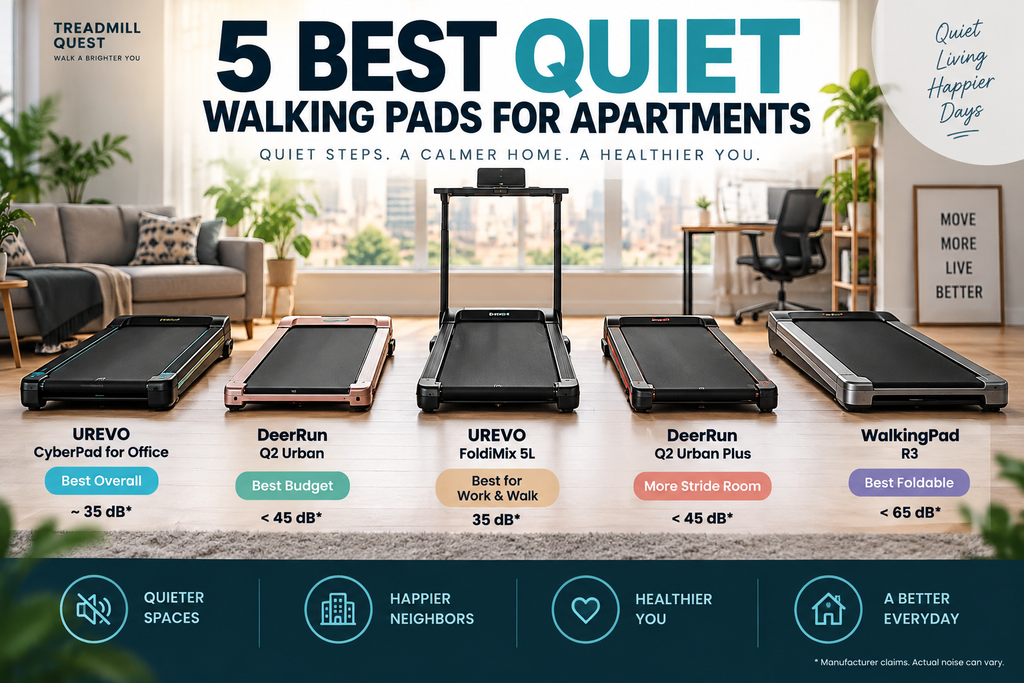
This should be the TQE original-value section and the place for the infographic.
The problem with comparing quiet walking pads is that the motor is only one part of what you hear.
UREVO says that in apartments, footstep impact and floor vibration can matter more than the motor itself.
WalkingPad similarly identifies the motor and feet hitting the deck as major noise sources, and recommends a rubber mat as one way to reduce transmitted sound.
So we’d think about noise in four layers.
1. Motor noise
This is what most published decibel claims measure.
A brushless motor can reduce mechanical hum, and all five picks here use manufacturers’ quiet-operation claims.
Useful?
Yes.
Complete picture?
No.
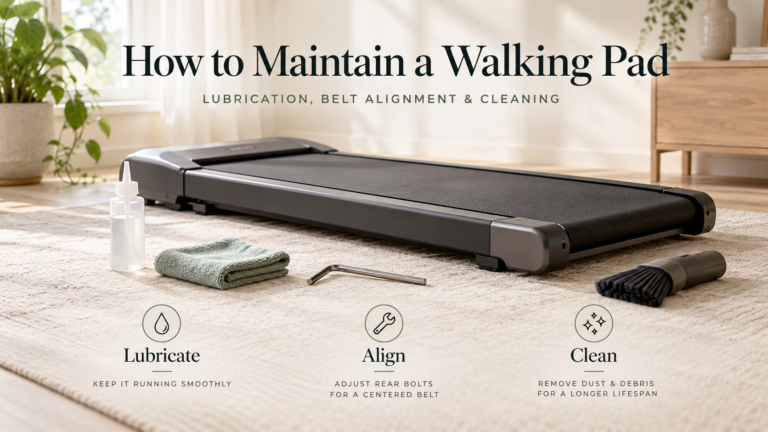
A walking pad that becomes louder over time may need attention rather than replacement. Our walking pad maintenance guide covers cleaning, lubrication, belt alignment, and the symptoms that should be referred to support.
2. Footfall noise
Every step transfers force into the walking belt and deck.
Walking faster, using harder footwear, or landing heavily can make the machine louder even if the motor itself is almost silent.
That’s why an empty-treadmill noise test may not tell you much about what your downstairs neighbor hears.
3. Floor vibration
This is probably the most apartment-specific issue.
Hard surfaces such as laminate or hardwood can transmit vibration through the building structure.
A walking pad may sound perfectly reasonable to you while still creating a repetitive thump downstairs.
UREVO explicitly calls this out in its own apartment-noise guidance.
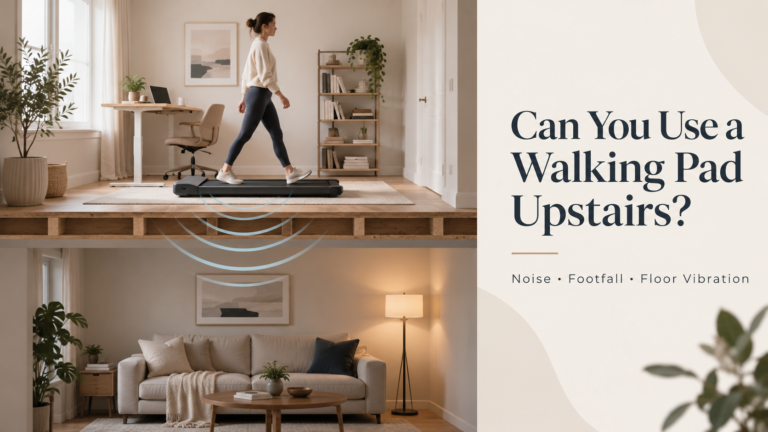
Living above another apartment? Our guide to using a walking pad upstairs looks specifically at footfall, structure-borne vibration, flooring, and what a downstairs neighbor may actually hear.
4. Cushioning and isolation
A cushioned deck can reduce impact at the machine.
A suitable rubber treadmill mat can add another isolation layer between the walking pad and the floor.
WalkingPad recommends a rubber mat specifically as a way to help reduce sound and vibration.
What Published dB Numbers Can and Can’t Tell You
I’d add this table because it’s very TQE.
| Spec | Useful for | What it does not prove |
|---|---|---|
| Motor dB claim | Approximate machine-side motor noise | Noise transmitted downstairs |
| Brushless motor | Potentially smoother/quieter operation | Complete apartment quietness |
| Cushioning layers | Reducing deck impact | Exact real-world dB reduction |
| Machine weight | Stability / movement tendency | That a heavier machine is automatically quieter |
| Rubber mat | Extra floor isolation | Complete elimination of vibration |
| Low walking speed | Generally reduces impact/noise | Silent operation |
This is probably the strongest editorial section in the article.
Which Quiet Walking Pad Should You Buy?
If the manufacturer’s published motor-noise figure is your main priority, the UREVO CyberPad for Office has the strongest claim in this group at approximately 35 dB under its stated testing conditions.
For a much lighter and cheaper machine, we’d look at the DeerRun Q2 Urban.
If you’re actually planning to work while walking and want the desk integrated into the machine, the UREVO FoldiMix 5L is the most purpose-built solution.
Choose the Q2 Urban Plus if the standard budget walking pads feel too short.
And choose the WalkingPad R3 if you’re willing to handle more weight in exchange for a significantly roomier folding deck.
But if you live above someone else, product choice is only half the answer.
The quietest machine on paper can still be the wrong apartment setup if footsteps and vibration travel through the floor.
How to Make Any Walking Pad Quieter in an Apartment
This section is worth including because it makes the article useful even after the purchase decision.
The simplest things to try are:
- place the machine on an appropriate rubber treadmill mat
- walk at a lower speed during calls or quiet hours
- avoid hard-soled shoes
- keep the belt properly lubricated and maintained
- check for loose components if the machine starts rattling
- avoid placing it directly against walls or furniture that can transmit vibration
WalkingPad specifically notes that speed, user weight, flooring, and maintenance can affect noise, and that a treadmill mat may help reduce vibration and impact sound.
I would not promise any particular dB reduction from a mat because we don’t have controlled testing for these specific setups.
A floor mat can help with vibration, but size and material matter. See our walking pad mat guide for the practical differences.
Frequently Asked Questions
Are walking pads quiet enough for apartments?
Often, yes at ordinary walking speeds, but apartment suitability depends on more than motor noise. Footsteps and structural vibration can be more noticeable to downstairs neighbors than the motor itself.
What is the quietest walking pad?
Among the models in this guide, UREVO publishes the lowest manufacturer figure for the CyberPad for Office and FoldiMix 5L at around 35 dB. However, the figures should not be treated as directly standardized tests across brands.
Is 45 dB quiet for a walking pad?
A manufacturer rating below 45 dB indicates relatively low machine noise, but real-world sound can vary depending on walking speed, flooring, footwear, and user weight.
Will a walking pad bother downstairs neighbors?
It can. Floor-transmitted vibration and footstep impact may reach the apartment below even if the motor sounds quiet in your own room.
Does a treadmill mat make a walking pad quieter?
It can help reduce vibration and impact transmission. WalkingPad specifically recommends a rubber mat as one way to reduce sound, but the amount of improvement will depend on the floor and setup.