
Disclosure: This article contains affiliate links. If you purchase through these links, we may earn a commission at no additional cost to you. As an Amazon Associate I earn from qualifying purchases.
A walking pad mat looks like one of the least exciting things you can buy for a home gym.
And that’s probably why it’s easy to buy the wrong one.
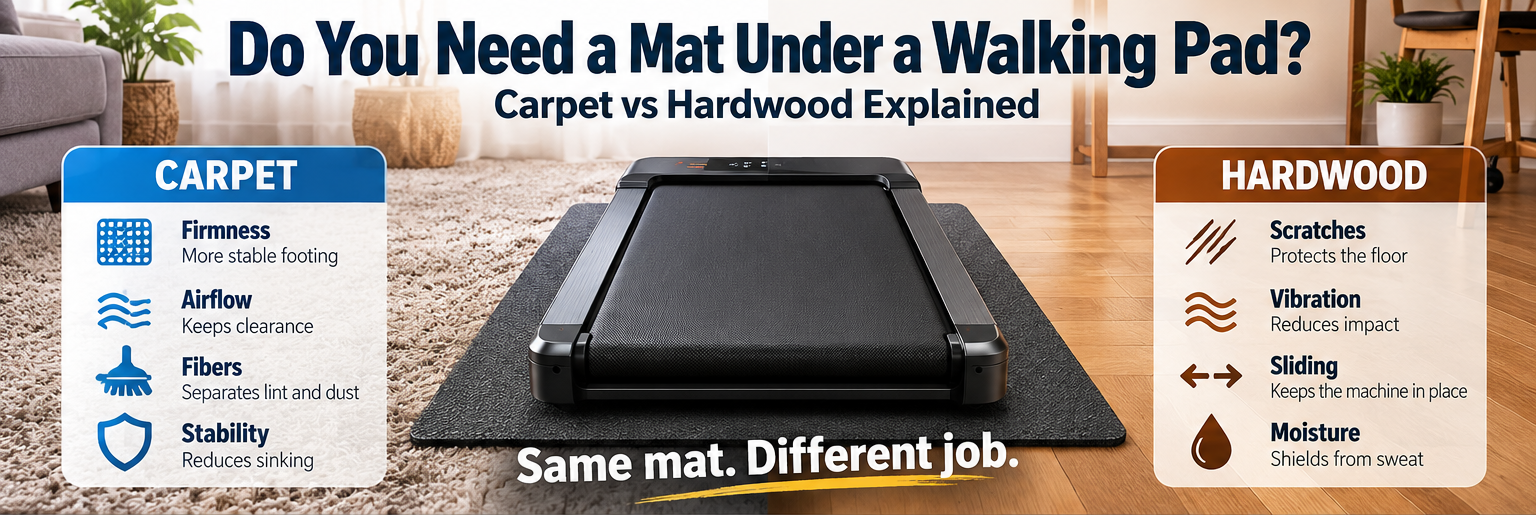
On hardwood, the mat’s main job may be preventing scratches, movement, and direct vibration transfer.
On carpet, the problem changes. Now the mat also has to create a firmer interface between the machine and a surface that can compress, shed fibers, and reduce clearance underneath a low-profile walking pad.
So the question isn’t really:
“Do walking pads need mats?”
It’s:
“What problem am I trying to solve underneath this machine?”
WalkingPad currently recommends a floor mat for protecting floors, reducing vibration and transmitted noise, and improving stability, while its own carpet guide specifically recommends a firm equipment mat rather than placing a treadmill directly onto carpet. UREVO likewise says its high-density PVC mat can be used on hardwood, tile, or carpet, provided the complete machine sits securely on it.
About our recommendations: We have not personally tested these mats. This guide compares current manufacturer dimensions, materials, storage design, published use cases, and how those differences affect walking-pad setups in real homes.
One Mat, Two Very Different Jobs
The same piece of PVC or rubber can be solving completely different problems depending on what’s underneath it.
On Hardwood or Laminate
The floor is already rigid.
You aren’t trying to create a stable platform.
You’re mostly adding a sacrificial layer between the machine and the finished surface.
That can help with:
- scratches from wheels or feet
- small movements during use
- sweat or moisture
- some vibration isolation
- marks from storing the machine in one position
WalkingPad and Sunny both explicitly market their mats around floor protection, vibration reduction, and non-slip performance on hard surfaces.
In this situation, a relatively thin mat can make sense.
You don’t necessarily need half an inch of cushioning beneath a machine that is already standing on a hard, flat floor.
Too much softness can actually create a different problem by making the machine less stable.
On Carpet
Now the floor itself can move.
The carpet pile and underlay compress beneath the treadmill, and that compression can affect how firmly the walking pad sits.
The mat becomes an interface layer.
WalkingPad’s current carpet guidance recommends a firm equipment mat because carpet can interfere with stability, airflow, and cleanliness around the machine.
A mat also helps separate the underside of the walking pad from lint and carpet fibers.
But the mat cannot perform miracles.
If the carpet underneath is very deep and soft, a flexible PVC mat will still follow that surface.
That’s why we wouldn’t treat a mat as a universal fix for shag or heavily padded plush carpet.
For that setup, a truly rigid base or a move to hard flooring can make more sense.
The Walking Pad Mats Worth Looking At
Rather than ranking these from “best” to “worst,” we’d choose by what problem they solve.
UREVO Foldable Treadmill Mat: Best for Small Spaces
UREVO’s mat is the one that fits the walking-pad philosophy most naturally.
It measures 63 × 26 × 0.24 inches when open, then folds down to approximately 15.8 × 12.8 × 2 inches.
The material is high-density PVC, and UREVO specifically lists use on hardwood, tile, and carpet. The company also says every support foot, wheel, and frame contact point should remain fully on the mat. Current direct pricing shows $39.99, with a $33.99 checkout price when we checked.
The folding design is the real advantage.
If you bought a walking pad specifically because it disappears after work, leaving a permanently unrolled six-foot mat behind defeats part of the point.
This one can disappear too.
That makes it particularly sensible for:
- bedrooms
- shared offices
- apartments
- rooms where the walking pad is stored every evening
Its 26-inch width is also generous enough for many conventional walking pads without creating a huge border around the machine.
Best fit: people who regularly put both the walking pad and the mat away.
WalkingPad Non-Slip Floor Mat: Best Brand-Matched Option
WalkingPad sells two sizes:
Walking-pad version: 25.6 × 61 inches
Treadmill version: 32.28 × 62.99 inches.
The mat uses NBR-based cushioning and WalkingPad lists it at roughly 4.3 mm thick. Its product page emphasizes a non-slip surface, floor protection, vibration absorption, water resistance, and roll-up storage.
There is an annoying wrinkle, though.
At the time of checking, the 25.6 × 61-inch walking-pad version was shown as sold out on its product page, while availability varied by size and color. The 32.28 × 62.99-inch treadmill version was displayed at $65 on another current variant page.
So this is a product we’d recommend based on fit and design, not guaranteed current availability.
It also illustrates an important lesson:
Buying the manufacturer’s own mat does not remove the need to check dimensions.
WalkingPad itself says shoppers should choose mats according to the actual machine footprint rather than simply buying whatever says “walking pad.”
Best fit: WalkingPad owners who want a brand-matched, roll-up mat and can find the correct size in stock.
Sunny Health & Fitness Floor Protector Mat: Best for Choosing the Exact Size
Sunny takes a different approach.
Instead of one general treadmill mat, the company offers multiple footprints:
- 30 × 20 in
- 51 × 23.5 in
- 79 × 35.5 in
- 90.5 × 39.5 in
all at approximately 0.16 inches thick.
The material is high-density PVC foam, and Sunny describes it as non-slip, water-resistant, rollable, and designed to absorb vibration while protecting flooring.
That range of sizes is useful because “walking pad mat” isn’t really a standardized size category.
A very compact machine may fit comfortably on the 51-inch mat.
A longer foldable model won’t.
So Sunny gives you more flexibility to size the mat around the equipment rather than the marketing category.
The small version is also less visually intrusive than putting an enormous traditional treadmill mat under a 40-inch walking pad.
Best fit: buyers who want to match mat size closely to the machine.
VEVOR Foldable Walking Pad Mat: Best for Longer Walking Pads
VEVOR’s current foldable mat measures approximately 68.11 × 24.02 inches when open and folds to roughly 11.81 × 13.39 inches.
It’s 0.24 inches / 6 mm thick and uses high-density PVC.
That extra length makes it interesting for machines that are just a bit too long for smaller 60- or 61-inch mats.
For example, a long conventional walking pad can sit entirely on a 68-inch mat without requiring the much wider footprint of a full treadmill mat.
Like UREVO’s option, it folds rather than rolls.
So the comparison between them is unusually practical:
UREVO
→ 63 × 26 in
→ wider, slightly shorter
VEVOR
→ 68.11 × 24.02 in
→ longer, slightly narrower
Neither geometry is universally better.
It depends on the walking pad.
Best fit: long, relatively narrow walking pads where storage still matters.
SuperMats 30GS TreadMat: Best Traditional Heavy-Duty Format
If you don’t care about folding and just want a straightforward equipment mat, SuperMats takes the old-school route.
Its 30GS TreadMat measures 30 × 72 inches and uses heavy-duty vinyl.
SuperMats says the mat is designed for treadmills and other exercise equipment, protects flooring and carpet from equipment and debris, reduces vibration and sound, and uses a non-slip surface.
The 72-inch length gives you plenty of room for most walking pads.
The downside is exactly what you’d expect.
You now own a six-foot-long conventional mat.
That may be perfectly fine in a dedicated office or exercise room.
It’s less appealing when the walking pad gets folded and pushed into a closet every night.
Best fit: permanent or semi-permanent setups where easy storage isn’t the priority.
The Size Mistake That’s Easier to Make Than It Looks
Here’s the most useful thing we found while comparing mats:
you shouldn’t size the mat from the walking belt.
Size it from the entire machine.
Take the UREVO SpaceWalk E1L.
Its walking area is only 35.43 × 15 inches, but the complete machine measures 42.1 × 19.3 inches.
A mat that covered the belt perfectly could still leave the actual frame or wheels resting on the floor.
WalkingPad explicitly says the full equipment footprint, including support points, should determine mat size. UREVO gives the same guidance for its own mat.
So Which Mats Actually Fit?
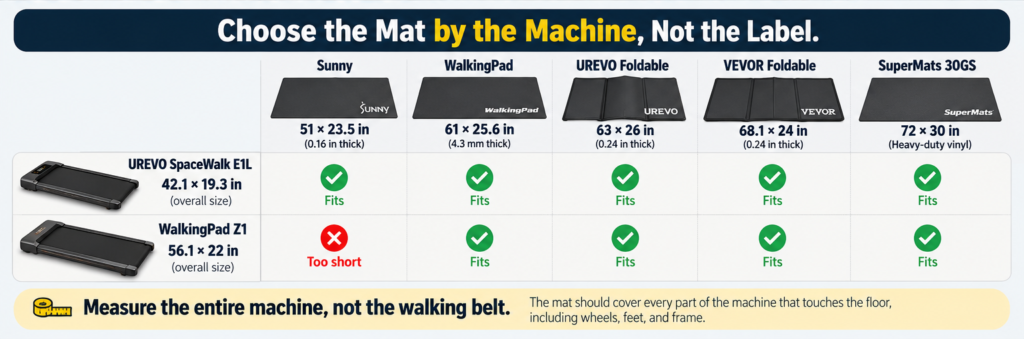
Let’s test two machines from our existing guides.
UREVO SpaceWalk E1L: 42.1 × 19.3 in.
WalkingPad Z1: 56.1 × 22 in when unfolded.
Now compare the mat footprints:
| Mat | Size | E1L | Z1 |
|---|---|---|---|
| Sunny No.083 Small | 51 × 23.5 in | ✅ | ❌ Too short |
| WalkingPad Mat | 61 × 25.6 in | ✅ | ✅ |
| UREVO Foldable Mat | 63 × 26 in | ✅ | ✅ |
| VEVOR Foldable Mat | 68.1 × 24 in | ✅ | ✅ |
| SuperMats 30GS | 72 × 30 in | ✅ | ✅ |
This isn’t manufacturer compatibility testing.
It’s simply comparing the published footprints.
But it exposes something useful.
The 51-inch Sunny mat is perfectly sensible for compact machines like the E1L, yet a 56.1-inch WalkingPad Z1 physically exceeds its length.
Buying “a treadmill mat” is not enough.
You need the numbers.
Building a desk setup around the machine? See our guide to the best walking pads for under a desk.
How Much Extra Mat Do You Actually Need?
Not much.
The mat doesn’t need to extend a foot around every side like a gym safety zone.
What it needs to do is support the entire machine footprint and every floor-contact point.
UREVO says that wheels, feet, and frame supports should all rest securely within the mat.
In practice, we’d still leave a small margin when possible.
Not because of some magic measurement, but because placing a 26-inch-wide treadmill exactly onto a 26-inch mat every morning is needlessly fiddly.
A little spare width makes daily setup easier.
So instead of:
Machine width = 22 in
Mat width = exactly 22 in
we’d rather see something closer to:
Machine width = 22 in
Mat width = 24–26 in
when space allows.
That’s an editorial preference, not a manufacturer requirement.
Carpet and Hardwood Shouldn’t Use the Same Buying Priorities
Here’s the shortcut.
For Hardwood
Prioritize:
1. Non-slip backing
You don’t want the walking pad slowly migrating during use.
2. Floor-safe material
The mat itself shouldn’t mark or discolor finished flooring.
3. Enough coverage
All wheels and contact points need to sit on it.
4. Easy cleaning
Sweat plus finished wood is not a combination we’d leave sitting indefinitely.
Thickness matters, but we’d put it behind those four.
For Carpet
Prioritize:
1. Firmness
The mat needs to create a more stable surface, not just add another soft layer.
2. Full contact-point coverage
3. Underside clearance
4. Resistance to sinking or rocking
5. Easy removal for cleaning
WalkingPad’s carpet guidance specifically warns about carpet interfering with airflow and allowing dust and fibers around low-set equipment.
That’s why we’d pick a firm, high-density mat before a thick, squishy one.
Already working with carpet? Our full guide to using a walking pad on carpet covers pile height, airflow, and stability in more detail.
Does a Thicker Mat Mean a Quieter Walking Pad?
Not automatically.
This is where product listings can get a bit enthusiastic.
UREVO, WalkingPad, Sunny, VEVOR, and SuperMats all describe their mats as helping with vibration or noise reduction.
That’s plausible as an isolation layer.
But none of that means:
“Put this mat down and your downstairs neighbor won’t hear you.”
UREVO explicitly says its mat cannot completely soundproof a room, because final noise also depends on the machine, walking speed, footwear, flooring structure, and building construction.
So if apartment noise is your main problem, we’d think in layers:
motor noise
- footfall
- walking speed
- machine cushioning
- floor structure
- mat
The mat is one variable.
Not a mute button.
If noise and floor vibration are your priority, see our guide to the best quiet walking pads for apartments.
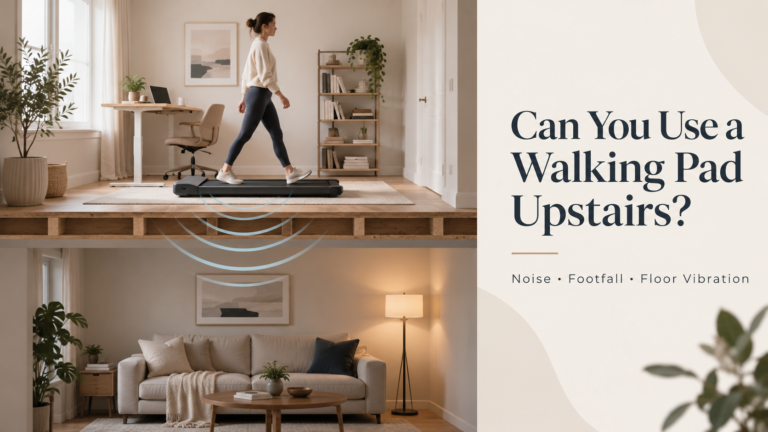
If the room is above another apartment, mat choice is only one part of the setup. Our upstairs walking pad guide explains how footfall and structure-borne vibration can reach the room below.
Foldable vs Roll-Up Mats: A Tiny Difference That Becomes Annoying Every Day
This one depends entirely on your routine.
A roll-up mat is simple.
But a six-foot-long roll is still a six-foot-long mat that needs to turn into a large cylinder somewhere in the room.
A foldable mat collapses into a much smaller block.
UREVO’s 63 × 26-inch mat folds to approximately 15.8 × 12.8 × 2 inches. VEVOR’s 68.1-inch mat folds to about 11.81 × 13.39 inches.
That’s a genuinely different storage behavior.
If the walking pad lives permanently under your desk:
who cares?
Leave the mat there.
If you turn your office back into a bedroom every evening:
foldability matters a lot more.
This is why we’d avoid paying a premium for compact storage unless your routine actually uses it.
If storage is already your biggest constraint, see our best walking pads for small apartments.
Do You Need a Mat at All?
Not always.
WalkingPad itself calls a mat recommended rather than mandatory.
On a hard, durable floor with a stable walking pad that doesn’t shift or mark the surface, you may decide you don’t need one.
A mat becomes more compelling when:
- the floor scratches easily
- the machine shifts
- you’re on carpet
- you’re worried about dents
- sweat reaches the floor
- vibration transmission is noticeable
- the manufacturer’s manual or guidance recommends one
Don’t buy an accessory simply because the accessory exists.
Buy it because you can name the problem it’s solving.
That philosophy matters especially with compact fitness equipment, where every extra item becomes another thing you have to store.
Our Pick Depends on the Room
If we were furnishing a small apartment where everything gets packed away, we’d start with the UREVO Foldable Mat.
Its 63 × 26-inch footprint works for a broad range of walking pads, while the folded package is genuinely small.
If we wanted a brand-matched WalkingPad setup, we’d consider WalkingPad’s own mat, but we’d check live stock and exact dimensions first.
For a short compact walking pad, Sunny’s smaller size can avoid wasting floor space.
For a longer pad, VEVOR’s 68-inch foldable format or the 72-inch SuperMats option gives you more room.
The bigger lesson, though, is simpler:
Don’t buy a “walking pad mat.” Buy a mat whose dimensions and material solve the problem under your specific walking pad.
That’s the part the product category name can’t tell you.
A Few Questions Before You Buy
Can I put a walking pad directly on hardwood?
Potentially, but a mat can help protect against scratches, movement, moisture, and some vibration. WalkingPad recommends mats particularly on hardwood, tile, and carpet surfaces.
What kind of mat should go under a walking pad on carpet?
Use a firm, high-density equipment mat rather than a soft yoga mat. Thick carpet can still create stability or airflow problems, so check the complete setup after placing the machine on the mat.
How big should a walking pad mat be?
Large enough for every part of the machine that contacts the floor. Use the walking pad’s overall dimensions, not its walking-belt dimensions.
Can a treadmill mat reduce noise?
It can help isolate some vibration and equipment noise, but it cannot completely soundproof the machine from another room or floor.
Is a foldable mat better?
Only if you actually store it regularly. For a permanent workstation, a roll-up or fixed mat can work just as well and may offer more size options.