
Yes, you can use a walking pad in a carpeted room.
But putting one directly onto carpet is not always a good setup.
The problem isn’t simply whether the carpet can support the machine.
Walking pads sit very close to the floor. Thick carpet can reduce the clearance underneath the motor housing, interfere with ventilation, allow dust and fibers to reach moving components, and make the machine sit less evenly.
Both UREVO and WalkingPad currently recommend using a firm equipment or treadmill mat between the machine and carpet rather than assuming any carpet surface is suitable on its own.
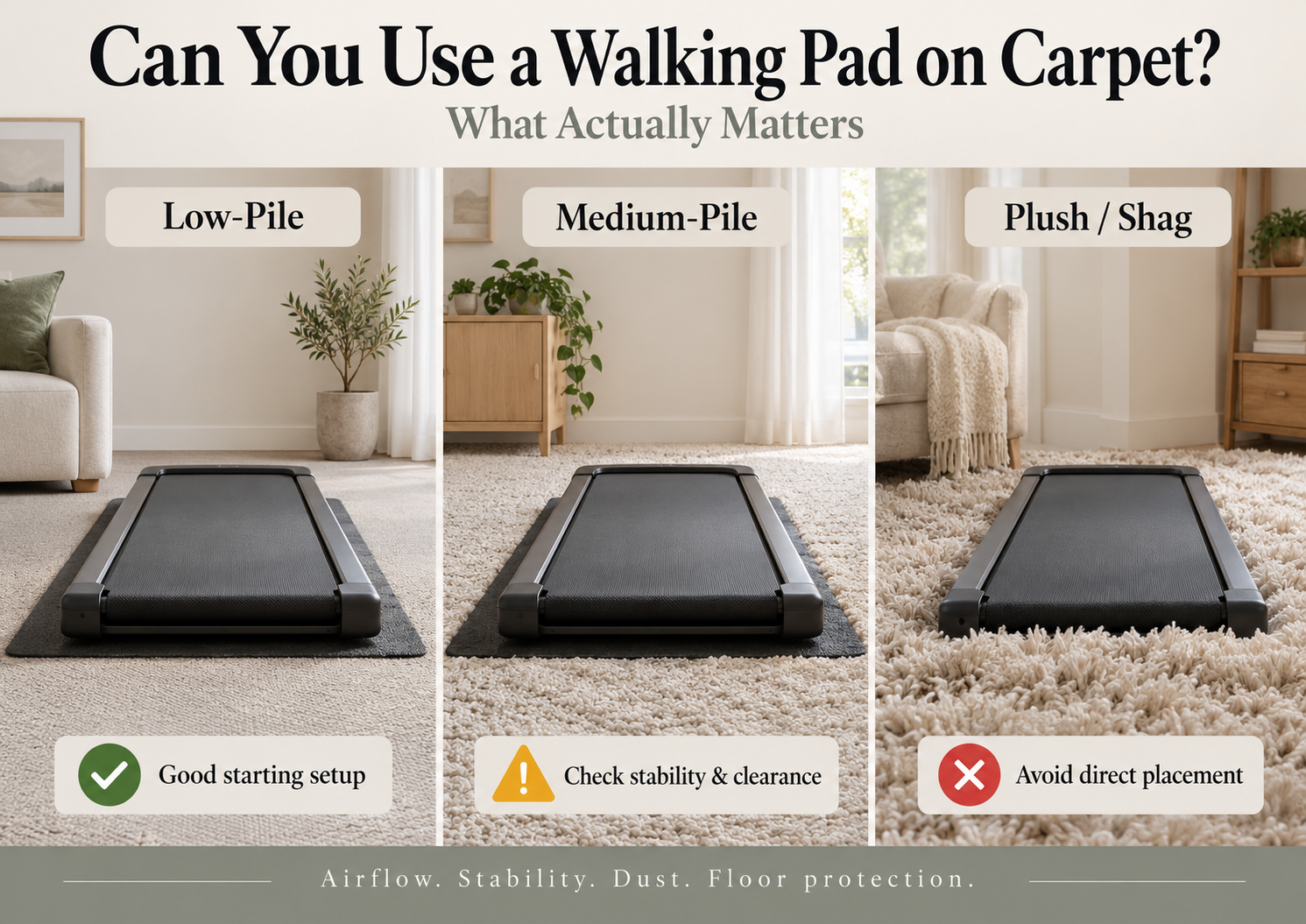
Quick answer: On low-pile carpet, a firm high-density treadmill mat is usually the simplest setup. On softer or medium-pile carpet, check carefully for sinking and instability. On thick plush or shag carpet, we’d avoid placing a walking pad directly on top at all. A rigid platform or hard-floor location may be the better solution.
How we researched this: We have not tested walking pads across different carpet types ourselves. This guide is based on current manufacturer guidance from UREVO and WalkingPad, plus the practical implications of walking-pad clearance, ventilation, equipment mats, and flooring.
Why Carpet Can Be a Problem for a Walking Pad
A walking pad may weigh only 30–60 pounds, but that doesn’t mean carpet is automatically a forgiving surface.
There are four separate issues to think about.
1. Carpet Can Restrict Airflow
This is probably the biggest concern.
Compact walking pads typically sit only a few inches above the floor.
On thick carpet, the machine’s feet can sink into the pile, reducing clearance around the underside and motor area.
UREVO specifically warns that plush carpet can press against the bottom of the machine and restrict airflow. WalkingPad similarly recommends a firm mat because thick carpet can obstruct cooling and push fibers toward vents.
That’s why we’d care more about actual underside clearance than simply asking whether the room is carpeted.
2. Dust, Lint, and Carpet Fibers Matter
Walking generates vibration.
On carpet, that can disturb dust, lint, pet hair, and loose fibers around the machine.
WalkingPad notes that this debris can work its way toward the belt, rollers, or motor area and potentially contribute to extra resistance, heat, or noise over time.
A mat creates a cleaner barrier underneath the machine.
It won’t eliminate household dust, obviously, but it gives the walking pad a more controlled surface than sitting directly against carpet fibers.
3. Soft Carpet Can Make the Machine Less Stable
A walking pad wants a flat, level surface.
Soft carpet does not always compress evenly.
One foot may sink deeper than another, particularly on plush carpet or over padded underlay.
WalkingPad warns that uneven compression can allow the frame to rock or potentially affect belt tracking. Some sensor-based walking pads also work best when the deck itself stays level.
Before turning the machine on, we’d check whether it:
- rocks when you press on each corner
- sinks noticeably when you step onto it
- shifts while you walk
- touches carpet fibers underneath the motor area
If any of those happen, direct-on-carpet use isn’t a setup we’d keep.
4. Carpet Can Be Damaged Too
The walking pad isn’t the only thing worth protecting.
A machine concentrates its weight onto wheels, feet, and frame contact points.
Repeated walking adds vibration and movement.
That can leave dents or compressed areas in softer carpet.
A proper equipment mat distributes that contact over a larger area and reduces direct rubbing between the machine and flooring.
What Type of Carpet Do You Have?
This is where the answer becomes more useful than just saying:
“Buy a treadmill mat.”
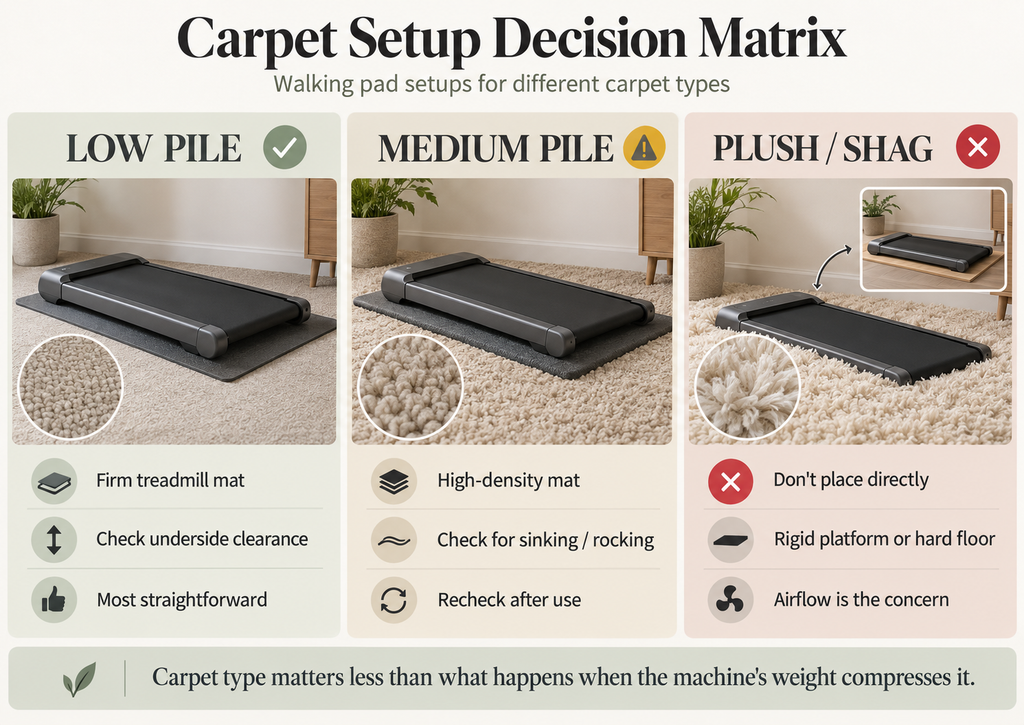
Low-Pile Carpet
Think office-style carpet or tightly woven carpet with very little softness.
This is the easiest carpet type to work with.
UREVO says thinner, firmer carpet may leave enough clearance for normal operation, but both UREVO and WalkingPad still recommend a firm equipment mat as the more controlled setup.
Our setup
Low-pile carpet → firm high-density treadmill mat → walking pad
This gives you a predictable surface while protecting the carpet.
Medium-Pile Carpet
This is where we’d stop relying on the carpet label and look at what actually happens under the machine.
Place the mat down.
Put the walking pad on top.
Then check:
- Does the mat stay flat?
- Do the machine’s feet remain level?
- Does the whole setup rock?
- Does the carpet still push the mat upward around the machine?
- Is there clear space around any underside ventilation?
If the mat visibly sinks and bends with the carpet, simply adding a mat may not completely solve the stability problem.
High-Pile, Plush, or Shag Carpet
This is the setup we’d be most cautious about.
UREVO specifically says not to place a walking pad directly onto thick plush or shag carpeting because the machine can sink into the fibers and lose ventilation clearance.
For very soft carpet, the decision becomes:
Can a truly rigid, stable platform create a flat surface?
If not, move the walking pad to hard flooring.
A flexible treadmill mat cannot magically turn deep carpet into concrete.
TQE Carpet Setup Decision Matrix
| Your flooring | Our starting setup |
|---|---|
| Hardwood / tile | Equipment mat recommended for protection and vibration |
| Low-pile carpet | Firm high-density treadmill mat |
| Medium-pile carpet | Firm mat + stability / clearance check |
| Plush carpet | Rigid platform or relocate to hard floor |
| Shag carpet | Avoid direct placement |
| Carpet + thick underlay | Treat cautiously like softer carpet |
The main idea is simple:
Pile height is only part of the problem. What matters is how much the complete surface compresses under the machine.
That’s the distinction we’d use rather than pretending every “low-pile” or “medium-pile” carpet behaves exactly the same.
A Simple Clearance Test
UREVO suggests a surprisingly practical test.
With the machine sitting in its intended position, check the clearance underneath the front motor housing.
If you can easily get your fingers underneath without carpet fibers touching the motor cover, you have meaningful clearance.
If the carpet is rubbing against the underside, the setup is too soft or too thick to use as-is.
We like this because it’s much more useful than trying to turn carpet-pile terminology into an exact compatibility chart.
Your actual floor tells you more than the carpet label.
What Kind of Mat Should You Use?
Not a yoga mat.
That’s worth saying explicitly.
A soft foam yoga mat can compress along with the carpet and may make the setup less stable rather than more stable.
UREVO recommends a firm, high-density equipment mat for this use.
The mat should:
- cover every wheel, foot, and support point
- stay flat under the machine
- resist compression
- provide a non-slip surface
- be large enough for the walking pad’s complete footprint
UREVO’s current foldable mat measures 63 × 26 × 0.24 inches when open and uses high-density PVC. The company says it is intended for protecting both hard floors and carpet and for reducing some vibration.
WalkingPad currently sells its own mats in approximately 25.6 × 61 inches for walking pads and 32.28 × 62.99 inches for larger treadmills. WalkingPad also recommends choosing the mat from the actual machine footprint rather than from the generic “walking pad” or “treadmill” label alone.
That’s the rule we’d use regardless of brand.
Not sure which size or design to buy? See our guide to choosing a walking pad mat for carpet and hardwood floors.
How Much Bigger Should the Mat Be?
You don’t need a giant gym floor beneath a walking pad.
But all structural contact points need to remain on the mat.
If a walking pad is 42 inches long but its rear wheels extend slightly beyond the main housing, don’t buy a 42-inch mat based on the body measurement alone.
Measure:
frontmost contact point → rearmost contact point
and
leftmost contact point → rightmost contact point
UREVO specifically states that every support foot and wheel should sit within the mat rather than hanging over an edge.
That tiny detail matters more than getting a mat with a walking-pad logo printed on it.
Will a Mat Make a Walking Pad Quieter?
Potentially, but this needs a caveat.
Both UREVO and WalkingPad say their mats can help reduce vibration and equipment noise.
But a treadmill mat is not soundproofing.
Actual apartment noise also depends on:
- your walking speed
- foot strike
- footwear
- user weight
- the walking pad’s cushioning
- flooring construction
- the building itself
UREVO explicitly notes that its mat cannot completely prevent sound from reaching the room below.
So we’d think of the mat as one isolation layer, not a downstairs-neighbor invisibility cloak.
For an upstairs room, the question gets more complicated because softer flooring can change both stability and vibration. See our walking pad upstairs apartment guide for the downstairs-noise side of the setup.
Does Carpet Make a Walking Pad Quieter?
Carpet may make a walking pad sound slightly quieter in the room you’re standing in because soft materials can absorb some airborne and contact noise. That does not necessarily mean less structural vibration is reaching the room below, however.
For that reason, we wouldn’t place a walking pad directly on thick carpet just for sound control. Any small acoustic benefit could come at the cost of worse stability or reduced airflow.
A better priority is to create a stable floor interface first, then think about vibration control.
Can You Use a Walking Pad Under a Desk on Carpet?
Yes, provided the flooring setup remains stable and ventilated.
But now you have three layers of fit to think about:
- carpet
- treadmill mat
- walking pad
The pad itself raises your standing position above the floor, and a firm mat adds a small amount more.
That can affect standing-desk ergonomics.
So after setting everything up, make sure your desk can still rise high enough for comfortable typing.
Building a walking workstation? See our guide to the best walking pads for under a desk.
Carpet vs Hard Floor: Which Is Better?
If we had both options available, we’d choose a hard, level floor with a suitable equipment mat. Carpet does not automatically make a walking pad unusable, but a rigid floor makes stability, ventilation, cleaning, storage, and belt alignment easier to control.
Carpet adds another variable because its behavior depends on pile, underlay, and how much the complete setup compresses under load. A firm equipment mat helps reduce some of that uncertainty, which is why we prefer it to placing the machine directly on carpet.
Don’t Forget Daily Storage
There is another practical downside people overlook.
A lightweight walking pad may normally roll underneath a bed or sofa.
Put it on carpet with a treadmill mat, and now your daily routine may become:
- move walking pad
- move or fold mat
- use room
- replace mat
- reposition walking pad
That routine is manageable, but it adds friction to something that may otherwise take only a few seconds to store.
UREVO’s current foldable mat is interesting specifically because it collapses from 63 × 26 inches to about 15.8 × 12.8 × 2 inches when stored.
If you’re already buying a walking pad because your apartment is short on space, a foldable mat can make more sense than permanently dedicating a six-foot rubber rectangle to the room.
If storage is already tight, see our guide to the best walking pads for small apartments.
How to Set Up a Walking Pad on Carpet
Here’s the simple version.
- Check the carpet pile and softness.
Very thick or plush carpet deserves extra caution. - Choose a firm equipment mat.
Avoid soft foam or yoga mats. - Make sure every foot and wheel sits on the mat.
- Check underside clearance.
No carpet fibers should touch or block the motor housing or vents. - Check stability before switching it on.
Press each corner and confirm the machine doesn’t rock. - Start at low speed.
Watch for shifting, rocking, or unusual belt movement. - Clean around the machine regularly.
Carpet creates more opportunity for dust, lint, and hair to accumulate near the pad. - Recheck the setup occasionally.
Carpet and underlay can compress over time.
WalkingPad also recommends regular cleaning around carpet-based treadmill setups because lint and dust can accumulate around the machine more easily.
Can You Put a Walking Pad Directly on Carpet?
We wouldn’t make that the default setup.
On very firm low-pile carpet, some manufacturers indicate that the machine may retain enough clearance to operate normally.
But a firm treadmill mat gives you:
- a cleaner surface
- better equipment isolation
- floor protection
- more predictable stability
- less direct contact with carpet fibers
for relatively little extra complexity. UREVO.US
And on plush carpet, direct placement is something we’d avoid entirely.
Our Verdict
Yes, you can use a walking pad in a carpeted room.
The important question is not:
“Is carpet allowed?”
It’s:
“Does this setup keep the machine level, ventilated, clean, and stable?”
For low-pile carpet, start with a firm high-density treadmill mat.
For medium-pile carpet, check how much the complete setup compresses.
For thick plush or shag carpet, use a truly rigid stable base or move the machine to hard flooring.
And don’t use a soft yoga mat as a substitute for an equipment mat.
The best setup is the boring one:
flat, firm, clean, stable, and easy enough that you’ll actually use the walking pad.
Frequently Asked Questions
Can you use a walking pad on carpet?
Yes, but both WalkingPad and UREVO currently recommend using a firm treadmill or equipment mat rather than placing the machine directly on carpet, particularly on thicker flooring.
Do I need a treadmill mat under a walking pad?
Not necessarily on every hard floor, but a mat is strongly recommended on carpet. It can protect flooring, improve stability, isolate some vibration, and keep fibers away from the underside of the machine.
Can I use a yoga mat under a walking pad?
We wouldn’t recommend it. UREVO specifically recommends a firm high-density mat rather than a soft, compressible exercise mat for carpet setups.
Can I put a walking pad on plush carpet?
Not directly. Thick plush or shag carpet can interfere with clearance and airflow. Use an appropriate rigid surface or relocate the walking pad to hard flooring.
Will a treadmill mat reduce noise?
It can reduce some vibration and impact transmission, but it will not completely soundproof the machine or prevent all noise from reaching another room or floor.
Can carpet damage a walking pad?
Carpet itself isn’t automatically damaging, but thick fibers can obstruct ventilation or introduce lint and dust near the belt and motor. An unstable surface can also make the machine sit unevenly.