
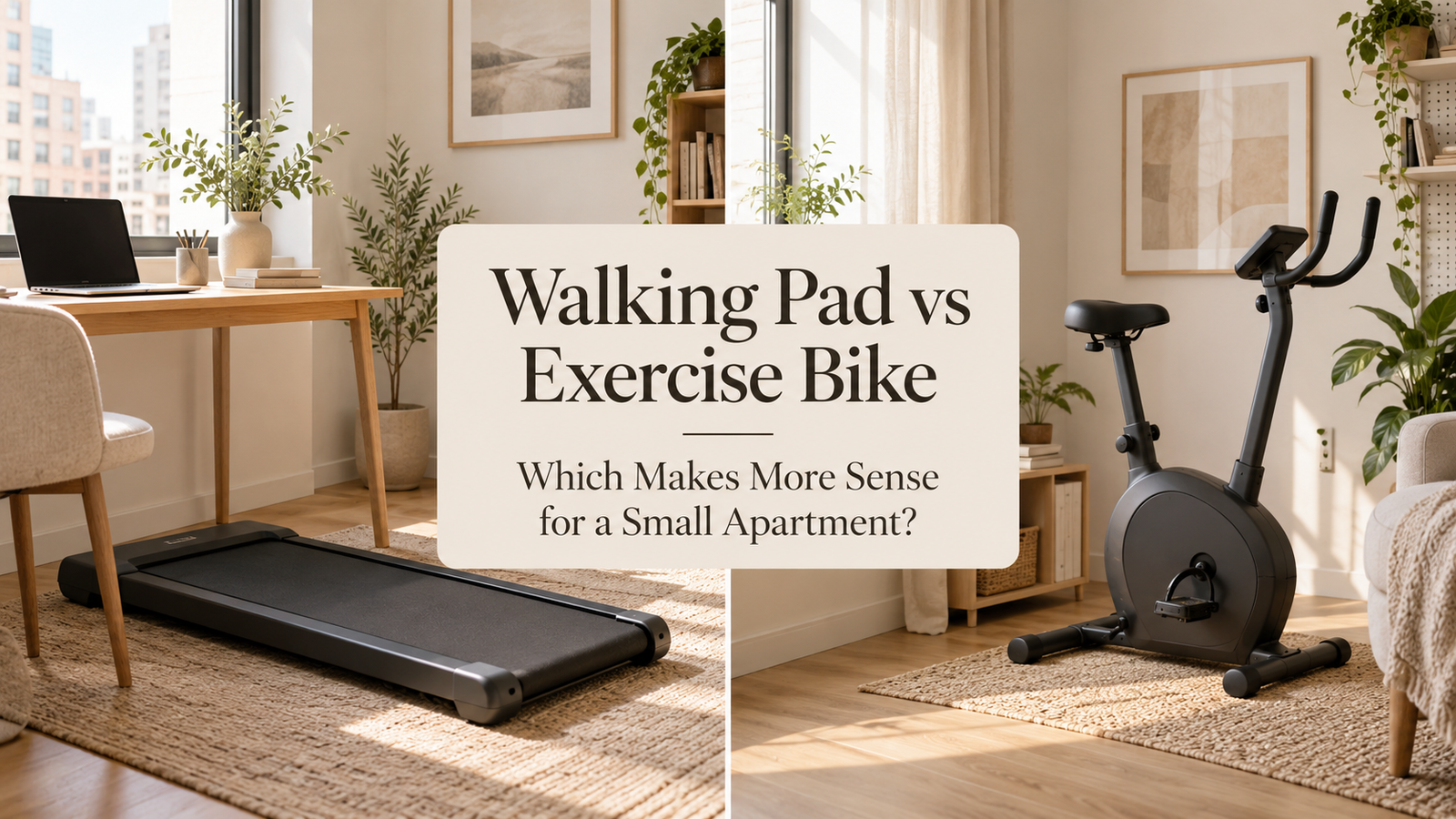
Choosing a walking pad vs exercise bike for a small apartment starts with the way you want to move throughout the day. Floor space matters, but so do your work routine, storage options, and whether you can leave exercise equipment ready to use.
A walking pad can fit into an existing standing-desk routine, while an exercise bike gives you a dedicated place to cycle with adjustable resistance. The more useful question is which arrangement your apartment can comfortably accommodate without repeatedly disrupting the rest of the room.
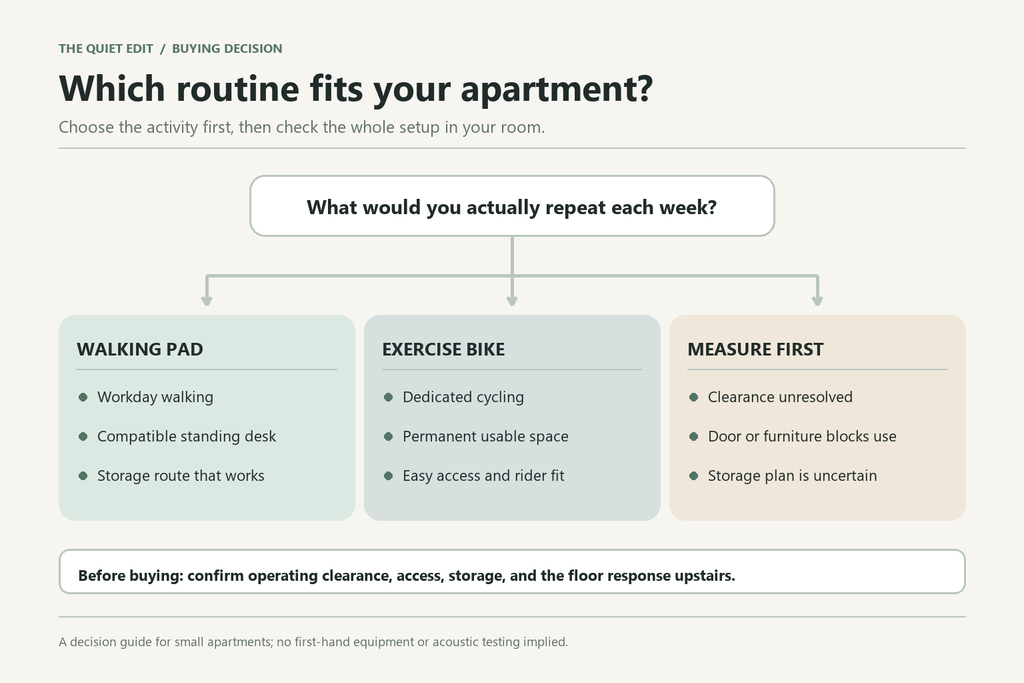
If you already have a suitable standing desk and somewhere to store a low-profile machine, we would start by considering a walking pad. If you prefer focused cycling sessions and have a permanent corner available, a magnetic exercise bike deserves the first look.
About this comparison: We have not physically tested either machine. This article uses published manufacturer specifications and manuals, with TQE’s own floor-area calculations and hypothetical apartment layouts. Product specifications and buying conditions should be confirmed for your region before purchasing.
The Quick Answer
A walking pad is generally the more practical starting point for someone who wants to add movement to compatible desk tasks. A suitable desk, clear walking area, and realistic storage location make a substantial difference to how conveniently it fits into daily life.
An exercise bike is worth prioritizing when your goal is seated cycling with adjustable resistance. It also deserves consideration in an upstairs apartment where repeated walking impacts are a concern, although the amount of sound transmitted downstairs still depends on the machine and building.
If your room has no reliable exercise area or every session would require moving several large pieces of furniture, neither option is an obvious purchase yet. Measuring the complete operating space should come before comparing features.
What Kind of Exercise Bike Are We Comparing?
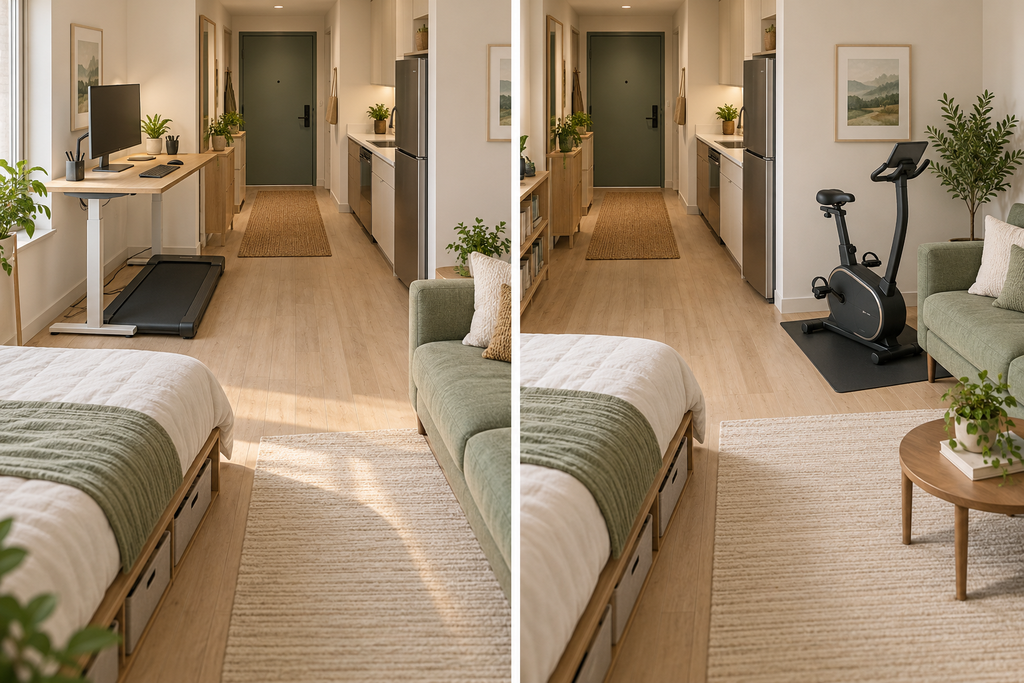
Our main comparison uses a compact motorized walking pad and a full-size stationary indoor cycling bike with magnetic resistance.
For concrete examples, we selected the UREVO SpaceWalk E1L (URTM041) and Schwinn IC4 Indoor Cycling Bike.
The E1L represents a low-profile walking pad intended for home and under-desk walking. The IC4 represents an indoor cycling bike designed around a stable riding position and adjustable magnetic resistance.
We chose the IC4 partly because its published manual provides both machine dimensions and a minimum workout area. That makes it particularly useful for separating the space occupied by the equipment from the space required to use it.
This is a comparison of two specific examples, rather than a claim that every exercise bike is larger than every walking pad.
Compact upright bikes, folding bikes, and under-desk pedal exercisers can have significantly different storage shapes and operating requirements. Those alternatives may be better suited to some apartments, but their dimensions need to be assessed individually.
| Your main requirement | Walking pad | Magnetic exercise bike |
|---|---|---|
| Movement during computer work | Works with a suitable standing workstation | Conventional bikes generally require a separate work arrangement |
| Dedicated exercise sessions | Walking within the model’s supported range | Cycling with adjustable resistance and cadence |
| Storage beneath furniture | Possible with a sufficiently low-profile model | Unusual for a full-size indoor cycling bike |
| Repeated footfall | Present during walking | No walking footfall during seated cycling |
| Getting on and off | Requires clear access to the walking deck | Requires mounting and dismounting space |
| Minimal daily preparation | Convenient when the desk and walking setup are ready | Convenient when the bike can remain accessible |
Personal preference can outweigh a small difference in equipment size. Someone who enjoys cycling but dislikes walking while working may use a bike more consistently, even if it occupies more floor space.
Floor Space: The Machine and the Room Around It
A useful apartment comparison needs three measurements: the equipment’s outer dimensions, its required operating area, and the route used to move or store it.
The first measurement is relatively easy to calculate from a specification sheet. The other two require more attention because riders need access to the equipment, and walking pads need adequate clearance around the moving belt.
Published Dimensions: UREVO E1L vs Schwinn IC4
The following figures describe the specific models used in this comparison.
| Measurement | UREVO SpaceWalk E1L | Schwinn IC4 |
|---|---|---|
| Length × width × height | 107 × 49 × 10.7 cm | 138.6 × 77.9 × 131.6 cm |
| Approximate dimensions in inches | 42.1 × 19.3 × 4.2 in | 54.6 × 30.7 × 51.8 in |
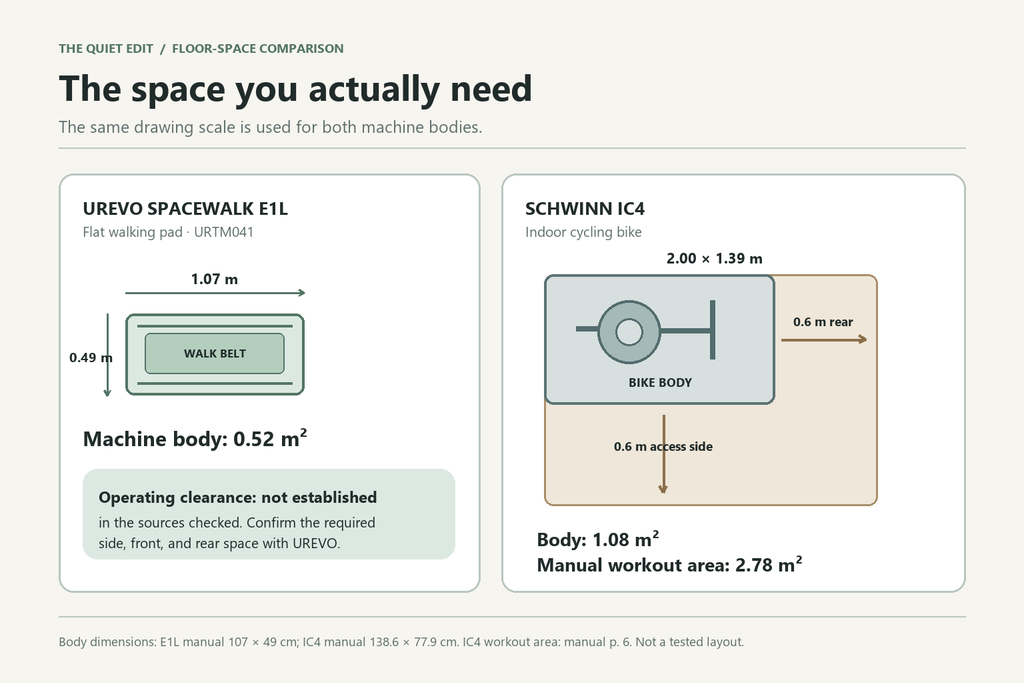
| Calculated body footprint | 0.5243 m² / 5.64 ft² | 1.0797 m² / 11.62 ft² |
| Published weight | 16.6 kg / 36.59 lb | 48.8 kg / 107.6 lb without dumbbells |
| Additional supplied weights | None included in this comparison | 2.7 kg / 6 lb of dumbbells |
| Manufacturer-documented minimum workout area | Not confirmed for E1L | 2.00 × 1.39 m |
| Storage configuration | Flat, non-folding body | Upright stationary bike |
Sources: UREVO SpaceWalk E1L specifications and Schwinn IC4/800IC owner’s manual.
The Schwinn calculations use the 138.6 × 77.9 cm dimensions in its manual. Regional product descriptions and rounded inch measurements may differ slightly, so the manual provides a consistent basis for the calculations below.
TQE Calculation: The IC4 Occupies About Twice the Body Area of the E1L
We calculated each machine’s footprint using its published length and width in meters.
UREVO SpaceWalk E1L
1.07 × 0.49 = 0.5243 m²
Schwinn IC4
1.386 × 0.779 = 1.079694 m²
Dividing the IC4’s footprint by the E1L’s gives:
1.079694 ÷ 0.5243 ≈ 2.06
The percentage difference is:
(2.06 − 1) × 100 ≈ 106%
In these two examples, the Schwinn IC4 occupies approximately 106% more floor area than the UREVO E1L when comparing the machines’ outer rectangles.
That difference can matter in a small bedroom or home office, particularly when an exercise machine must share space with a desk, bed, sofa, or dining table.
A compact or folding exercise bike could produce a different result. The 106% figure applies specifically to these two models.
Operating Area Can Change the Buying Decision
The Schwinn IC4 manual specifies at least 0.6 m (24 inches) of clear space along the side used to access the bike and behind it. It also provides a minimum workout rectangle of 2.00 × 1.39 m.
The full rectangle covers:
2.00 × 1.39 = 2.78 m²
Converting that to square feet gives approximately 29.92 ft².
Compared with the IC4’s body footprint:
2.78 ÷ 1.079694 ≈ 2.57
The manufacturer-documented operating area is therefore approximately 2.57 times the bike’s body footprint.
This calculation demonstrates why the dimensions printed on a product listing may understate the amount of room you need during a workout. A bike can physically fit into a corner while leaving insufficient space to mount, ride, or dismount safely.
For the E1L, the manufacturer’s current product listing establishes the body dimensions, but we could not verify an equivalent minimum operating rectangle from the model-specific documentation available for this review. The E1L’s body footprint should therefore be treated as a lower bound for planning, with the required surrounding clearance confirmed through UREVO before purchasing for a tight space.
We have not assigned an invented front, rear, or side clearance to the E1L. A useful matched operating-area comparison would require manufacturer-supported requirements for both machines.
Two Hypothetical Apartment Layouts
Consider a clear area measuring 1.5 × 2.1 m.
The Schwinn IC4’s documented 1.39 × 2.00 m workout rectangle fits geometrically inside that space. Only approximately 0.11 m remains across one dimension and 0.10 m across the other, so a door swing, nearby furniture, or restricted entry route could still make the position unsuitable.
Now consider a smaller clear area measuring 1.2 × 1.6 m.
The bike’s physical body fits inside that rectangle, but its required workout area does not. For the IC4, this layout can be ruled out using the published operating dimensions.
The E1L’s body also fits within the smaller area, but its complete safe-use clearance has not been established here. Its smaller footprint makes the space worth investigating, while the final decision still depends on its model-specific requirements.
These examples illustrate a useful distinction between space available for storing equipment and space available for operating it.
A room may support both activities at different times, provided furniture and household traffic are completely clear during exercise.
Storage: What Happens After the Workout?
A walking pad has a practical advantage when its low-profile body can slide beneath furniture.
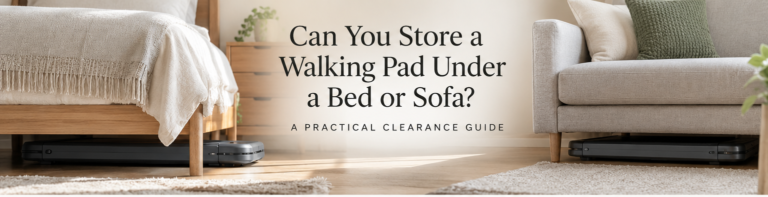
The UREVO E1L measures approximately 4.2 inches high, making under-bed or under-sofa storage possible where the complete opening is sufficiently large. Its full length must still fit, and the machine needs a practical route in and out.
Related reading
Our walking pad under-bed and sofa clearance guide explains how to measure the lowest opening, account for hidden supports, and decide whether a walking pad will actually fit beneath your furniture.
The Schwinn IC4 is intended to occupy a standing position. Its transport wheels can help with repositioning, but its substantial weight and tall structure make moving it around a small apartment a more involved task.
A full-size bike is often easier to live with when it has a permanent location and the required riding clearance can remain available.
Folding upright bikes introduce another possibility. Their reduced stored dimensions may be useful in a small apartment, although folded height, stability, and the manufacturer’s permitted storage method still need consideration.
We would prioritize the arrangement that requires the least daily furniture rearrangement. A walking pad that must be retrieved from an awkward location for every session may eventually become less convenient than a bike that is always ready to ride.
Walking While Working: Start With Your Desk
The main practical appeal of a walking pad is its potential to fit into activities you already do.
For computer work, that requires a standing workstation with suitable adjustment range, adequate legroom, and a safe cable arrangement. The machine must fit between or around the desk supports without interfering with its operation.
Keyboard and monitor height also deserve attention. Standing on a walking pad changes your position relative to the desk, so a workstation that feels comfortable while standing directly on the floor may need further adjustment.
Walking can also affect concentration differently across tasks. Reading or attending a less interactive meeting may be compatible with gentle movement, while detailed mouse work, writing, or precision tasks may be easier while stationary.
A conventional indoor cycling bike presents a different workstation arrangement. Its handlebars, saddle position, and pedaling movement usually make ordinary desk work less straightforward.
Some bikes provide a tablet holder, which can be useful for watching content or following a class. That does not necessarily provide a comfortable setup for sustained typing.
If your main goal is movement during work, our best walking pads for under a desk guide explores workstation fit and the practical differences between walking-pad models.
For seated movement during desk work, an under-desk pedal exerciser is another category worth considering. Its usability depends on available knee clearance, chair stability, and the space needed throughout the pedal stroke.
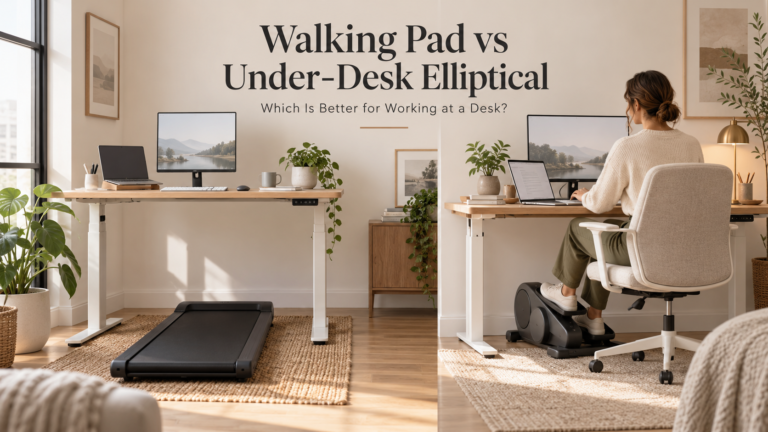
For movement during computer work, our walking pad vs under-desk elliptical guide compares standing walking with seated pedaling, including the space your knees and chair need.
Dedicated Workouts: Which Format Fits Your Routine?
An exercise bike makes particular sense when you enjoy structured cycling sessions.
The Schwinn IC4 offers magnetic resistance, allowing riders to adjust how demanding their cycling session feels. The bike’s riding position and controls are designed around a workout performed in one place.
A walking pad supports a different kind of activity. Models such as the UREVO E1L are intended for walking at home, including gentle activity during portions of the workday.
The E1L’s published speed range is 0.6–4.0 mph, with a flat walking surface and no incline function. Its intended use is more limited than that of a treadmill designed for running.
For people who specifically want additional walking steps, the walking-pad format aligns more directly with that goal. For those who enjoy cycling or want resistance-based cardio sessions, a bike may encourage more consistent use.
There is also a comfort consideration.
A bike requires suitable saddle adjustment, handlebar reach, and a manageable mounting and dismounting movement. A walking pad requires a comfortable step onto the deck and the ability to maintain balance during belt movement.
Neither set of dimensions alone establishes that a machine is suitable for a particular person’s body proportions or mobility needs.
If you prefer a compact standing workout, our walking pad vs mini stepper comparison examines storage height, overhead space, and the operating clearance a hydraulic stepper can require.
Schwinn’s Published Height Recommendations Differ
Schwinn’s product information provides a recommended rider height of 5 ft 1 in to 6 ft 4 in, while its IC4 FAQ gives a broader range of 4 ft 6 in to 6 ft 6 in.
Those manufacturer figures conflict.
We would recommend confirming suitability directly with Schwinn if you are near either end of the stated range. Inseam, saddle adjustment, handlebar reach, and comfortable riding posture provide more useful fit information than height alone.
If running is part of your intended exercise routine, our walking pad vs treadmill comparison addresses the trade-offs involved in moving beyond walking-only equipment.
Noise and Floor Vibration in Apartments
Noise deserves consideration in any apartment, particularly when another home is directly beneath the exercise area.
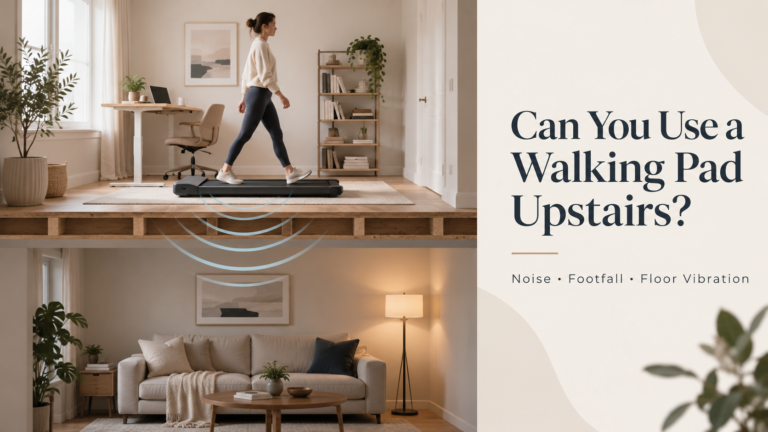
A walking pad produces motor and belt sound while also receiving repeated impact from the user’s footsteps. The resulting vibration can reach the floor through the machine’s frame and support points.
Seated cycling removes the repeated walking-footfall pattern. This makes a magnetic-resistance bike worth considering when footstep impact is a primary concern.
That is an editorial inference based on the mechanics of each activity, rather than a measured comparison between the E1L and IC4.
An exercise bike can still produce sound through its drivetrain, bearings, pedals, and other moving components. Movement against the floor or loose fittings may also create vibration.
An older NBS/NIST report on noise control discusses how vibration can travel through building structures and create audible sound away from the original source.
For this reason, a quiet motor specification cannot establish whether a machine will disturb the apartment below. The construction of the floor, equipment stability, walking or pedaling behavior, and placement all influence the result.
We do not have comparable loaded noise measurements for the two specific machines in the same apartment, so assigning either one a numerical noise advantage would be unsupported.
Related reading
Our guide to using a walking pad upstairs examines footsteps, structure-borne vibration, flooring, mats, and practical setup checks.
For either format, start with a stable, manufacturer-permitted floor setup. Unusual rattling, rocking, or increasing noise should be investigated rather than assumed to be normal.
The Additional Costs of a Usable Setup
The purchase price of the equipment may be only part of the first-year cost.
For a walking pad, a suitable height-adjustable desk could be the largest additional expense if you do not already own one. A mat, maintenance supplies, and a practical storage arrangement may also matter.
For an exercise bike, consider delivery, assembly, an equipment mat where appropriate, and any optional connected-fitness subscriptions.
The Schwinn IC4 supports basic riding without requiring a paid subscription. Its dual-sided pedals also provide toe cages for regular athletic footwear, so cycling shoes and connected classes can be considered optional purchases rather than necessities for basic use.
A simple ownership-cost comparison is:
First-year cost = machine + delivery and assembly + required setup purchases + 12 months of chosen subscriptions + anticipated consumables
Enter zero for equipment you already own and optional services you do not plan to use.
For example, someone with a suitable standing desk may need very little additional equipment to integrate a walking pad into an existing workspace. Someone starting from a conventional seated desk may face a more substantial setup cost.
The opposite can also be true. A bike that remains permanently set up in an unused corner might require fewer furniture changes and accessories than a walking workstation built from scratch.
Warranty, Returns, and Apartment Delivery
Warranty coverage, return periods, shipping charges, and seller conditions can change. Before purchasing, compare the current UREVO warranty and return policy with the Schwinn product information and return policy.
Apartment logistics deserve attention alongside those terms. Check whether delivery reaches your door, whether assembly help is available, and how a heavy or bulky machine would be packed and collected if it needed to be returned.
Keeping the original packaging may take up valuable storage space, so the return process should be considered before the box is discarded.
Safety and Practical Ownership
Both machine types require a clear operating area, secure placement, and familiarity with their stop controls.
Keep children, pets, loose cables, and household traffic away from moving equipment. Follow the model-specific instructions for cleaning, maintenance, transportation, and storage.
The Schwinn IC4 uses a fixed-gear design. Its manual warns that the pedals cannot stop independently of the flywheel, so the rider must allow the pedals to stop completely before dismounting.
A walking pad brings different considerations, including belt access and maintaining balance while walking.
Before buying either type, check current official recall information for the exact model and follow any applicable manufacturer safety notices. Product identity matters because warnings concerning other machines do not automatically apply to the models compared here.
Which One Should You Choose for a Small Apartment?
Choose a Walking Pad If…
A walking pad deserves priority when you already have a compatible standing desk or a clear reason to incorporate walking into everyday activities.
Its low body height can make storage beneath furniture possible, and a compact model may occupy less floor area than a full-size indoor cycling bike.
The purchase makes the most sense when your planned operating clearance is suitable and retrieving the machine will remain convenient.
Choose an Exercise Bike If…
An exercise bike is worth prioritizing when you want a dedicated cycling routine with adjustable resistance and can provide enough permanent workout space.
A magnetic bike is also a sensible category to investigate when repeated walking impact is a concern, although actual apartment noise depends on the complete setup.
If space is particularly limited, consider compact or folding upright bikes separately from full-size indoor cycling models such as the IC4. Their smaller storage footprint may change the comparison substantially.
Reconsider Both If…
Neither format is ideal when the required operating area blocks essential household access or when every session involves substantial furniture rearrangement.
In a very small apartment, a smaller exercise format, another room, or a different routine may be more practical than purchasing equipment that competes with the room’s everyday purpose.
Final Verdict
For a small apartment, the walking pad has a compelling advantage when you want movement during everyday activities and can store the machine conveniently afterward.
A stationary bike offers a more dedicated cycling experience and can be easier to integrate when it has a permanent location. Compact and folding models deserve separate consideration because the Schwinn IC4 example represents a full-size indoor cycling bike.
Our comparison of the UREVO E1L and Schwinn IC4 illustrates why equipment footprint and operating space should be evaluated separately. The IC4’s body occupies approximately 106% more floor area than the E1L’s, while its manufacturer-documented workout area reaches 2.78 m². An equivalent operating-area figure for the E1L remains unverified.
Before purchasing, mark the proposed equipment position on your floor. Include the space needed to get on, get off, move around, and store the machine, then consider how often you would actually use it.
The better choice is the one that supports the activity you want while keeping the rest of your apartment comfortable and functional.