
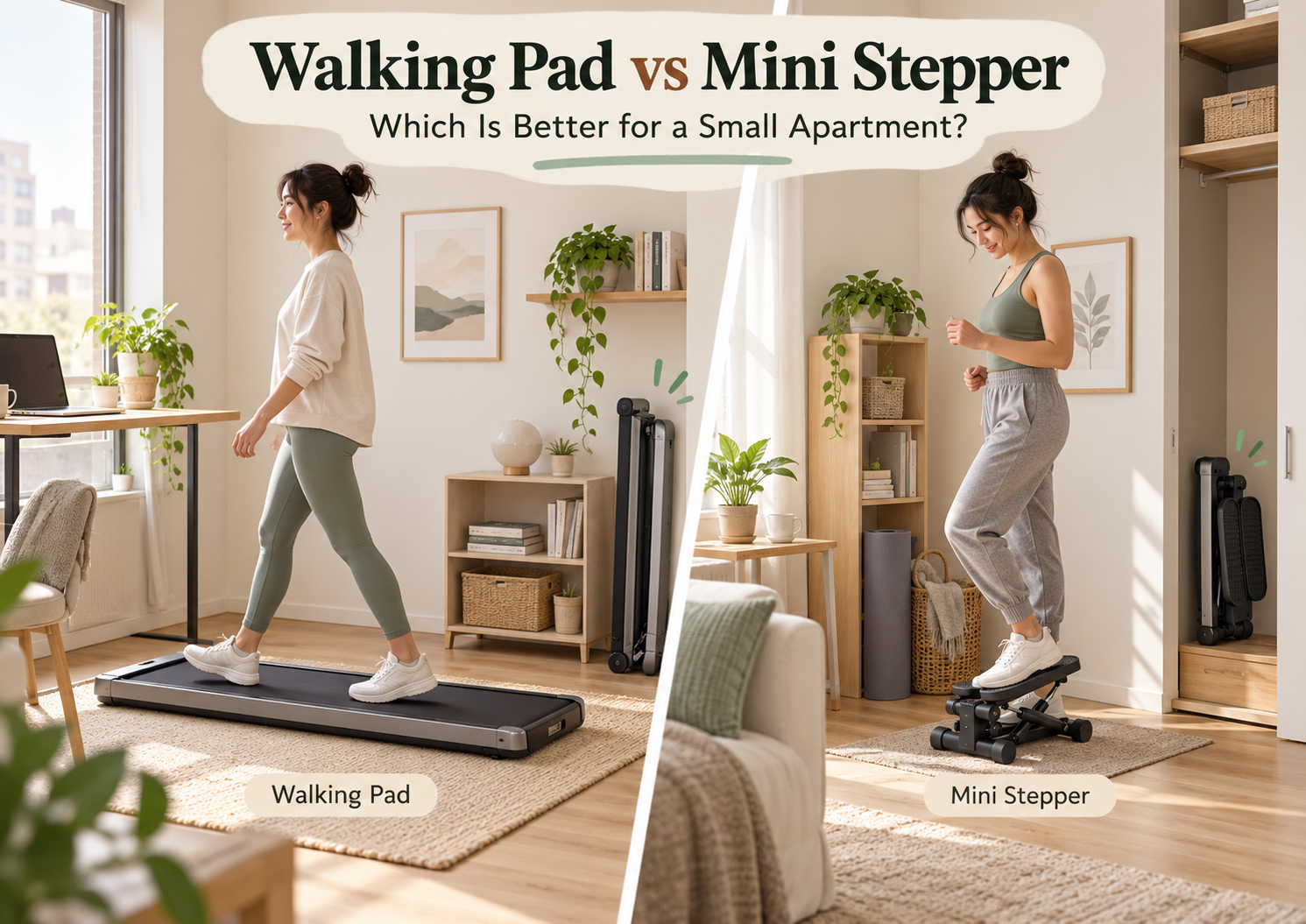
Choosing a walking pad vs mini stepper for a small apartment involves more than comparing the dimensions of two exercise machines. You need enough room to use the equipment comfortably, somewhere practical to store it, and a routine that fits the way you spend your day.
A walking pad suits people who want to accumulate walking steps, potentially while doing compatible standing-desk tasks or watching something at home. A hydraulic mini stepper offers a different arrangement: a compact, manually operated machine for focused stepping sessions.
The mini stepper occupies much less floor space when parked, but its operating clearance and the extra height beneath your feet deserve attention. In a low-ceilinged room or a crowded apartment, those details can be more important than the size of the machine itself.
About this comparison: We have not physically tested either machine. This article uses published manufacturer specifications and manuals, together with TQE’s original space calculations and hypothetical apartment layouts. Product information was researched for US-market examples in October 2026. Check your exact model and local purchasing conditions before ordering.
The Quick Answer
A walking pad makes sense when walking is the activity you want and your room can accommodate the moving belt, access space, and daily setup. It is particularly appealing if you have a suitable standing desk or prefer a gentler walking routine alongside another activity.
A mini stepper is worth considering when you want short, dedicated exercise sessions and need a machine that is easy to store in a small corner or closet. Its compact body is appealing, although the manufacturer’s operating-space instructions and the height of the pedals can limit where it can be used.
| Your priority | Start with | Main consideration |
|---|---|---|
| Gentle walking during compatible activities | Walking pad | Belt space, desk height, attention, and operating clearance |
| Short, focused stepping sessions | Mini stepper | Balance, surrounding space, and hydraulic cooling |
| Storage beneath low furniture | Walking pad | Available height, length, and retrieval route |
| Compact floor-level storage | Mini stepper | Stored height and easy access |
| Low ceilings or sloping rooflines | Measure both first | Highest head and hand positions during movement |
| Neighbors directly below | Evaluate the actual setup | Footfall, mechanical vibration, and building construction |
Both formats require stable footing and sufficient room for movement. If you need a fixed handrail or additional balance support, look for equipment specifically designed to provide it before narrowing your choice.
Two Specific Models: UREVO E1L and Sunny 012-S
For a practical comparison, we selected the UREVO SpaceWalk E1L (URTM041) and the Sunny Health & Fitness NO. 012-S Mini Stepper with Exercise Bands.
These examples provide manufacturer-published dimensions and supporting documentation, allowing us to compare body footprint, storage shape, and operating requirements.
The E1L is a flat motorized walking pad. The Sunny 012-S is an up-and-down hydraulic mini stepper operated by the user’s movement.
| Published specification | UREVO SpaceWalk E1L | Sunny NO. 012-S |
|---|---|---|
| Length × width × height | 42.1 × 19.3 × 4.2 in | 16 × 12.5 × 13.5 in |
| Product weight | 36.59 lb / 16.6 kg | 15.2 lb / approximately 6.9 kg |
| Published user-weight limit | 265 lb / 120 kg | 300 lb / 135 kg in current documentation |
| Movement adjustment | 0.6–4 mph, flat walking belt | Hydraulic stepping with adjustable step height |
| Walking surface | 35.43 × 15 in | Not applicable |
| Power | Mains-powered motor | User-powered pedals with battery display |
Sources: UREVO SpaceWalk E1L, Sunny NO. 012-S, and the Sunny 012-S V4.2 manual.
Sunny also publishes a slightly smaller footprint in its product description. We use the complete specification-table dimensions of 16 × 12.5 inches consistently in the calculations below.
An older Sunny manual lists a lower weight capacity of 220 lb. If you are purchasing an older or secondhand unit, follow the capacity on its actual label and the instructions supplied with that version.
The published weight limits help identify whether a person falls within the manufacturer’s stated capacity. Comfortable foot placement, balance, stride, and stability still require separate consideration.
TQE Space Analysis: The Mini Stepper Uses About 75% Less Body Area
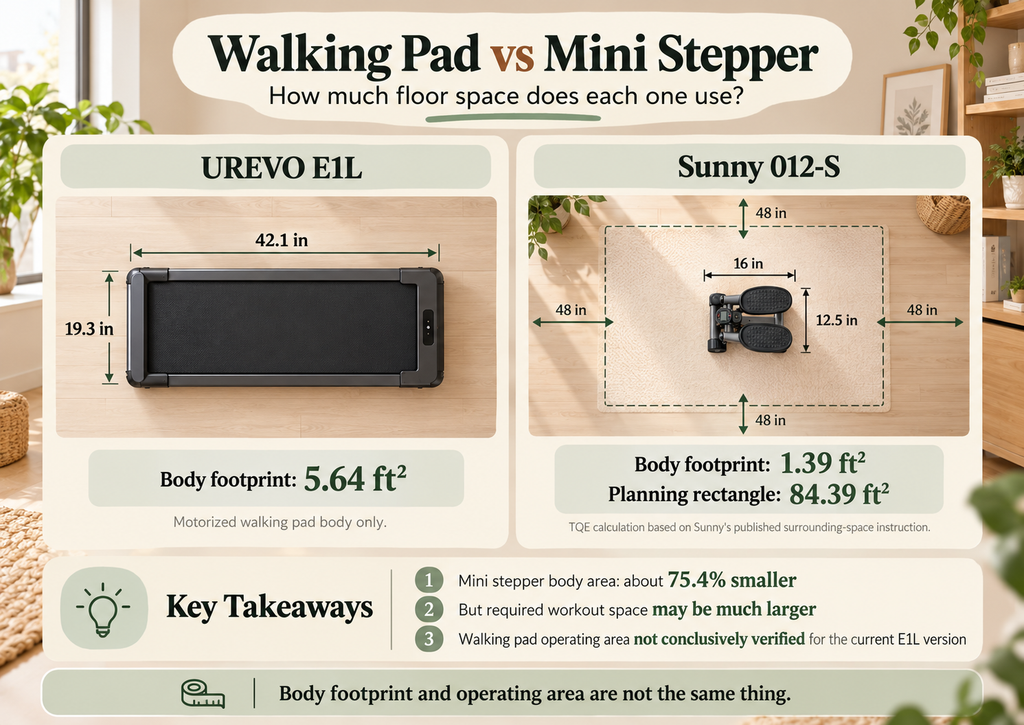
A machine’s body footprint is the rectangle formed by its published length and width.
Using the manufacturer dimensions above, we can calculate how much floor each machine occupies when viewed from above.
The Walking Pad
42.1 × 19.3 = 812.53 square inches
Converting to square feet:
812.53 ÷ 144 = 5.64 ft²
That is approximately 0.5242 m².
The Mini Stepper
16 × 12.5 = 200 square inches
Converting to square feet:
200 ÷ 144 = 1.39 ft²
That is approximately 0.1290 m².
The percentage reduction is:
(812.53 − 200) ÷ 812.53 × 100 = 75.4%
For these two examples, the Sunny mini stepper occupies approximately 75.4% less floor area than the UREVO walking pad’s body.
That is a substantial saving when parking equipment beside a wardrobe, under a desk, or in a small closet.
However, the amount of floor occupied by the machine is only the first part of the apartment-space calculation. The operating area can be considerably larger.
A Small Stepper Can Still Require Significant Clear Space
Sunny’s current 012-S manual specifies 4 ft (approximately 120 cm) of free space around the equipment.
For a conservative rectangular planning example, we apply that clearance to all four sides of the published machine footprint.
The resulting dimensions are:
Length
16 + 48 + 48 = 112 inches
Width
12.5 + 48 + 48 = 108.5 inches
The calculated rectangle covers:
112 × 108.5 = 12,152 square inches
12,152 ÷ 144 = 84.39 ft²
That is approximately 7.84 m².
This 84.39 ft² figure is a TQE planning calculation derived from the manual’s surrounding-space instruction. Sunny does not publish this calculated rectangle as a separate workout-area specification.
A hypothetical 6 × 6 ft empty area easily accommodates the stepper’s physical body, but falls short of the calculated surrounding-clearance rectangle.
For a small apartment, that difference changes how the product should be evaluated. A machine that occupies only 1.39 ft² when stored may require considerably more free space when used according to its published instructions.
If your proposed room layout places furniture or walls within the specified clearance, confirm the arrangement directly with Sunny before purchasing.
What About the Walking Pad’s Operating Area?
The E1L’s published body footprint is approximately 5.64 ft². Its complete operating clearance must also account for access, the moving belt, and the manufacturer’s installation requirements.
An earlier URTM041 manual includes numerical surrounding-clearance guidance, but the requirements for the exact current E1L version used in this comparison have not been conclusively reconciled across manual revisions. We therefore do not assign a confirmed operating-area rectangle to the E1L here.
This means the two machines can be compared accurately by body footprint, while their complete operating areas cannot yet be ranked on an equivalent verified basis.
Before buying the E1L for a confined location, confirm the applicable front, rear, and side clearances with UREVO for the version being sold.
Storage: A Low Machine and a Short Machine Solve Different Problems
The E1L has a long, relatively flat body. The Sunny stepper is shorter but substantially taller.
That difference matters when deciding whether equipment will fit beneath furniture or inside a closet.
Consider two hypothetical storage spaces.
Under-Bed Storage: 45 × 24 × 6 Inches
A space measuring 45 inches long, 24 inches wide, and 6 inches high can accommodate the published outer dimensions of the E1L in its flat position.
The Sunny stepper is too tall for this opening because its published height is 13.5 inches.
This example assumes a clear rectangular space without hidden furniture supports, loose cables, or obstacles along the entry route.
Closet Storage: 18 × 15 × 16 Inches
A smaller storage space measuring 18 inches long, 15 inches wide, and 16 inches high accommodates the Sunny’s published assembled dimensions.
The E1L is too long to fit horizontally in that space.
The E1L’s manufacturer instructions restrict upright and side storage, so its low body should not be treated as permission to stand it vertically against a wall.
These examples show why the best storage arrangement depends on the shape of the available space.
Related reading
Our walking pad under-bed and sofa clearance guide explains how to measure hidden furniture supports, storage openings, and the route needed to move a walking pad in and out.
Storage Volume Tells a Different Story
We can also compare the volume of each machine’s rectangular outer box.
For the E1L:
42.1 × 19.3 × 4.2 = 3,412.63 cubic inches
For the Sunny:
16 × 12.5 × 13.5 = 2,700 cubic inches
The reduction is:
(3,412.63 − 2,700) ÷ 3,412.63 × 100 = 20.9%
The Sunny occupies approximately 20.9% less space when measured as a simple rectangular bounding volume.
This helps explain the difference between the two designs.
The mini stepper saves about 75% of the floor area but only about 21% of the rectangular storage volume. Much of its footprint advantage is exchanged for greater height.
The calculation describes the machines’ outer boxes rather than their actual material volume. It is useful for understanding storage shape, particularly when furniture openings have strict height limits.
Headroom: The Space Above Your Feet Matters
A mini stepper raises your feet above the floor as the pedals move.
That can matter beneath sloping ceilings, exposed beams, low light fittings, or loft-bed structures.
The relevant measurement is the highest position your head reaches during the intended movement, with footwear included. If you use the resistance bands, your hands may reach higher than your head and require additional clearance.
The E1L also raises your standing position, although its published overall height may differ from the actual height of the walking surface beneath your feet.
Sunny’s published adjustable step-height feature establishes that pedal travel can change, but the complete loaded foot-support height has not been verified for this comparison.
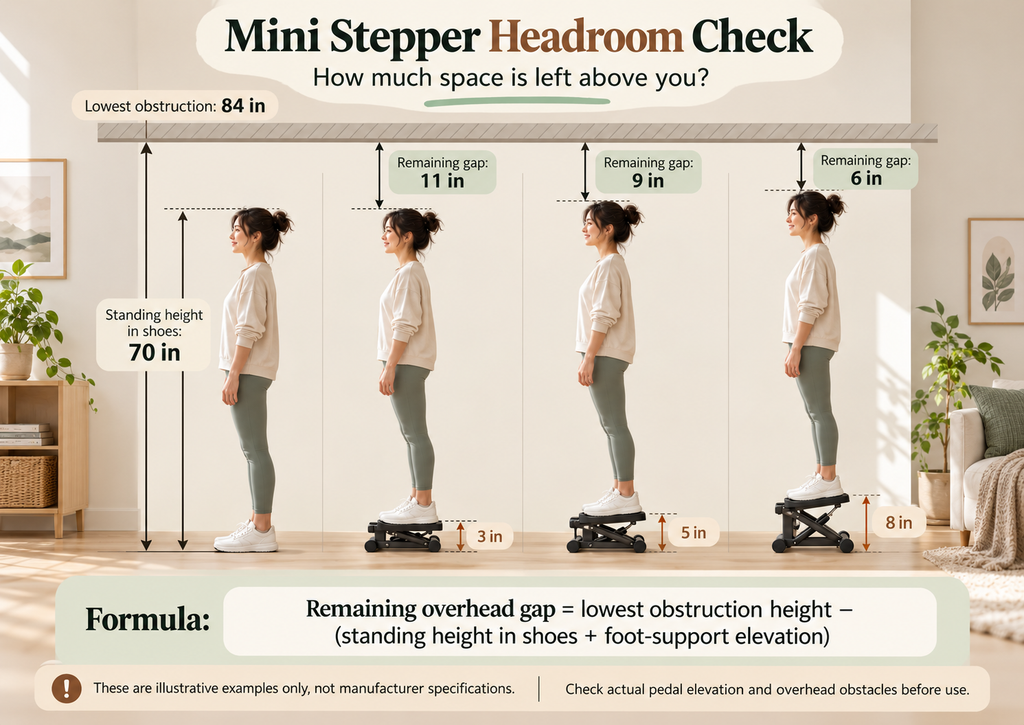
A Practical Headroom Calculation
For an initial estimate, use:
Remaining overhead gap = lowest obstruction height − (standing height in shoes + foot-support elevation)
This formula calculates a static gap based on the values supplied.
It does not include dynamic head movement, reaching, manufacturer-required clearance, or changes in posture. Use it to identify potentially unsuitable locations before trying to exercise there.
Suppose an overhead obstruction is 84 inches above the floor and a person measures 70 inches tall while wearing exercise shoes.
For illustration, consider three hypothetical foot-support elevations:
| Assumed foot-support elevation | Remaining gap |
|---|---|
| 3 inches | 11 inches |
| 5 inches | 9 inches |
| 8 inches | 6 inches |
The calculations are:
84 − (70 + 3) = 11 inches
84 − (70 + 5) = 9 inches
84 − (70 + 8) = 6 inches
These are examples of how changing the input affects available headroom. The 3-, 5-, and 8-inch elevations are hypothetical values, not published loaded pedal heights for the Sunny or measurements of the E1L.
We also cannot use the Sunny’s 13.5-inch overall body height as a substitute for its pedal elevation. The highest part of the frame and the moving surface supporting your feet may occupy different positions.
Before using either machine in a low-ceilinged space, obtain the applicable surface-height and overhead-clearance information from the manufacturer.
If the remaining space appears limited, choose an unobstructed location rather than trying to establish clearance by exercising beneath a low beam or fixture.
Longer Gentle Walking or Short Focused Stepping?
The two formats encourage different exercise routines.
A walking pad can support gentle walking while watching television, listening to content, or performing suitable standing-desk tasks. A low belt speed may make it easier to incorporate movement into an existing part of the day, provided the activity and workstation remain comfortable.
A hydraulic mini stepper asks you to press against resistance while maintaining balance and controlling an alternating stepping motion.
For that reason, we would approach the stepper primarily as equipment for dedicated exercise breaks.
Exercise Intensity and Calorie Estimates
It is tempting to compare which machine burns more calories, but the information available here does not support a reliable category-wide winner.
Exercise intensity depends on walking speed, stepping depth, resistance, body size, individual fitness, and the duration of activity.
A more demanding stepping session may feel different from gentle walking, although that observation alone cannot establish a universal calorie advantage.
For this comparison, the more useful question is which type of activity you intend to perform consistently.
If you want additional walking steps throughout the day, the walking pad serves that goal directly. If you prefer a separate stepping workout, the mini stepper offers another way to organize your exercise time.
Check Continuous-Use Guidance
Sunny’s current 012-S manual recommends shorter sessions of approximately 10–15 minutes and instructs users to allow the hydraulic cylinders to cool between uses.
The cylinders can become very hot during operation, so follow the manual’s cooldown and handling precautions.
Older documentation contains different wording about session duration and rest periods. For an older or secondhand stepper, use the instructions matching the actual product version.
For the E1L, confirm the intended continuous-use limits with UREVO if you plan lengthy uninterrupted walking sessions.
Walking while working can be a useful routine, but the machine’s permitted operating duration remains a separate consideration from how long you would personally like to walk.
Related reading
If you want to move while remaining seated at your existing desk, our walking pad vs under-desk elliptical comparison examines knee clearance, chair stability, and workstation compatibility.
Stability and Balance in a Small Room
A compact footprint creates a different balance arrangement from a machine with a fixed handrail.
Neither of the two examples here includes a dedicated upright support rail as standard equipment.
The Sunny’s resistance bands are intended for arm exercise and should not be treated as a fixed balance support. Likewise, an ordinary desk edge may be unsuitable for supporting your weight while walking.
If you rely on a handrail for stability, choose equipment designed for that purpose.
Getting Onto a Mini Stepper
Stepping onto a raised pedal requires balance before the exercise movement begins.
As the pedals move, body weight shifts between your legs. The user must control that alternating movement while keeping their feet properly positioned.
The compact body may be convenient for storage, but it does not automatically make mounting or stepping off easier for every user.
Follow the manufacturer’s setup and operating instructions, and avoid combining the stepping motion with resistance-band exercises until you are familiar with the basic movement.
Walking-Pad Stability
A walking pad requires attention to the moving belt, the controls, and the surrounding floor space.
Leave enough room to enter and exit the machine according to the manual. Keep household traffic, loose cables, pets, and children away from the moving components.
For both machines, use the flooring arrangements permitted by the manufacturer.
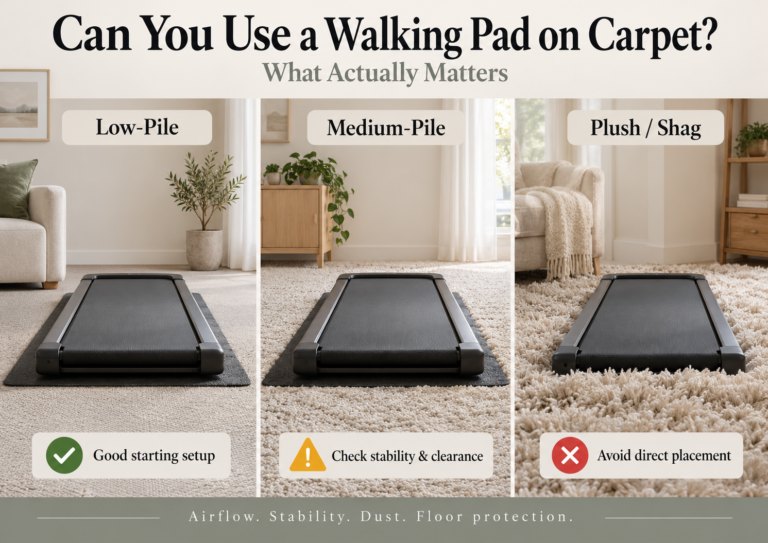
The E1L documentation restricts direct use on carpet and thick or soft cushioning. Sunny specifies a level, stable surface and appropriate floor protection.
Additional padding should be compatible with the machine’s instructions, especially if the surface begins to rock or compress unevenly.
Noise and Floor Vibration: What Can We Conclude?
A walking pad combines motor and belt noise with the repeated impact of footsteps.
A hydraulic mini stepper has no motorized walking belt, but its pedal mechanism, alternating loads, and contact with the floor can still create sound and vibration.
The different mechanisms may produce different patterns of noise. Without comparable measurements during loaded operation in the same room, we cannot reliably rank these two examples by sound level.
Floor vibration deserves particular consideration in an upstairs apartment.
An older National Bureau of Standards report hosted by NIST discusses how vibration can travel through building structures and become audible elsewhere.
That mechanism helps explain why the sound you hear beside exercise equipment may differ from what someone hears downstairs.
A stable installation and appropriate floor protection can help address aspects of the setup, but they cannot guarantee that neighboring rooms will remain quiet.
Related reading
Our walking pad upstairs apartment guide explains motor noise, footsteps, floor vibration, and the limits of judging downstairs sound from a phone recording.
If noise is likely to determine whether you can use the equipment, prioritize a manufacturer-permitted demonstration or an authorized home trial. When practical, have someone assess sound from the room below during normal operation.
Maintenance and Everyday Ownership
Both types of equipment require some maintenance, although the tasks differ.
The E1L has a moving belt that needs inspection, cleaning, alignment checks, and lubrication according to its model-specific manual.
Some URTM041 manual versions recommend lubrication at approximately 125-mile intervals. Because UREVO also publishes general maintenance guidance and documentation may differ between revisions, follow the instructions supplied with your exact model rather than applying that number universally.
The Sunny stepper has hydraulic cylinders, moving joints, resistance bands, fasteners, and a display that require appropriate inspection and care.
Its documentation contains differing cleaning instructions, so ask Sunny to clarify the approved procedure if your manual is unclear. Keep moisture away from areas the manufacturer does not permit you to clean with liquids.
Unusual scraping, excessive movement, or a new mechanical sound deserves investigation before further use.
The Cost of a Complete Setup
The mini stepper may have a lower initial purchase price, but total cost depends on the equipment and accessories required for your room.
A walking pad used at a workstation may involve purchasing a suitable standing desk. A mini stepper may be inexpensive to store, while a model with a fixed balance support could be a more appropriate alternative for some users.
A simple first-year budget is:
First-year cost = machine + delivery and taxes + required accessories + maintenance supplies + electricity or batteries
Include only the purchases that apply to your intended use.
For electricity, a useful budgeting formula is:
Electricity cost = average watts ÷ 1,000 × operating hours × local electricity rate
For example, an assumed average draw of 200 W over 100 hours at $0.20 per kWh would cost approximately $4.
That is a hypothetical budgeting example, not a measured E1L electricity-consumption figure. A machine’s advertised peak motor horsepower does not provide the same information as measured average power use.
Current product details and pricing are available from UREVO and Sunny Health & Fitness.
Warranty and Returns
Warranty coverage, return eligibility, and shipping charges can change by seller and region.
Before ordering, review the current UREVO warranty, UREVO return policy, Sunny warranty, and Sunny return policy.
If your purchase depends on a tight storage fit or uncertain noise conditions, ask whether an assembled trial is permitted and what happens if the equipment needs to be returned afterward.
These details matter because a compact machine can still be difficult to repack or ship once assembled.
Before Ordering: Check the Exact Model and Available Space
Begin with the manufacturer’s documentation for the exact model and version you intend to buy.
Confirm the published dimensions, operating clearance, permitted flooring, weight capacity, storage position, and any continuous-use or cooling requirements.
For older or secondhand equipment, use the capacity label and manual that match the actual unit.
Before purchase, check the exact model against the latest CPSC recall and product-warning information, or the equivalent product-safety authority in your country.
Sunny’s stepper documentation also includes precautions concerning hot hydraulic cylinders and the display’s button battery. Store the machine and accessories where children cannot access potentially hazardous components.
Which One Makes More Sense for Your Apartment?
Choose a Walking Pad If…
A walking pad is a good starting point when your main goal is walking and you have enough clear operating space for the machine.
Its low-profile design can be particularly useful when a long, shallow storage area is available beneath furniture. A compatible standing desk may also allow gentle walking during appropriate tasks.
The E1L illustrates that arrangement, although its exact operating-clearance requirements and intended session limits should be confirmed for the version you purchase.
Choose a Mini Stepper If…
A mini stepper deserves consideration when you prefer short, focused exercise sessions and value compact floor-level storage.
The Sunny 012-S occupies considerably less floor area than the E1L when stored. Its taller body, balance requirements, hydraulic cooldown instructions, and published surrounding-space clearance remain important parts of the decision.
For a very small apartment, confirm that your intended workout area can satisfy those requirements before selecting it solely for its compact size.
Consider Another Format If…
Neither example is ideal when you need a fixed handrail, cannot provide sufficient operating clearance, or have limited balance during mounting and movement.
If your goal is seated movement, an under-desk elliptical may be more relevant. If you prefer a supported cycling session, a stationary bike represents another option with its own space requirements.
Our walking pad vs exercise bike comparison for small apartments examines that separate choice.
Final Verdict
The Sunny mini stepper has a clear advantage in stored floor footprint, occupying approximately 75.4% less body area than the UREVO E1L in this comparison. Its higher profile reduces that difference when calculated as rectangular storage volume, while the manufacturer’s surrounding-space requirements introduce another important consideration.
The walking pad offers a more direct route to accumulating walking steps and may fit beneath low furniture. The mini stepper suits a different routine centered on dedicated stepping sessions, provided its balance, operating-space, and cooling requirements work for your home.
The complete operating-clearance requirements have not been verified on an equivalent basis for both specific models, so their usable workout areas cannot be ranked conclusively from the dimensions presented here.
Before ordering, measure the area you can clear for exercise, the full opening of your intended storage location, and the lowest overhead obstruction. Compare those measurements with the instructions for the exact model you plan to purchase.