
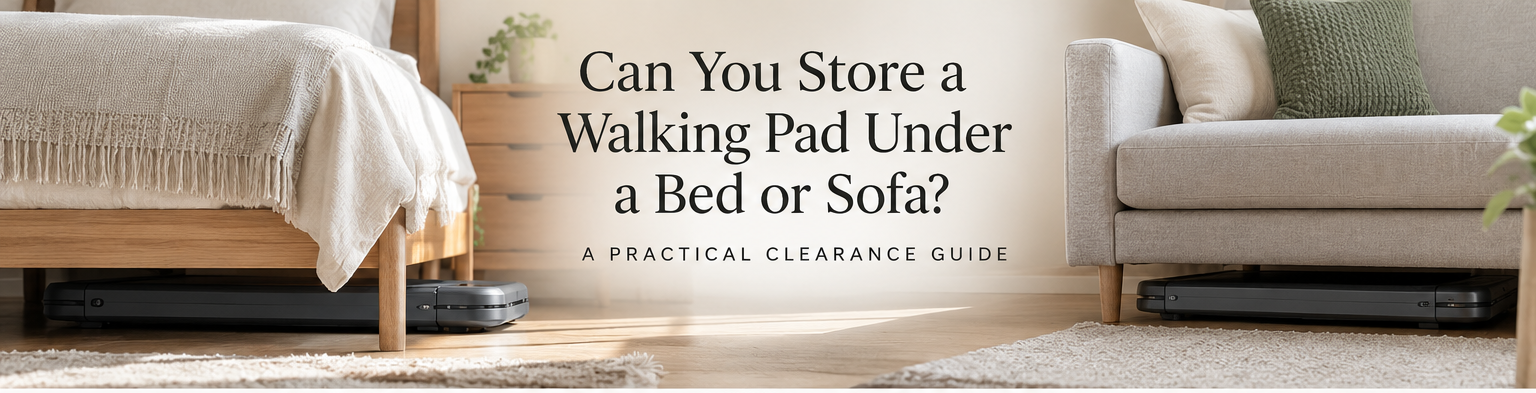
Storing a walking pad under a bed can make a shared bedroom or home office much easier to use. The difficulty often comes when the front of the machine clears the furniture, but a motor cover, folded deck, or hidden support stops it halfway in.
The most useful measurement is the smallest opening along the entire storage route. You also need enough unobstructed space for the machine’s full length and width, along with a practical way to move it in and out every day.
About this guide: We have not physically tested these walking pads or checked them beneath furniture. This is researched editorial analysis using published manufacturer specifications and manuals, with original TQE clearance calculations and hypothetical room examples.
The Quick Answer
Yes, a walking pad can go under a bed or sofa when its stored configuration fits the lowest clearance, the space between supports, and the approach route. A slim, non-folding model can suit low furniture, while a folding deck can help when available storage length is limited.
Among the five configurations compared here, none clears a true 4-inch opening. At 5 inches, the UREVO SpaceWalk E1L and an unfolded WalkingPad Z1 pass our height screening; at 6 inches, the folded Z1 joins them. The Egofit M1 and rail-down M1T leave only about 0.11 inches beneath a 7-inch opening, which is too tight for our recommended planning allowance.
These results address vertical clearance. A machine can pass that first check and still be unsuitable because of its width, length, transport method, or an obstruction farther beneath the furniture.
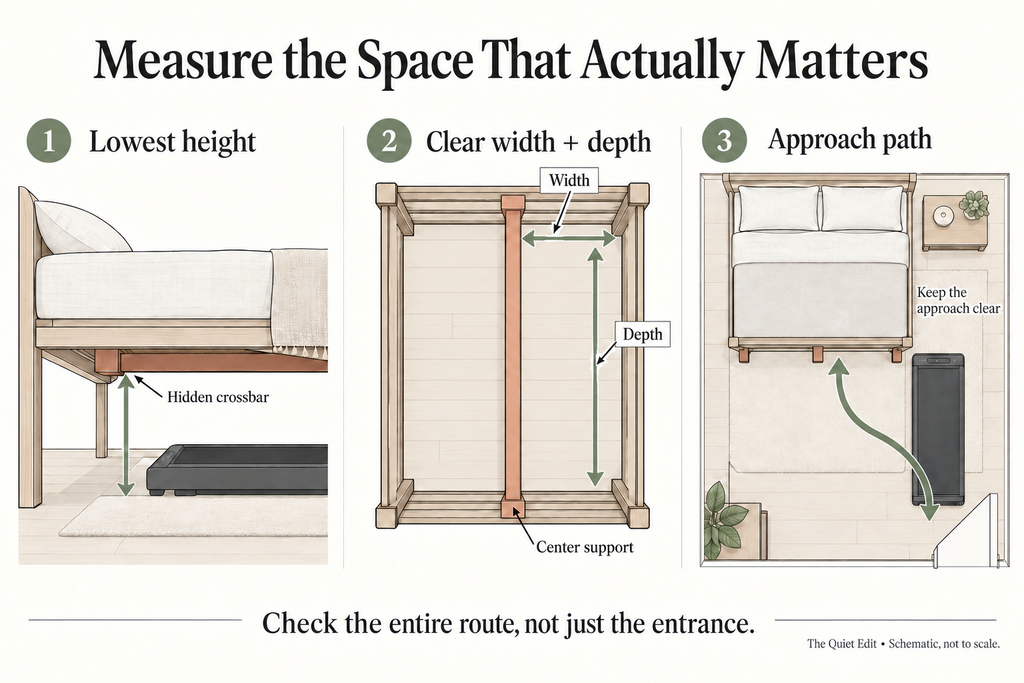
Measure the Whole Storage Space
Find the Lowest Point, Including the Route Behind the Opening
Start at the floor surface where the walking pad will rest and measure vertically to the lowest obstruction. Check the entrance, center, both sides of the intended path, and the far end. The visible height of the furniture legs tells you only part of the story.
A sofa may have a low crossbar behind its front edge, hanging upholstery, or a reclining mechanism. A bed may have a center rail, support feet, or drawers that divide an apparently large opening into smaller spaces.
A flashlight and a rigid ruler can be more useful than a flexible tape measure when checking difficult corners. Measure the furniture in its normal position, including any sagging upholstery or structural parts that reduce the usable opening.
For a reclining sofa, keep the walking pad outside the mechanism’s movement area and follow the furniture manufacturer’s instructions.
Measure the Clear Width and Depth
Record the usable width between legs or other supports, then measure the unobstructed depth from the entrance to the first obstacle. Compare those numbers with the walking pad’s overall dimensions in the configuration you intend to store.
Use the complete machine dimensions, including its motor housing, frame, feet, and any folded handrail. Walking-belt dimensions describe the exercise surface and are generally smaller than the complete machine.
Rotating the walking pad may change which dimension must fit beneath the furniture. Sideways insertion can reduce the depth required, but it also demands a wider opening and a practical way to move the machine in that direction.
Check the Approach Before Counting the Space as Usable
Consider where you will stand and how you will move the machine into position. A nightstand, desk leg, doorway, or narrow aisle can interrupt the process even when the storage space itself is large enough.
If the manual requires lifting one end to use transport wheels, check whether you have room to lift that end before entering the opening. The same space will be needed when pulling the walking pad out.
A cardboard rectangle cut to the manufacturer’s published length and width can help you check the route around furniture and support legs. It will not reproduce the walking pad’s weight or height, but it can eliminate layouts that clearly cannot work.
Official Storage Dimensions: Four Models, Five Configurations
The following dimensions come from the manufacturers’ published product information. WalkingPad Z1 and Egofit M1T appear twice only in the sense that their storage configuration matters: the Z1 can be folded, while the M1T’s handrail folds down.
The measurements below are length × width × height.
| Model and configuration | Dimensions (inches) | Dimensions (mm) | Storage characteristic |
|---|---|---|---|
| WalkingPad Z1, open | 56.1 × 22 × 4.1 | 1,425 × 560 × 106 | Low profile, full length |
| WalkingPad Z1, folded | 31.8 × 22 × 5.4 | 810 × 560 × 138 | Shorter, but taller |
| UREVO SpaceWalk E1L, flat | 42.1 × 19.3 × 4.2 | 1,070 × 490 × 107 | Slim, non-folding deck |
| Egofit Walker Pro M1 | 38.39 × 21.85 × 6.89 | 975 × 555 × 175 | Shorter fixed body |
| Egofit Walker Plus M1T, rail down | 40.55 × 26.18 × 6.89 | 1,030 × 665 × 175 | Folding handrail, wider body |
Manufacturer sources: WalkingPad Z1, UREVO SpaceWalk E1L, Egofit M1, and Egofit M1T.
Some regional manufacturer pages publish different dimensions, particularly for the Z1 and M1T. We have used the US product specifications supported by the available model documentation, but buyers should confirm the dimensions of their exact regional version before ordering.
This comparison covers the standard E1L, M1, and M1T, rather than similarly named alternatives such as the E1L Pro or Egofit M2.
Will It Fit Under 4, 5, 6, or 7 Inches?
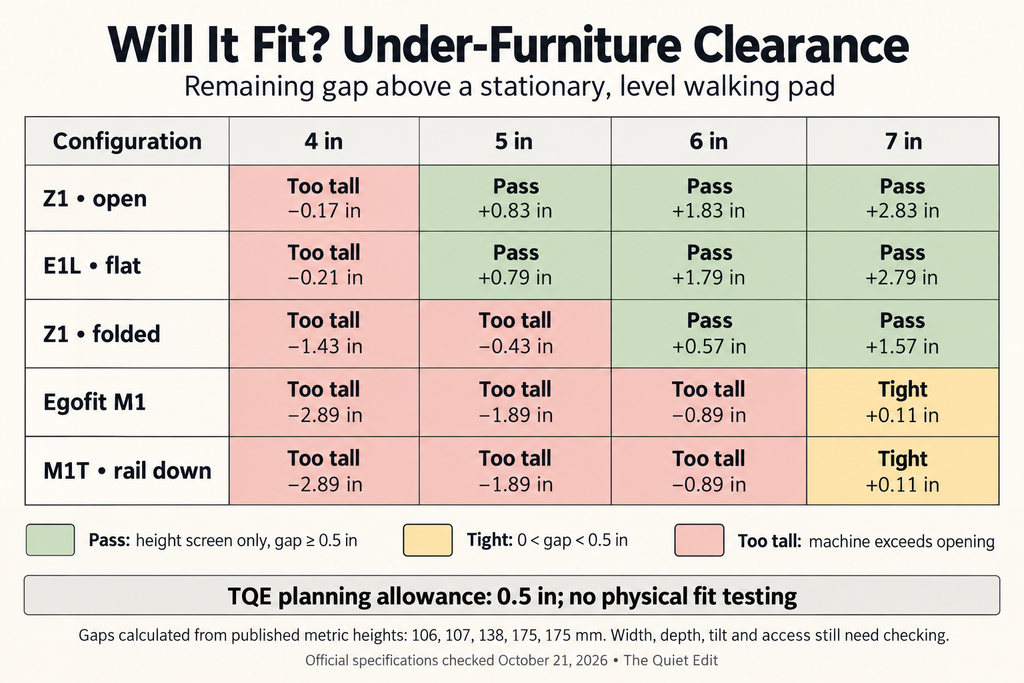
To compare storage clearance, TQE subtracted each machine’s published height in millimeters from four hypothetical furniture openings: 4, 5, 6, and 7 inches.
We used 25.4 mm per inch to avoid relying entirely on rounded product labels. The resulting gap represents the space above the stationary machine when it is sitting level beneath the furniture.
For initial shopping decisions, we recommend allowing an additional 0.5 inches (12.7 mm) of vertical clearance beyond the machine’s published height.
This is a TQE planning allowance, not a manufacturer requirement or a physically tested fit. The appropriate margin may be larger when a machine must be tilted, lifted, or moved over uneven flooring.
Our calculation applies that 0.5-inch allowance only to height. It does not include additional handling clearance for width or depth, which must be evaluated separately.
| Configuration | 4 in opening | 5 in opening | 6 in opening | 7 in opening |
|---|---|---|---|---|
| Z1, open | Too tall: −0.17 in | Pass: +0.83 in | Pass: +1.83 in | Pass: +2.83 in |
| E1L, flat | Too tall: −0.21 in | Pass: +0.79 in | Pass: +1.79 in | Pass: +2.79 in |
| Z1, folded | Too tall: −1.43 in | Too tall: −0.43 in | Pass: +0.57 in | Pass: +1.57 in |
| M1 | Too tall: −2.89 in | Too tall: −1.89 in | Too tall: −0.89 in | Tight: +0.11 in |
| M1T, rail down | Too tall: −2.89 in | Too tall: −1.89 in | Too tall: −0.89 in | Tight: +0.11 in |
How to read the table: “Pass” means at least 0.5 inches remain above the machine. “Tight” means the machine fits mathematically but leaves less than that allowance. “Too tall” means the machine exceeds the opening. A pass establishes only a preliminary height match.
For example, a 6-inch opening provides 152.4 mm of height. The folded Z1 measures 138 mm tall, leaving 14.4 mm, or approximately 0.57 inches.
After our 12.7 mm handling allowance, only 1.7 mm of additional margin remains. We would therefore measure this opening particularly carefully and confirm how the machine must be moved into place.
The approximate minimum openings after adding the 0.5-inch allowance are:
| Configuration | Height plus allowance |
|---|---|
| Z1, open | 4.67 in |
| E1L, flat | 4.71 in |
| Z1, folded | 5.93 in |
| Egofit M1 | 7.39 in |
| Egofit M1T, rail down | 7.39 in |
These thresholds are useful for early screening. Actual storage suitability still depends on the complete opening and the way the machine enters it.
Folding Solves a Different Storage Problem From Being Thin
The WalkingPad Z1 illustrates why folded dimensions can change the buying decision.
Using its published metric measurements, folding reduces the machine’s length from 1,425 mm to 810 mm, a reduction of approximately 43%. At the same time, its height increases from 106 mm to 138 mm, an additional 32 mm, or about 1.26 inches.
That creates a clear trade-off between height and depth.
Consider a hypothetical storage space measuring 45 inches deep, 24 inches wide, and 5 inches high, with an unobstructed end-first approach.
The E1L passes the basic dimensions and vertical allowance. The open Z1 is too long, while the folded Z1 is too tall. Both Egofit configurations also exceed the available height.
Now imagine a different space measuring 35 inches deep, 24 inches wide, and 6 inches high.
The folded Z1 becomes the only configuration in our comparison that passes those basic dimensions and vertical clearance screening. The E1L needs more depth, while the Egofit machines require more height.
These hypothetical examples assume clear rectangular openings. They do not include extra width or depth for handling, so a tight opening may still be impractical even when the stated dimensions fit.
If the Z1’s folding design suits your furniture but you want to compare it with another WalkingPad model before buying, our WalkingPad Z1 vs C2 comparison examines the broader size and usability trade-offs.
If no walking pad fits your available storage, our walking pad vs mini stepper comparison considers a shorter, taller alternative alongside its exercise-space and headroom requirements.
Why the Egofit M1T Needs a Wider Opening
The M1T’s folding handrail changes its stored configuration, but the deck itself remains full length. According to the published dimensions used here, its rail-down body measures 26.18 inches wide, compared with 21.85 inches for the M1.
In a hypothetical 24-inch-wide opening, the M1 leaves approximately 2.15 inches in total, or about 1.08 inches on each side if centered.
That is a relatively narrow margin once you consider your hands, the approach angle, and nearby furniture supports. The M1T already exceeds the opening by about 2.18 inches, making the width decisive before height or handling is considered.
For buyers considering a handrail, our Egofit M1 vs M1T comparison explains what that additional hardware provides and how it changes the overall machine.
Wheels, Protrusions, and the Last Few Inches
Transport Wheels Need Room to Work
Transport wheels can make it easier to move a walking pad across a level room. However, the space required while moving can differ from the machine’s height when it is resting flat.
The Egofit M1/M1T manual describes lifting the rear of the machine and moving it on the front transport wheels. The UREVO E1L documentation also illustrates moving the machine with one end raised.
When the rear is lifted, the machine changes angle. The front housing, wheels, or raised end may need additional space during insertion.
Before buying for a very low opening, check whether the manufacturer’s recommended moving method will work with your available clearance. Make sure you can reach the end or handle specified in the manual without placing your hands beneath an unsupported machine.
Avoid dragging the walking pad by the belt, power cord, or folded handrail.
Check the Complete Stored Configuration
Look closely at the highest and widest parts of the machine, including the motor housing, feet, wheel housings, hinges, and handrail locks.
Published overall dimensions should provide a starting point, but accessories or the storage position may change the amount of room you need.
Wheel diameter should not automatically be added to the stated overall height because the published figure may already include the wheels. The more useful step is to confirm that the specification describes the complete machine in its intended stored position.
Remove loose accessories from the top of the machine before comparing it with a tight opening. A power cable or remote left on the housing can consume a surprisingly small remaining gap.
Sofa Depth Can Be the Limiting Factor
A sofa may offer enough height while providing very little usable depth.
For example, if a sofa has only 30 inches of clear space behind its front edge, none of the configurations in our table can fit completely when inserted lengthwise.
Sideways insertion may be possible with a sufficiently wide and unobstructed opening. However, front transport wheels should not be assumed to move sideways like furniture casters.
Consider whether the machine would protrude into a walkway or block drawers and doors. A storage position that works on paper may still be inconvenient for daily use.
Include the Mat and the Daily Routine
A mat left beneath the stored machine increases the total height.
Suppose a hypothetical 0.25-inch-thick mat stays beneath the folded Z1. In a 6-inch opening, its original 0.57-inch vertical gap would fall to approximately 0.32 inches, changing our height-screening result from “Pass” to “Tight.”
Measure from the actual surface supporting the machine, and make sure the mat is included only once in your calculation.
The machine’s weight also matters if you plan to move it every evening. The following manufacturer-published kilogram figures are accompanied by approximate pound conversions calculated using 1 kg = 2.20462 lb.
| Model | Weight |
|---|---|
| UREVO SpaceWalk E1L | 16.6 kg / approximately 36.6 lb |
| WalkingPad Z1 | 23 kg / approximately 50.7 lb |
| Egofit M1 | 22 kg / approximately 48.5 lb |
| Egofit M1T | 26.5 kg / approximately 58.4 lb |
Weight alone does not describe how difficult the machine is to move. Balance, where you grip it, whether the wheels can be used, and the distance between the desk and storage space all influence the routine.
Imagine the process at the end of a normal workday. You stop the belt, switch off and unplug the machine, fold it if the manual permits, move it beneath the furniture, and put the cable and remote somewhere accessible.
Then imagine retrieving it the following morning.
If that process requires moving several pieces of furniture, lifting a heavy machine at an awkward angle, or repeatedly bending into a narrow space, a slightly larger but more accessible storage location may be preferable.
Follow the Manufacturer’s Permitted Storage Position
The UREVO SpaceWalk E1L manual for model URTM041 instructs owners not to store the treadmill upright or on its side. A narrow gap beneath a bed therefore cannot automatically be replaced with vertical storage against a wall.
The WalkingPad Z1 is designed to fold for compact storage. Before folding, stop the belt completely, switch off and disconnect the power, and follow the folding sequence in the manual supplied with your model. Check the exact instructions for disconnecting the cord and handling the deck.
For longer-term storage, choose a dry location away from excessive dust and moisture, and keep the machine accessible enough for routine care.
Our walking pad maintenance guide covers cleaning, lubrication, belt alignment, and the signs that call for manufacturer support.
How to Choose for Your Furniture
Choose a Slim Flat Model if Height Is Your Main Constraint
If the opening is relatively low but offers plenty of uninterrupted depth, the E1L is an interesting starting point among the models compared here. Its published height is only slightly greater than the unfolded Z1, while its overall body is considerably shorter.
The available width and the route into storage still need to work. The E1L also requires a horizontal storage position under the manual reviewed for this article.
Consider the Folded Z1 if Depth Is Limited
The Z1 becomes more attractive when you have a shorter storage space with enough vertical clearance for the folded deck.
Its reduction in length is substantial, but the resulting increase in height needs to be included in your measurements. Allow enough space outside the furniture to unfold it fully before use.
Give the Egofit Models More Vertical Room
The M1 and M1T have relatively compact overall lengths, but their published 175 mm height makes very low furniture openings unsuitable.
A nominal 7-inch opening leaves only about 0.11 inches of vertical clearance before any allowance is considered. If the M1T’s handrail appeals to you, plan for its additional stored width as well.
These models may suit a different storage location better than a low bed or sofa.
Look Beyond Under-Furniture Storage When Necessary
If no model suits the available opening, there may be a simpler solution.
Keeping the walking pad on a suitable floor area, relocating a piece of furniture, or selecting another permitted storage position can remove much of the daily effort. Avoid inventing a storage orientation that the manufacturer has not approved.
For a wider buying shortlist, our best walking pads for small apartments guide considers room footprint, walking space, and everyday portability. This article focuses specifically on the measurements needed to fit a machine beneath furniture.
If no suitable walking pad fits the space you can actually use and store, our walking pad vs exercise bike comparison for small apartments helps you assess a standing bike as another option.
Final Verdict: Measure the Opening Before Choosing the Machine
The most useful starting point is the narrowest part of your intended storage space, followed by the full unobstructed width, depth, and approach route.
Among the machines compared here, a flat E1L suits some lower, longer openings, while a folded Z1 can work in shorter spaces with more vertical clearance. The Egofit M1 and M1T require more height, and the M1T’s wider stored body introduces an additional constraint.
Before ordering, record the lowest usable height, the clear rectangle beneath the furniture, and the space needed to move the machine into position. Add a sensible handling allowance and follow the storage instructions for the exact model you purchase.
Those measurements will tell you much more about daily convenience than a general claim that a walking pad is suitable for under-bed storage.