
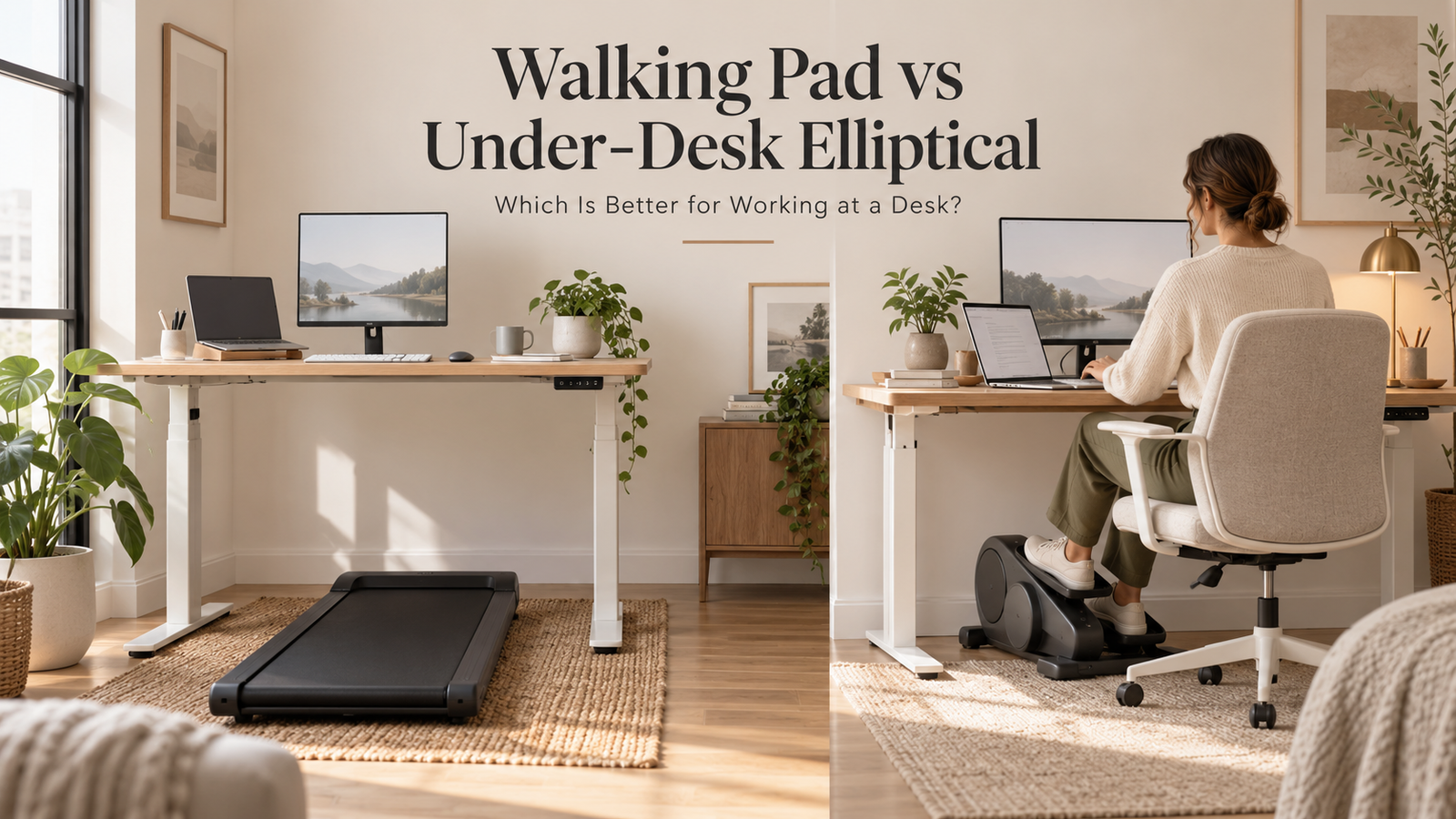
Choosing a walking pad vs under-desk elliptical starts with the workstation you already have. A walking pad requires a desk that reaches a comfortable standing height once you are on the machine, while a seated elliptical needs enough room for your moving legs and a chair that stays securely in position.
Both can bring movement into a workday, although the practical setup is quite different. A low drawer, narrow desk frame, or unsuitable chair may rule out an otherwise appealing machine before price or exercise features enter the decision.
If you already own a suitable height-adjustable desk and specifically want to walk during part of your working day, a walking pad is a natural starting point. If you intend to remain seated, an under-desk elliptical deserves consideration, provided the complete arrangement meets the manufacturer’s operating-space requirements.
About this comparison: We have not physically tested these machines. This article uses published manufacturer specifications and manuals, together with TQE’s own dimensional calculations and hypothetical workstation examples. The products discussed are US-market examples, and regional specifications or buying conditions may differ.
The Quick Answer: Which Format Fits Your Workday?
An under-desk elliptical may be the more convenient format if you want to keep your existing seated workstation. Before buying one, check the space beneath your desk, the highest position your knees reach while pedaling, and whether your chair stays stable throughout the movement.
A walking pad makes more sense when walking steps are your goal and your desk can accommodate your raised standing position. You will also need enough clear floor space to walk safely and somewhere to move the chair during those sessions.
The difference becomes clearer when you look at the workstation rather than the equipment alone.
| Your current setup or goal | Start with | Main fit question |
|---|---|---|
| Fixed seated desk with open legroom | Under-desk elliptical | Can your knees and thighs move freely? |
| Height-adjustable standing desk | Walking pad | Does the desk reach your comfortable walking-work height? |
| Frequent detailed mouse or keyboard work | Consider seated pedaling | Does moving affect your working posture or accuracy? |
| Increasing walking steps | Walking pad | Can you walk comfortably while doing your intended tasks? |
| Concern about repeated footstep impacts | Under-desk elliptical | Does the machine and chair remain stable without troublesome vibration? |
| Low drawers or very limited chair space | Measure both arrangements first | Can either meet the required clearances? |
These are starting points for choosing an equipment category. Your comfort, task requirements, and the manufacturer’s installation instructions determine whether the final setup is practical.
Two Real Models Make the Space Trade-Off Clearer
For a concrete comparison, we selected the UREVO SpaceWalk E1L (URTM041) and Sunny Health & Fitness SF-E3872 Magnetic Under Desk Elliptical.
Both manufacturers publish product dimensions and supporting documentation, allowing us to compare their physical sizes and examine the different space requirements of standing and seated movement.
The E1L is a low-profile motorized walking pad with a moving belt. The SF-E3872 is a manually operated seated elliptical with magnetic resistance. The Sunny model discussed here is the standard SF-E3872, rather than the SF-E3872SMART or a motorized pedal machine.
| Published measurement | UREVO SpaceWalk E1L | Sunny SF-E3872 |
|---|---|---|
| Overall dimensions (L × W × H) | 42.1 × 19.3 × 4.2 in | 24 × 19 × 11 in |
| Walking surface or pedal movement | 35.43 × 15 in walking belt | 7 in published stride length |
| Speed or resistance | 0.6–4 mph | Eight magnetic resistance levels |
| Published weight | 36.59 lb | 25 lb in specifications; 24.2 lb in FAQ |
| Moving-foot height information | Actual standing height on belt not confirmed here | Published pedal heights of 3.46–7.4 in |
Sources: UREVO SpaceWalk E1L product specifications, E1L V4.0 manual, and Sunny SF-E3872 product specifications.
Sunny’s published information contains two slightly different weight figures, so both are shown rather than selecting one without clarification.
The walking-belt dimensions describe the surface available for walking. The elliptical’s stride length describes part of the pedal motion, with the rider’s legs extending beyond the machine itself. For desk fit, the complete equipment dimensions and the position of the person using it are more useful than either movement measurement alone.
TQE Calculation: 44% Less Body Area, Almost the Same Width in These Two Models
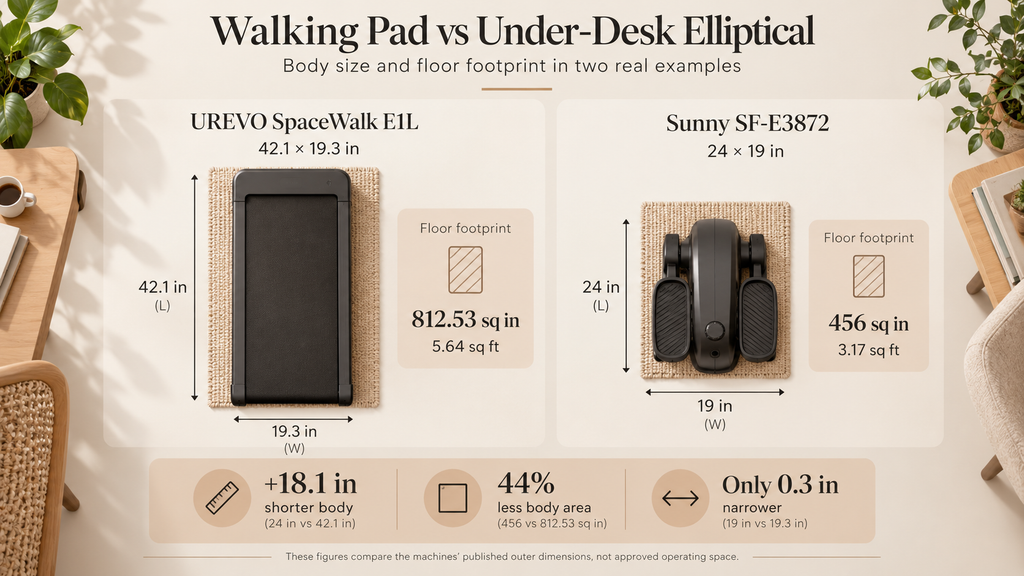
Using the manufacturers’ published inch dimensions, we calculated each machine’s body footprint as length multiplied by width.
UREVO SpaceWalk E1L
42.1 × 19.3 = 812.53 square inches, or approximately 5.64 square feet.
Sunny SF-E3872
24 × 19 = 456 square inches, or approximately 3.17 square feet.
The reduction in body area is:
(812.53 − 456) ÷ 812.53 × 100 = approximately 44%
The Sunny elliptical occupies about 44% less floor area than the E1L when comparing their published outer rectangles.
Most of that difference comes from length. The elliptical is 18.1 inches shorter, while its width is only 0.3 inches narrower.
That width difference has an interesting consequence for desk fit.
Imagine an opening between desk legs that measures exactly 20 inches wide. The E1L’s 19.3-inch body leaves just 0.7 inches in total, while the Sunny’s 19-inch body leaves 1 inch.
If the equipment were perfectly centered, those gaps would amount to approximately 0.35 inches and 0.5 inches per side.
The examples describe basic body clearance only. They exclude the additional room required for safe operation, movement, access, and nearby furniture.
The Sunny model therefore provides a substantially shorter body without creating much more space between narrow desk supports. That is one reason a compact product can still be difficult to accommodate beneath an existing workstation.
Why the Manufacturer’s Clearance Instructions Matter
Sunny’s SF-E3872 manual specifies at least 2 feet (60 cm) of free space all around the equipment.
That wording applies to the surrounding area as a whole, rather than only the front or rear. The manual does not provide an explicit exception for placing the machine beneath a desk with legs, supports, and a chair nearby.
This creates a practical buying question. The SF-E3872 is marketed for seated under-desk exercise, yet a tightly enclosed workstation may conflict with the clearance language in its manual.
If your desk cannot accommodate that stated clearance, ask Sunny to confirm whether your proposed layout is permitted before purchasing. The product’s compact body dimensions alone cannot resolve the conflict between its advertised use and installation instructions.
For the E1L, a complete numerical operating-clearance requirement for the exact URTM041 model was not verified in the documentation available for this comparison. Buyers planning a confined workstation should obtain the required front, rear, and side clearances from UREVO.
With those installation requirements established, the next useful measurement is the space your body occupies during movement.
Under-Desk Clearance Is a Three-Dimensional Problem
A desk can have enough floor space for an elliptical and still leave insufficient room for your legs to move.
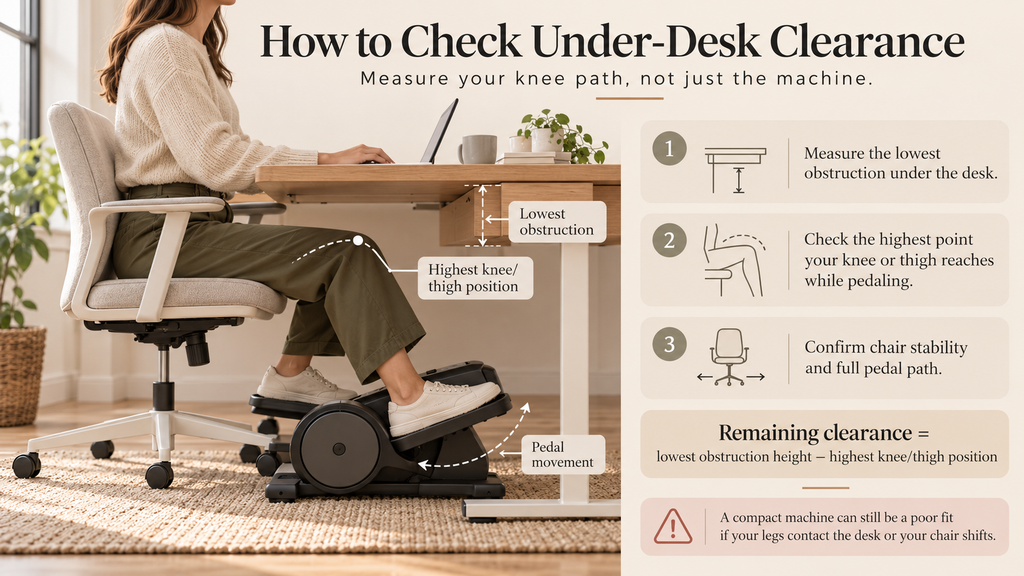
Start by measuring from the floor to the lowest obstruction above the intended pedaling area. A desk’s advertised height often refers to the top surface, while drawers, keyboard trays, reinforcing bars, or cable baskets may sit several inches lower.
Check the full area beneath the desk, including the back corners and any supports that divide the available space.
Then consider your seated position. The highest point reached by your knees and thighs depends on seat height, leg proportions, foot placement, pedal movement, and distance from the machine.
Pedal Height and Knee Height Are Different Measurements
Sunny publishes pedal step-height endpoints of 3.46 inches and 7.4 inches.
The difference is:
7.4 − 3.46 = 3.94 inches
That calculation describes the difference between the published pedal heights. Your knees move according to the geometry of your legs and the position of the pedals, so the 3.94-inch figure cannot be substituted directly for knee movement.
The machine’s 7-inch published stride length describes another part of the pedal path. It also cannot be added directly to your seated knee height to predict clearance.
For a practical personal measurement, use:
Remaining clearance = height of lowest obstruction − highest observed knee or thigh position
Consider a hypothetical workstation where the underside of a drawer sits 26 inches above the floor.
If the highest point of your knee during the intended movement reaches 25 inches, the remaining gap is:
26 − 25 = 1 inch
That example uses illustrative personal measurements rather than Sunny’s product specifications.
A small positive gap can disappear when you change posture, move your chair, or wear different footwear. If your knees or thighs contact the desk at any point, the arrangement needs modification.
Where possible, measure the full leg movement using an appropriate demonstration or an explicitly permitted fit trial. A cardboard model of the equipment footprint may help with floor planning, but it cannot reproduce the movement of your legs.
Depth Matters as Much as Height
Moving the elliptical farther away may alter the position of your knees, but it also changes your leg extension and the distance between your chair and desk.
You may gain clearance beneath a drawer while having to reach farther forward to type. Moving the chair closer again could reintroduce the original problem.
A practical arrangement should let you keep your back supported and your usual keyboard and mouse within comfortable reach.
Check the entire pedal path with both feet. Include shoe tips, thigh movement, the chair base, and obstructions farther beneath the desk.
A rear crossbar or cable tray can interfere with movement even when the front opening looks generous.
Chair Stability Is Part of the Equipment Setup
An under-desk elliptical depends on the chair beneath you.
A rolling office chair may move backward as you pedal, while a chair with a flexible base can rock or swivel. These movements can affect comfort, posture, and your ability to maintain a consistent working position.
Before buying, consider how your normal chair behaves when your feet push forward and downward.
A stable chair or a manufacturer-compatible method of preventing unwanted movement may help. Any restraint should also comply with the chair’s instructions and allow you to get up normally without obstructing the exit from your workspace.
Check how the elliptical fits around the chair’s wheels or legs. A short machine can still interfere with the position where your feet ordinarily rest.
The arrangement should remain comfortable for ordinary seated work after the elliptical is moved away.
A Walking Pad Needs Enough Desk Height
A walking pad creates a different workstation challenge.
When you step onto the moving deck, your standing position rises relative to the floor. Your desk must be able to move upward enough to preserve a comfortable keyboard and monitor arrangement.
The relevant measurement is the height of the surface beneath your feet while standing on the belt.
That may differ from the walking pad’s maximum overall height, particularly when a motor housing or another component rises above the deck.
For the E1L, the overall body height is approximately 4.2 inches, but the exact height of the occupied walking surface was not established for this comparison.
Measure that surface on the actual model or confirm it with the manufacturer before calculating the desk adjustment you need.
A Simple Desk-Height Example
Suppose your standing desk has only 2 inches of upward adjustment remaining when you stand comfortably on the floor.
If your chosen walking pad raises your standing position by 3 inches, the desk would need an additional inch of travel to maintain the same relative keyboard height.
That is a hypothetical example rather than a measurement of the E1L.
The same check applies to monitor height, mouse position, and cable routing. A desk that technically reaches the required height can still be uncomfortable if other parts of the workstation cannot be adjusted accordingly.
Once you have confirmed that walking fits your desk, our best walking pads for under a desk guide compares walking-surface dimensions, controls, portability, and everyday setup considerations.
Which One Works Better With Typing and Calls?
The type of work you do can influence which form of movement is more practical.
An under-desk elliptical preserves a seated working position, making it a reasonable option to consider for tasks involving frequent typing or mouse use. Pedaling may still affect posture, attention, and fine movements, particularly when resistance increases.
Walking creates more visible body movement relative to a stationary desk.
Reading documents or joining a less interactive meeting may be easier to combine with movement than detailed spreadsheet editing or work requiring precise cursor placement. Individual preferences and the pace of movement will affect that experience.
We have not measured productivity, typing accuracy, calorie expenditure, or health outcomes for these two models. This comparison focuses on workstation compatibility and the practical space required to use them.
If a demonstration is available, try representative tasks after becoming familiar with the equipment. Typing, selecting small screen elements, and speaking during a call can reveal whether the arrangement suits your routine.
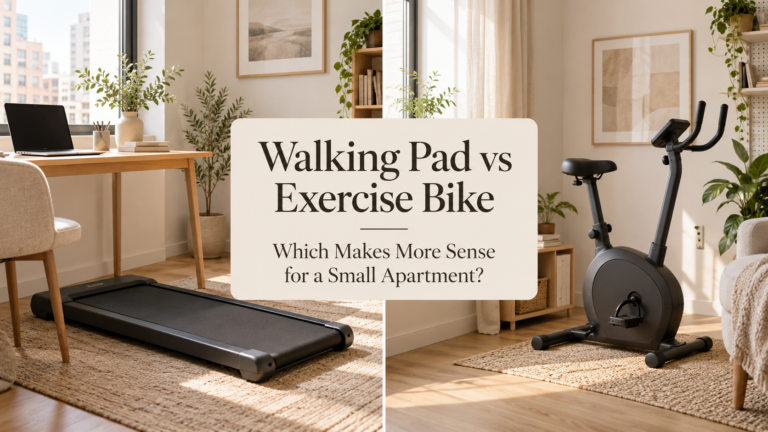
For readers comparing walking with a dedicated cycling workout rather than seated desk pedaling, our walking pad vs exercise bike comparison for small apartments covers that separate decision.
Noise and Floor Vibration During Work
A walking pad produces sound from its motor and moving belt, together with the impact of repeated footsteps.
An under-desk elliptical removes that walking-footfall pattern, making seated pedaling a reasonable option to consider where impact noise is a concern. Its pedals, bearings, resistance mechanism, and contact with the floor can still produce sound or vibration.
These observations describe differences in how the equipment operates. We do not have comparable loaded sound measurements for the E1L and SF-E3872, so there is no verified numerical noise advantage to assign to either model.
For video calls, listen to what the microphone captures during your normal tasks.
For apartments with neighbors below, consider floor vibration separately from sound in your own room. A microphone recording beside the desk cannot establish how vibration travels through the building.
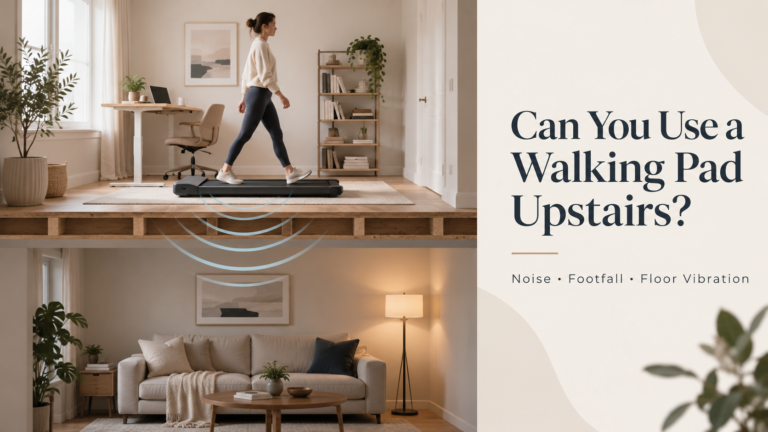
Our guide to using a walking pad upstairs explains the difference between motor noise, footsteps, and structure-borne vibration, along with practical placement checks.
Check the Floor Requirements
The E1L manual includes restrictions concerning direct placement on carpet and thick or soft cushioning. For a model-specific installation decision, follow the supplied manual and confirm any uncertainty about the intended floor or mat with UREVO.
Sunny’s manual calls for a solid, flat, level surface and describes using a protective floor covering.
A stable, permitted setup matters for both formats. If equipment rocks, scrapes, shifts unexpectedly, or develops unusual noises, stop and address the problem before continuing.
Storage: Shorter and Lower Offer Different Advantages
The SF-E3872 has a shorter body than the E1L, which may make it easier to store beside a desk or in a nearby closet.
The E1L is much lower. Its approximately 4.2-inch body height may suit certain under-bed or under-sofa spaces that cannot accommodate the Sunny’s 11-inch height.
For example, a hypothetical 6-inch-high opening provides enough vertical room for the E1L’s published body height but is too low for the Sunny model.
The E1L still needs sufficient storage length, width, and a workable route into that space.
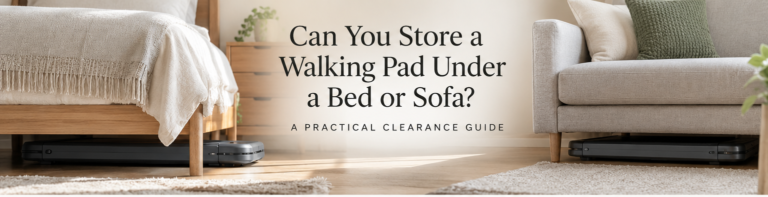
For the detailed measurement process, see our walking pad under-bed and sofa clearance guide, which explains how hidden furniture supports and handling space can change the result.
For either machine, think about what happens to your feet and furniture when the equipment is put away. Keeping a pedal unit permanently beneath a desk may reduce the space available for normal seated work, while using a walking pad requires somewhere to park the chair.
If you are considering standing exercise away from the desk, our walking pad vs mini stepper guide explains how a smaller footprint can come with greater storage height and different balance requirements.
Compare the Cost of the Complete Workstation
The least expensive machine may require the most changes to your current setup.
A walking pad could involve purchasing a height-adjustable desk, modifying the monitor position, or finding a suitable storage location.
An under-desk elliptical may work with your existing desk, but a different chair or more unobstructed legroom could be necessary.
A practical first-year budget can be calculated as:
First-year cost = equipment + delivery and tax + required furniture or accessories + maintenance and electricity + optional subscriptions
Only include purchases your intended arrangement actually requires. If your standing desk is already suitable, its additional cost is zero.
For current product details, see the UREVO SpaceWalk E1L and Sunny SF-E3872 manufacturer pages.
Prices, availability, and offers change, so compare current totals for your location and seller.
Check Return Conditions Before Buying for a Tight Desk
Desk-fit problems can be difficult to identify from product photographs alone.
Before ordering, check whether the seller permits an assembled trial, what condition the product must be in for a return, and who pays return shipping.
The UREVO return policy and Sunny return policy provide the relevant starting points. Warranty coverage and return eligibility should both be confirmed at the time of purchase.
Keep the original packaging until you understand those conditions, especially if you are buying for a desk with very little spare space.
A Practical Decision Flow Before Ordering
Start by measuring the feature most likely to limit your setup. For seated pedaling, that is often the underside of a drawer, the highest position of your knees or thighs, or the space around your chair. For walking, it is usually the desk’s available height adjustment, the clear area around the belt, or where the chair will go.
Next, check the manufacturer’s operating-space requirements for the exact model. Sunny’s SF-E3872 manual specifies 60 cm (2 feet) of clearance all around the machine, so confirm your proposed desk arrangement with Sunny if nearby furniture would encroach on that space.
Before ordering, review the current CPSC recalls and product safety warnings, or the equivalent authority in your country. Follow the manufacturer’s instructions for safe operation, including the SF-E3872’s seated-use requirement.
Once the workstation measurements and safety requirements are satisfied, compare the complete setup cost and consider how easily you can switch between exercise and ordinary work.
Final Verdict
For an existing seated desk, an under-desk elliptical is worth considering when your knees and thighs have sufficient room to move and your chair remains stable. The compact machine body can help with storage, although the surrounding-space requirements of a specific model may limit where it can be used.
For an adjustable standing desk, a walking pad is a practical choice when walking steps are your goal and the workstation can accommodate your elevated standing position. The available operating space and daily storage routine deserve as much attention as the machine’s dimensions.
Before purchasing either format, measure the desk’s lowest obstruction, the chair’s position, and the available height adjustment. Those three checks will help identify which type of equipment deserves a closer look in your actual workspace.