
A walking pad can physically fit underneath a standing desk and still be frustrating to use while you work.
The machine might be too heavy to move every morning. The walking belt might feel cramped. The controls may interrupt your workflow. Or the deck may raise your standing position enough that your desk no longer reaches a comfortable typing height.
So when choosing the best walking pad for under a desk, we think the useful question is not simply:
“Will it fit underneath?”
It’s:
“Will I actually want to set this up and use it during a normal workday?”
For this guide, we looked at walking-area size, overall dimensions, product weight, controls, published noise information, storage design, and how each machine fits into a working routine.
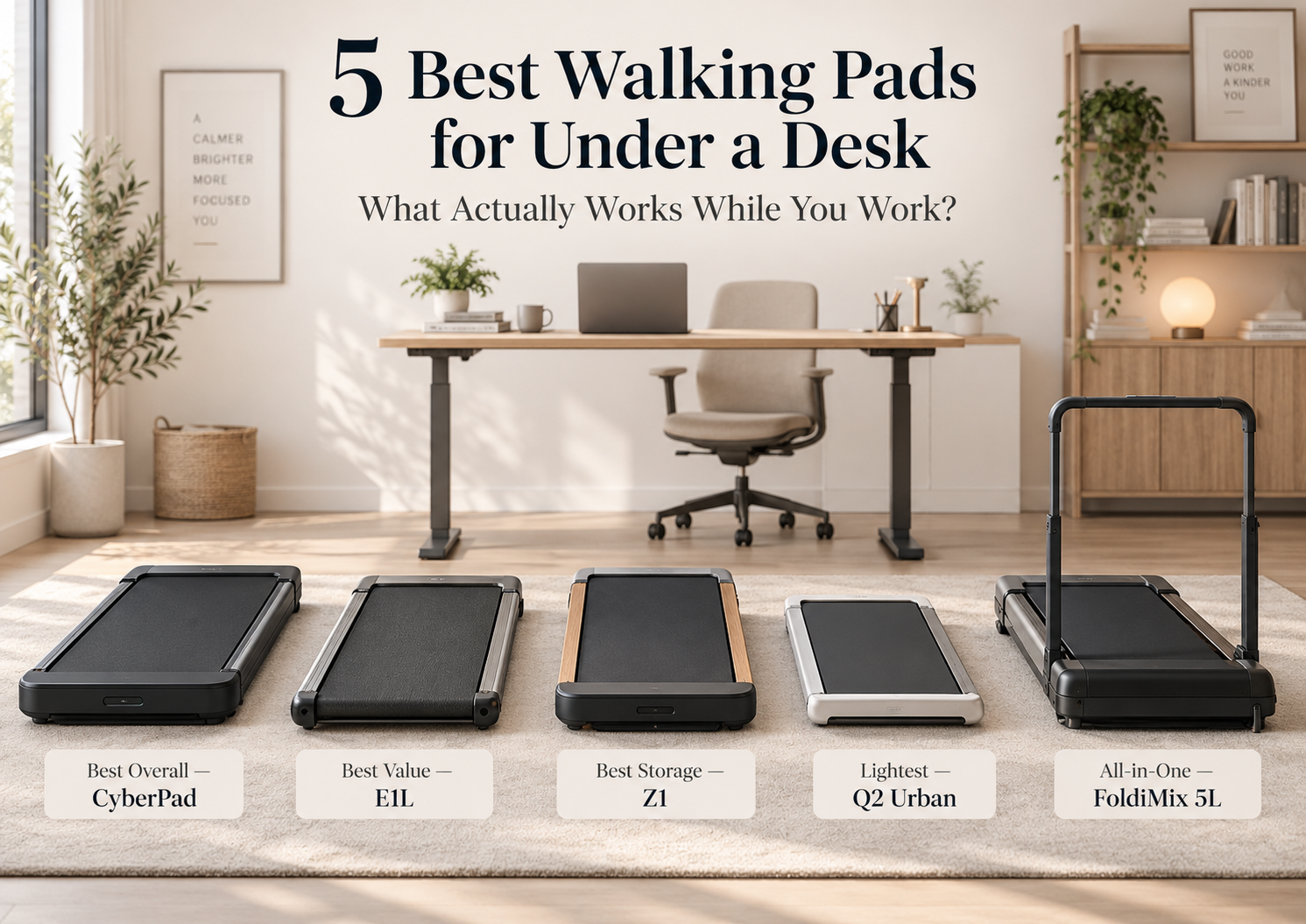
Quick answer: The UREVO CyberPad for Office is our best overall under-desk pick because it combines a 39.4 × 16.5-inch walking area, 400-pound published capacity, 4 mph maximum speed, and a manufacturer-rated 35 dB dual-brushless-motor system. The UREVO SpaceWalk E1L is our compact value choice, while the WalkingPad Z1 is the standout if folding storage matters most.
How we chose: We have not personally tested these walking pads. Our selections are based on current manufacturer specifications, pricing, dimensions, controls, published noise information, storage design, and the practical implications of those differences for working at a standing desk. Specifications and prices were checked September 20, 2026 and may change.
Disclosure: This article contains affiliate links. If you purchase through these links, we may earn a commission at no additional cost to you. As an Amazon Associate I earn from qualifying purchases.
The Best Under-Desk Walking Pads at a Glance
| Model | Best for | Walking area | Weight | Top speed | Current price* |
|---|---|---|---|---|---|
| UREVO CyberPad for Office | Best overall | 39.4 × 16.5 in | 63.1 lb | 4 mph | $409.99 checkout |
| UREVO SpaceWalk E1L | Best compact value | 35.43 × 15 in | 36.59 lb | 4 mph | $139.99 |
| WalkingPad Z1 | Best folding storage | 47.6 × 15.7 in | 51 lb | 4 mph | $299 |
| DeerRun Q2 Urban | Best lightweight/incline value | 35.43 × 14.96 in | 35.05 lb | 3.8 mph | $119–139 |
| UREVO FoldiMix 5L | Best all-in-one workstation | 39.4 × 15.8 in | 65.3 lb | 7.6 mph | $349.99 |
*Manufacturer pricing checked September 20, 2026. Promotions, colors, and pre-order status can change.
UREVO currently lists the CyberPad for Office at a $409.99 checkout price and the E1L at $139.99. WalkingPad lists the Z1 at $299. DeerRun’s Q2 Urban currently varies from $119 to $139 by color, while the FoldiMix 5L is listed at $349.99.
1. UREVO CyberPad for Office
Best Overall for Under-Desk Walking
The UREVO CyberPad for Office is the most purpose-built conventional under-desk model in this group.
Its walking surface measures 39.4 × 16.5 inches, giving you noticeably more width than ultra-compact models such as the E1L or Q2 Urban.
UREVO also rates it for up to 400 pounds and 4 mph.
But the specification that matters most during actual work may be noise.
UREVO says its dual brushless motors achieved approximately 35 dB under its laboratory testing conditions.
That doesn’t tell us exactly how much footfall or floor vibration your coworker or downstairs neighbor will hear, but it is one of the stronger explicit machine-noise claims among current office-focused walking pads.
The CyberPad also includes up to 14% automatic incline.
That gives it far more workout range than a conventional flat desk pad, although we’d probably keep the incline modest while actually typing.
The downside is portability.
At 63.1 pounds, this is not a machine we’d want to carry around the room twice a day.
The catch: heavier and taller than basic under-desk pads.
Our take: If your walking pad will mostly stay around your workstation, the CyberPad offers the strongest combination of walking room, capacity, quiet-motor claims, and work-focused design.
2. UREVO SpaceWalk E1L
Best Compact Value
The SpaceWalk E1L takes almost the opposite approach.
It keeps everything simple.
The machine measures 42.1 × 19.3 × 4.2 inches, weighs 36.59 pounds, supports up to 265 pounds, and reaches 4 mph.
Current US price is just $139.99.
That makes the E1L especially appealing if your walking pad won’t permanently live under the desk.
At the end of your workday, you can use its transport wheels to move it away and slide it under suitable furniture.
The 36.6-pound weight makes that daily routine much less annoying than moving a 60-plus-pound machine.
Its compromise is the walking surface.
At 35.43 × 15 inches, the belt is much shorter than the WalkingPad Z1’s 47.6-inch walking area.
For slow, straight-ahead desk walking, that may be perfectly adequate.
For users with longer strides, it deserves more attention.
The catch: shorter walking belt and no incline.
Our take: The E1L is one of the easiest walking pads here to integrate into a workday if you value low price, low weight, and easy storage over maximum belt space.
Want a closer look at UREVO’s compact models? See our SpaceWalk E1L vs E4W comparison.
3. WalkingPad Z1
Best for Folding Storage
The WalkingPad Z1 solves a problem the E1L and CyberPad don’t.
It folds.
The Z1 measures 56.1 inches long while open, but its deck folds down to just 31.8 inches long for storage.
That makes it unusually useful when you want a long walking surface during the workday but don’t have 50-plus inches of uninterrupted storage space afterwards.
The walking area is 47.6 × 15.7 inches, the longest in this group.
That gives you substantially more front-to-back room than most low-cost under-desk pads.
Top speed is 4 mph, product weight is 51 pounds, and the Z1 supports app and remote control. Current direct price is $299.
WalkingPad itself currently positions the Z1 as its strongest overall workday under-desk option, specifically highlighting its belt length and folding design.
The trade-off is setup.
A rigid pad can simply roll out from underneath furniture.
The Z1 has to unfold before use.
That’s not exactly a major engineering operation, but every extra step matters if you’re trying to build a habit you repeat five days a week.
The catch: larger while in use and requires unfolding.
Our take: The Z1 makes the most sense when walking comfort and compact storage are both important.
4. DeerRun Q2 Urban
Best Lightweight Option with Incline
The DeerRun Q2 Urban is the lightest machine in this comparison at just 35.05 pounds.
It also measures only 3.94 inches high, making it one of the lowest-profile designs here.
For a workday routine, that’s useful.
A walking pad that is slightly worse on paper but easy to pull out every morning may get used far more than a premium machine that feels like furniture relocation.
The Q2 Urban also includes something unusual around its price:
7% manual incline.
DeerRun rates it for 0.6–3.8 mph, 300 pounds, and publishes a brushless-motor claim below 45 dB.
Current pricing ranges from around $119 to $139 depending on color and promotion.
There is one important practical point with the incline.
Because it is manual, you don’t dynamically change the slope from the remote while working.
For some people, that’s actually fine.
Set it once, start working, forget about it.
The catch: short 35.43-inch walking belt and fixed manual incline.
Our take: If you expect to move the machine constantly and like the idea of adding incline without spending much money, the Q2 Urban is extremely compelling.
Working with a tighter budget? See our best walking pads under $200.
5. UREVO FoldiMix 5L
Best All-in-One Walking Workstation
The UREVO FoldiMix 5L is technically a different proposition.
Instead of asking you to bring your own standing desk, it integrates the work surface into the treadmill.
UREVO gives the desk eight height settings and up to 9.06 inches of adjustment.
The machine also includes a 39.4 × 15.8-inch running area, 400-pound published capacity, 0–9% automatic incline, and speeds up to 7.6 mph in workout mode. UREVO.US
That means it can function as:
- walking workstation
- incline walking machine
- brisk-walking treadmill
- light-running treadmill
without requiring a separate adjustable desk.
That’s a very different value proposition from a $140 E1L.
The downside is obvious.
It weighs 65.3 pounds, and while folded it still measures approximately 52.4 × 24.6 × 6.1 inches. UREVO.US
So this is closer to a semi-permanent piece of home-office equipment.
The catch: big and heavy compared with a conventional walking pad.
Our take: The FoldiMix makes sense if you’re building the workstation around the treadmill rather than trying to slip a walking pad underneath an existing desk.
Want more workout capability while you work? See our guide to the best walking pads with incline.
The Desk-Fit Trap: “Under Desk” Doesn’t Mean Your Desk Fits You
This is the part I really want to keep in this article.
Most product pages tell you the walking pad’s overall height.
They rarely tell you the exact height of the walking surface under your feet.
Those are not necessarily the same measurement.
The front motor housing may sit higher than the belt itself.
That means we cannot responsibly say:
“A 4.2-inch walking pad means your desk must rise exactly 4.2 inches.”
But the practical issue is still real.
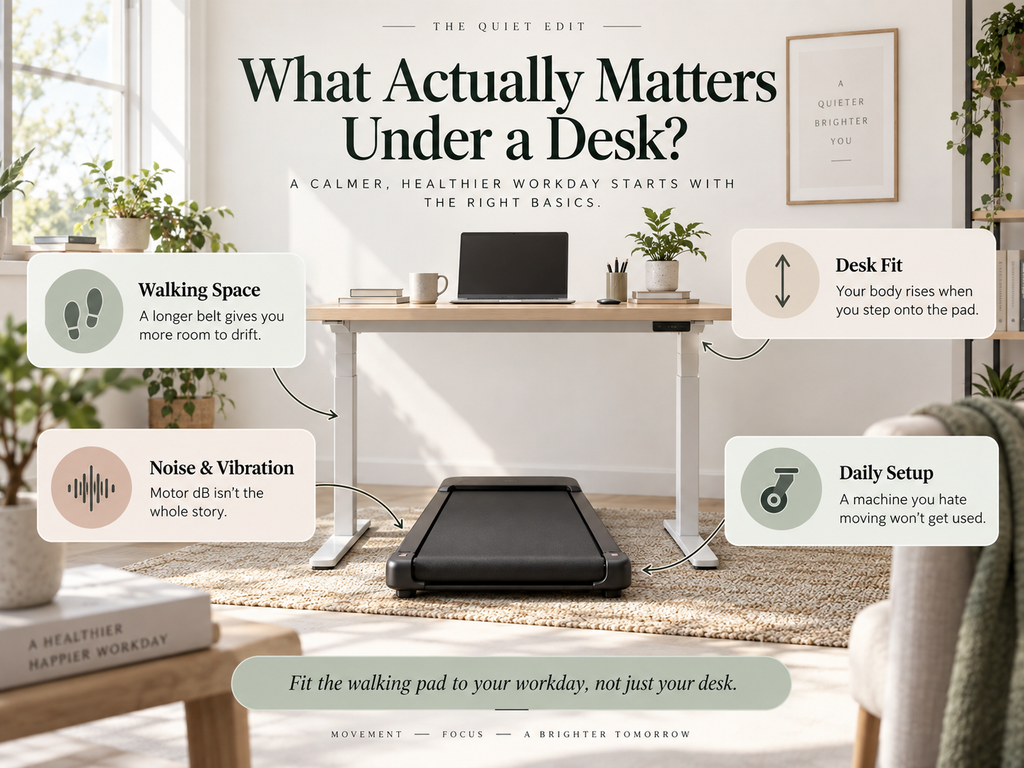
When you step onto any walking pad, your entire body rises above its normal floor-standing position.
Your keyboard, mouse, and monitor need to rise with you.
So before buying a walking pad, check:
- your current comfortable standing-desk height
- your desk’s maximum height
- whether it has enough remaining adjustment once you’re standing on the walking surface
This matters particularly for taller users.
A walking pad may fit perfectly under the desk while leaving the desk itself too low for comfortable typing.
That’s a buying problem most “under-desk compatible” labels don’t answer.
If you’re considering Egofit specifically, our M1 vs M1T comparison shows how much extra size a folding handrail adds to an otherwise compact desk treadmill.
Under-Desk Walking Pad Size Comparison
A useful way to think about these machines is to separate workday footprint from after-work storage.
| Model | Workday advantage | After-work advantage |
|---|---|---|
| CyberPad for Office | Wider 16.5-in belt | Limited, heavy |
| SpaceWalk E1L | Short overall body | Light + easy to roll |
| WalkingPad Z1 | Longest walking area | Folds to 31.8 in |
| Q2 Urban | Lowest/lightest | Very easy to move |
| FoldiMix 5L | Built-in desk | More permanent setup |
That’s why there isn’t one universal “most compact” under-desk treadmill.
The smallest machine during use and the easiest machine to store may be completely different products.
What Matters Most While You’re Actually Working?
A spec sheet can tell you whether a machine fits.
It can’t tell you whether the setup will annoy you every Tuesday morning.
For desk use, we’d prioritize four things.
1. Low-speed control
Typing and walking at the same time usually calls for lower speeds than dedicated exercise.
All the conventional pads here start around 0.6–1 mph, making slow walking possible.
The important part is easy adjustment.
Remote and app controls mean you don’t need to bend down beneath the desk whenever your pace changes.
2. Walking area
Tiny belts save space.
They also give you less room to drift while your eyes are on a screen.
Compare:
E1L / Q2 Urban
→ about 35.4 inches long
CyberPad
→ 39.4 inches
Z1
→ 47.6 inches
That is more than a foot of difference between the shortest and longest options.
If you’re a naturally long-stride walker, belt length deserves more weight than marketing terms like “office ready.”
3. Noise and vibration
Motor noise matters during calls.
Footfall and floor vibration matter to everyone around you.
CyberPad’s 35 dB figure and DeerRun’s sub-45 dB motor claim are useful manufacturer references, but they are not standardized cross-brand measurements.
Hard flooring, user weight, shoes, speed, and an appropriate treadmill mat can all change the real-world result.
So we’d use manufacturer dB numbers as context, not a definitive leaderboard.
4. Daily setup friction
This one never appears on spec sheets.
Imagine using the walking pad 200 workdays a year.
A setup that takes an extra three minutes to pull out, unfold, reposition, and put away would cost you roughly:
3 minutes × 200 days = 600 minutes
That’s 10 hours a year of setup.
That’s just an illustrative calculation, not a measured difference between these five machines.
But it shows why “easy enough to use every day” can matter more than winning one specification.
A walking pad only helps your work routine if getting it into position isn’t a tiny daily tax.
Don’t forget what’s underneath the machine: our walking pad mat guide explains how to size one without wasting desk space.
TQE Under-Desk Decision Matrix
| Your work setup | Start with |
|---|---|
| Walking pad stays near the desk permanently | UREVO CyberPad for Office |
| I want the cheapest simple setup | UREVO SpaceWalk E1L |
| I need long stride room + compact storage | WalkingPad Z1 |
| I move the walking pad every day | DeerRun Q2 Urban |
| I don’t already own a standing desk | UREVO FoldiMix 5L |
| Quiet apartment use is my priority | CyberPad, then read our quiet guide |
| I’m tall / have a long stride | WalkingPad Z1 |
Which Walking Pad Should You Buy for Under a Desk?
For a dedicated work-from-home setup, we’d start with the UREVO CyberPad for Office.
It was designed around desk use, provides a relatively wide walking area, supports up to 400 pounds, and has one of the strongest manufacturer-published low-noise claims in the category.
If you want something much cheaper and easier to move, choose the UREVO SpaceWalk E1L.
If your room doesn’t have space to store a full-length pad after work, the WalkingPad Z1 is the most interesting solution because its long walking deck folds down dramatically.
The DeerRun Q2 Urban makes more sense if low weight, price, and incline matter most.
And if you’re starting from scratch without an existing standing desk, the FoldiMix 5L may be simpler than trying to build a workstation around a separate walking pad.
The most important question isn’t:
“Will this fit under my desk?”
It’s:
“Will this fit into the way I actually work?”
Frequently Asked Questions
What is the best walking pad for under a desk?
For a dedicated workstation, our current overall pick is the UREVO CyberPad for Office. It provides a 39.4 × 16.5-inch walking area, 400-pound published capacity, 4 mph maximum speed, and UREVO reports approximately 35 dB motor operation under its laboratory conditions.
How fast should you walk while working at a desk?
There is no universal ideal speed. Walking while typing generally favors slower speeds than dedicated exercise. All conventional walking pads in this guide support low-speed walking around 1 mph or below.
Can any walking pad go under a standing desk?
Not necessarily. Check the walking pad’s overall dimensions, your desk’s leg/frame layout, and whether the standing desk can rise high enough to maintain a comfortable typing position while you’re elevated on the walking surface.
Is a longer walking belt better for desk walking?
It can provide more front-to-back margin while your attention is on the computer. The WalkingPad Z1 offers a 47.6-inch walking area, compared with around 35.4 inches on the E1L and Q2 Urban.
Do you need a special standing desk for a walking pad?
Usually not, provided your desk has enough clearance and height adjustment. However, all-in-one products such as the UREVO FoldiMix 5L integrate their own adjustable work surface.
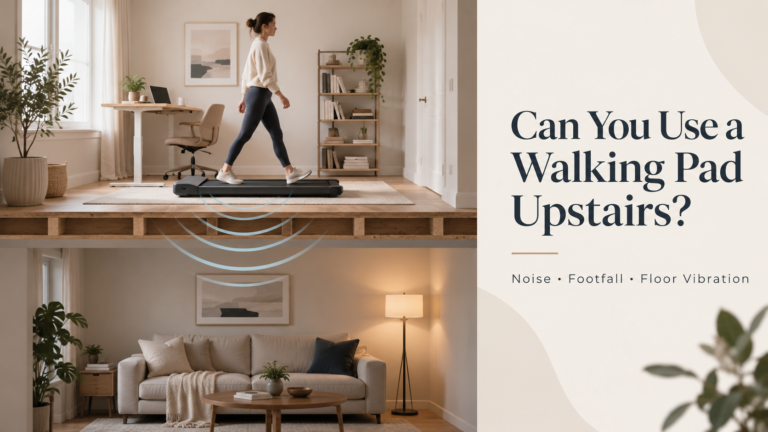
Are under-desk walking pads noisy?
They can be relatively quiet at low walking speeds, but motor noise is only one component. Footsteps and floor vibration can also matter, particularly in apartments and shared offices.