
The Egofit M1 and M1T share far more than their names suggest.
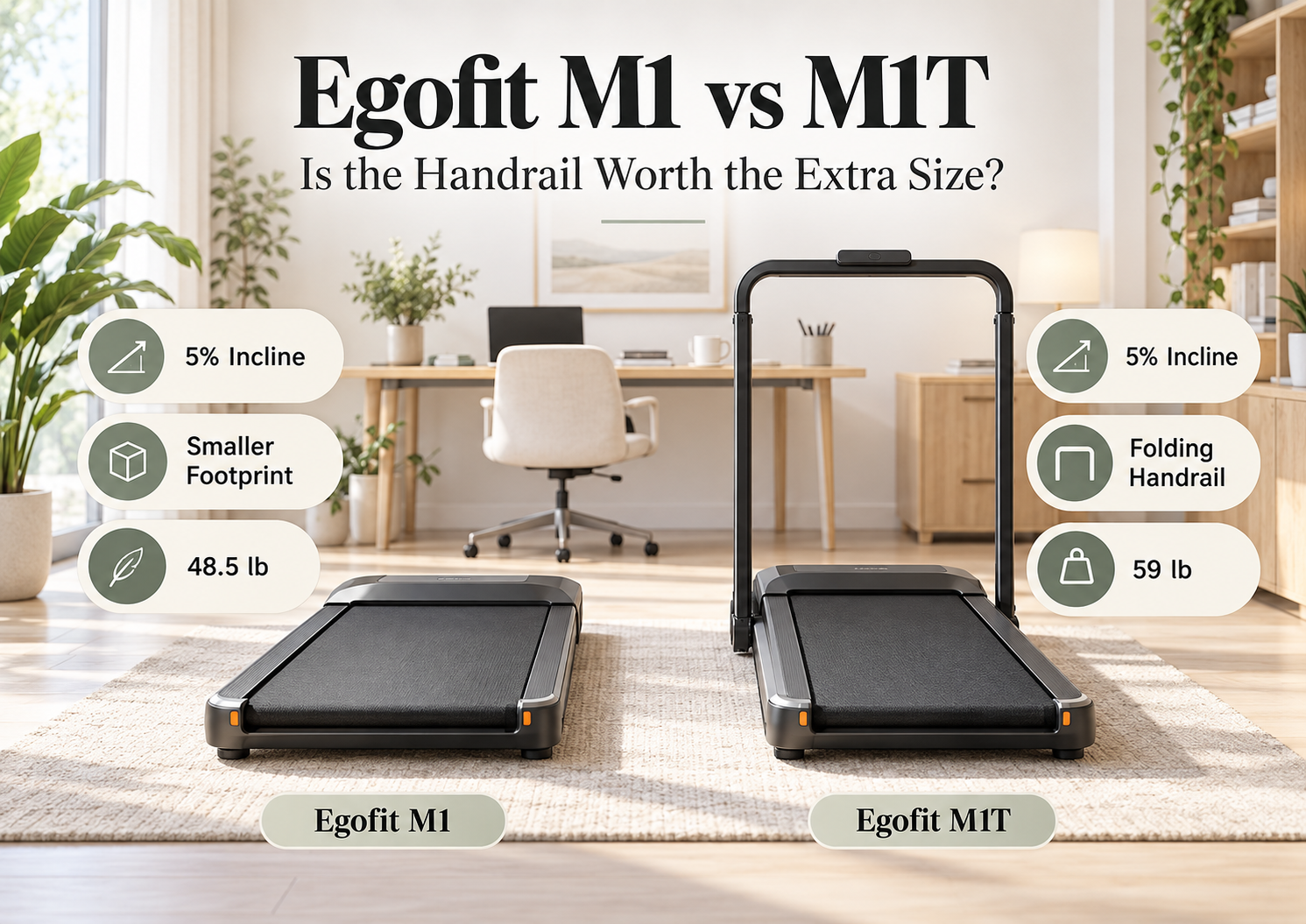
Both use the same 5% fixed incline. Both have the same 34.25 × 16.54-inch walking area. Both use a 2.0 HP motor, support up to 220 pounds on Egofit’s current product pages, and work at under-desk speeds up to roughly 3.1 mph.
The M1T’s reason for existing is much simpler:
it adds a folding handrail.
Raise that rail and you also unlock a slightly higher 3.73 mph speed limit, plus a safety key. Fold it down and the M1T returns to under-desk mode.
So the real question isn’t whether the M1T is the more capable machine.
It is.
The question is whether that extra capability is worth making an unusually compact walking pad noticeably bigger and heavier.
For many desk-only users, we’d stick with the M1.
If you genuinely expect to use the handrail or want one machine that can switch between desk walking and slightly faster unsupported-workout sessions, the M1T earns its extra bulk.
We have not personally tested either treadmill. This comparison uses Egofit’s current published specifications and original calculations based on those dimensions.
M1 vs M1T at a Glance
| Egofit M1 | Egofit M1T | |
|---|---|---|
| Main idea | Minimal under-desk walking | Under-desk + folding handrail |
| Incline | 5% fixed | 5% fixed |
| Walking area | 34.25 × 16.54 in | 34.25 × 16.54 in |
| Top speed, desk mode | 3.11 mph | 3.11 mph |
| Top speed, rail raised | — | 3.73 mph |
| Weight capacity | 220 lb | 220 lb |
| Machine weight | 48.5 lb | 59 lb |
| Dimensions, rail down | 38.39 × 21.85 × 6.89 in | 40.55 × 26.18 × 6.89 in |
| Handrail | No | Foldable |
| Safety key | No rail system | Yes |
| App / remote | Yes | Yes |
Current Egofit product pages publish these specifications.
The Walking Experience Is More Similar Than You Might Expect
If you looked only at the names, you might expect the M1T to have a larger belt or stronger core hardware.
It doesn’t.
Both use the same 34.25 × 16.54-inch walking area, the same 2.0 HP motor rating, the same 5% fixed incline, and the same current 220-pound published user limit.
That matters because it makes this comparison unusually clean.
The M1T doesn’t buy you more stride room.
It doesn’t buy you a gentler incline.
It doesn’t even increase the normal under-desk speed.
When the rail is folded down, both top out around 3.11 mph.
So if you intend to put the machine under a standing desk and leave it there, the M1T gives you surprisingly little functional advantage.
The M1 remains the cleaner tool for that job.
The Handrail Changes What the M1T Can Do Away From the Desk
Raise the M1T’s folding handrail and its speed ceiling increases to 3.73 mph.
Egofit describes this as a walking/jogging mode and pairs the rail with a safety key.
3.73 mph still isn’t what we’d consider serious running-treadmill territory.
But it’s enough to change the role of the machine.
The M1 is essentially committed to:
desk walking → casual walking → desk walking again.
The M1T can move between:
under-desk walking → rail-up dedicated exercise → back under the desk.
That’s a subtle difference, but it’s probably the strongest reason to spend more on the M1T.
If your walking pad will only ever be an office accessory, the rail is mostly extra hardware.
If you expect it to double as your compact home exercise machine after work, it starts making more sense.
Want to see how other rail designs change a walking pad? See our guide to the best walking pads with handrails.
The Price of the Handrail Is Floor Space
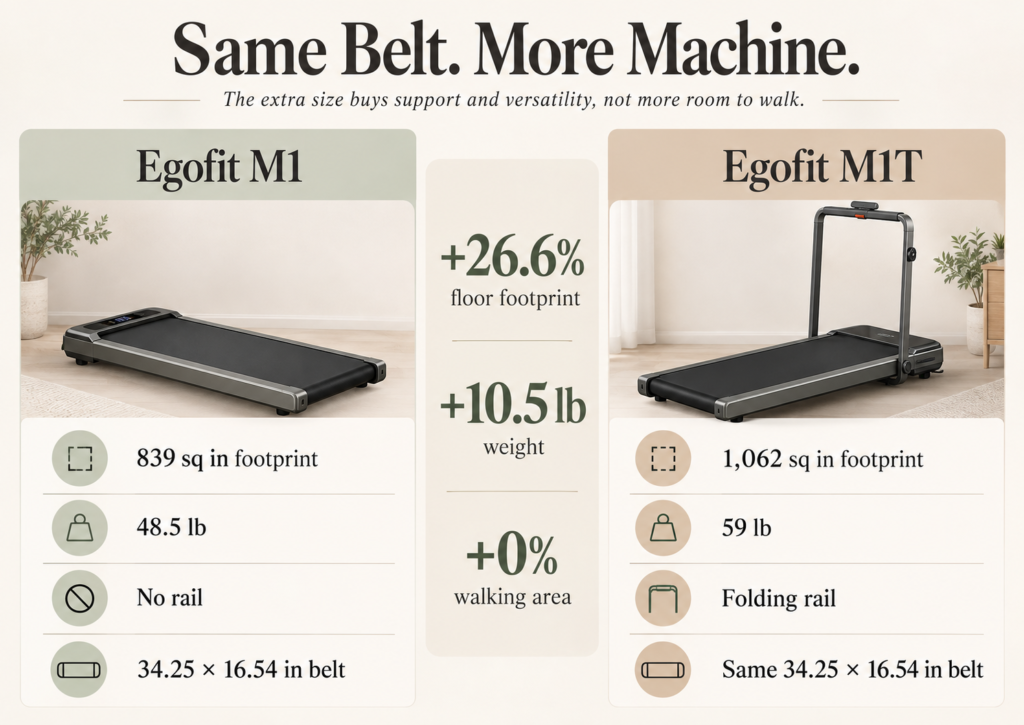
Here’s the difference that isn’t obvious from product photos.
Using Egofit’s published length and width:
M1
38.39 × 21.85 in
≈ 839 sq in
M1T, handrail folded
40.55 × 26.18 in
≈ 1,062 sq in
That makes the M1T’s floor footprint roughly 26.6% larger.
And remember, the walking belt itself is exactly the same size.
So almost none of that extra footprint becomes extra walking room.
It goes into the wider support structure and handrail hardware.
That’s the opposite of what we found in our M1 vs M2 comparison, where the larger M2 translated most of its extra dimensions into a larger walking surface.
Here, the additional machine exists primarily to support an additional feature.
M1 → less machine around the same belt.
M1T → more structure around the same belt.
For a genuinely small office, that’s probably the most useful distinction between them.
If every inch matters in your room, see our best walking pads for small apartments.
The M1T Is Also About 22% Heavier
The M1 weighs 48.5 pounds.
The M1T weighs 59 pounds.
That’s an extra 10.5 pounds, or about 21.6% more machine weight.
Both use transport wheels, so this won’t feel like carrying an extra ten pounds in your arms every time you reposition them.
But small walking pads tend to get rotated, pulled sideways, pushed underneath furniture, and navigated around desk legs.
That’s where extra mass starts to matter.
If your routine is:
pull it out every morning → work → put it away every evening
the M1 has the more appealing numbers.
If the treadmill mostly stays in one place, the difference matters much less.
Both Keep the 5% Fixed Incline
One reason the M1T is more interesting than many generic 2-in-1 treadmills is that Egofit kept the 5% fixed incline.
The M1 uses the same incline.
There is no adjustment mechanism.
Every session happens at the same grade.
That keeps the machines relatively simple and distinguishes them from flat under-desk pads, but it also means neither is ideal if you specifically want to vary incline during a workout.
The choice between these two is therefore not really about incline at all.
It’s about whether you want support above the deck.
If adjustable incline matters more than the rail, compare our best walking pads with incline.
One Specification Needs a Small Warning Label
Egofit’s own older M1 vs M1T article lists the M1T at approximately 55 lb and 242 lb user capacity.
The current M1T product page, however, lists:
- 59 lb machine weight
- 220 lb maximum user weight
For this article, we’d use the current product-page figures.
This is worth mentioning because old reviews or comparison pages may still repeat the older 242-pound number.
For something as important as user capacity, always verify the current specification for the exact model you’re buying rather than relying on an older article.
That’s also why we wouldn’t position the M1T as the better option for higher-weight users.
According to Egofit’s current listings, capacity is a tie.
What Are You Actually Paying For?
Egofit’s individual US product pages currently show the M1 at $399 and M1T at $459, although Egofit’s collection pages have recently displayed lower “From” pricing for both models.
Because Egofit’s own pricing changes between pages and promotions, we’d avoid anchoring the buying decision to a fixed $60 difference.
Instead, look at what the upgrade actually consists of:
M1T adds
- folding handrail
- safety key
- 3.73 mph rail-up speed
- two-mode usage
M1T does not add
- longer walking belt
- wider walking belt
- more incline
- higher current published capacity
- more under-desk speed
That’s a useful way to judge whatever the live price difference happens to be when you’re buying.
The M1 Makes More Sense for a Dedicated Walking Desk
For a standing-desk setup, we’d choose the M1 unless there’s a specific reason you want the rail.
It’s shorter.
It’s narrower.
It’s lighter.
And it provides exactly the same walking surface and normal desk-mode speed as the M1T.
That makes it the more focused product.
There’s less machine surrounding the task you actually bought it for.
For more desk-focused options, see our guide to the best walking pads for under a desk.
The M1T Makes More Sense If Your Walking Pad Has a Second Job
The M1T becomes worthwhile when the treadmill doesn’t stop being useful after the laptop closes.
The rail gives you something to hold during dedicated walking, raises the available speed slightly, and brings a safety-key system into the design. Egofit lets you fold the handrail down again when it’s time to use the machine under a standing desk.
That versatility is what you’re buying.
Not a larger walking surface.
Not a stronger incline.
A second way to use the same basic platform.
Which One Would We Choose?
For most people searching specifically for an under-desk treadmill, the Egofit M1 is the more logical choice.
It keeps the core experience of the M1T while saving roughly:
- 26.6% of horizontal floor footprint
- 10.5 lb of machine weight
without giving up belt size, incline, normal desk speed, or current published weight capacity.
Choose the M1T when the handrail solves an actual problem for you.
Maybe you prefer having support during dedicated walking.
Maybe multiple people will use the treadmill differently.
Maybe you want your desk treadmill to double as your only compact exercise machine.
Those are good reasons to accept more hardware.
Buying the M1T simply because “T must mean better” isn’t.
The upgrade is very specific:
M1 keeps the treadmill out of your way.
M1T gives the treadmill another job.
If you’re deciding between compactness and cushioning instead, our Egofit M1 vs M2 comparison looks at a very different Egofit trade-off.
Already own one of these models? Our walking pad maintenance guide compares Egofit’s published care guidance, including the current 40-hour and 50-hour lubrication discrepancy.
FAQ
Does the Egofit M1T have a bigger walking belt than the M1?
No. Egofit’s current specifications list both at 34.25 × 16.54 inches.
Does the M1T have more incline?
No. Both use a fixed 5% incline.
Is the M1T faster?
Only with the handrail raised. Under-desk mode tops out at approximately 3.11 mph, while rail-up mode reaches 3.73 mph.
Can the M1T still be used under a desk?
Yes. Egofit specifically designs the handrail to fold down for under-desk use.
Does the M1T support more weight?
Not according to Egofit’s current product pages. Both are presently listed at 220 pounds. An older Egofit comparison article lists a higher figure for the M1T, which appears inconsistent with the current listing.