
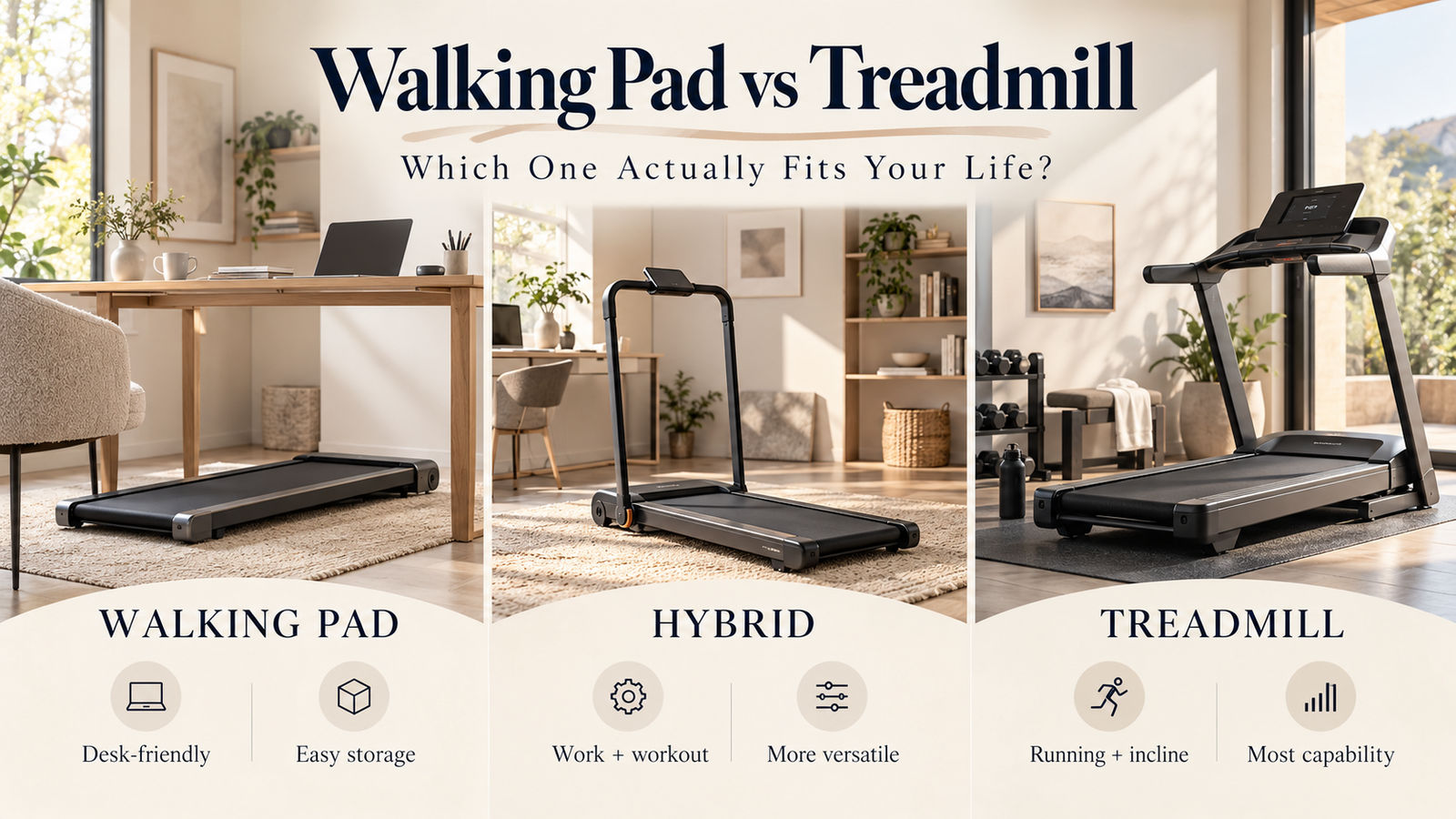
A walking pad and a treadmill can both move a belt underneath your feet.
That’s where the simple comparison ends.
A walking pad is usually designed to fit movement into the rest of your day.
A treadmill is usually designed to make the workout itself the main event.
That difference affects almost everything else: speed, handrails, belt size, incline, storage, noise, weight, and even how likely you are to use the machine on a random Tuesday afternoon.
So instead of asking whether a walking pad or treadmill is objectively better, start with a more useful question:
Disclosure: This article contains affiliate links. If you purchase through these links, we may earn a commission at no additional cost to you. As an Amazon Associate I earn from qualifying purchases.
Are you trying to add movement to your existing routine, or build a dedicated workout routine?
If the answer is “I want to walk while working, watching TV, or between other things,” a walking pad usually makes more sense.
If the answer includes jogging, running, steep incline training, intervals, or deliberately setting aside time to exercise, a treadmill gives you substantially more room to grow.
And if you’re somewhere in between, today’s hybrid machines make the boundary surprisingly blurry.
About this comparison: We have not personally tested every format discussed here. This article combines current manufacturer specifications with editorial analysis of how space, speed, storage, controls, and machine design affect everyday use.
Start With the Problem You’re Actually Trying to Solve
Here’s the short version.
| If you mainly want to… | Start with |
|---|---|
| Walk while working | Walking pad |
| Add more casual daily movement | Walking pad |
| Store the machine under furniture | Walking pad |
| Walk and occasionally jog | Hybrid treadmill |
| Run regularly | Treadmill |
| Train with steep automatic incline | Treadmill |
| Have handrails at higher speeds | Hybrid or treadmill |
| Own one machine for work + workouts | Hybrid treadmill |
WalkingPad’s current product range illustrates the distinction clearly.
Its standard walking pads typically top out around 3.7–4 mph, while hybrid models add foldable handrails and speeds around 7.5 mph. Its dedicated running treadmills go considerably further, with current models reaching up to 11.5 mph.
That’s not just a difference in motor power.
It changes what the machine is for.
The Real Difference Isn’t Size. It’s Commitment.
Walking pads are often described as “small treadmills.”
That’s technically understandable, but it misses the most important distinction.
A walking pad can disappear into another activity.
You can answer email, watch a show, read, take a call, or spend twenty minutes moving without mentally declaring:
“I am now exercising.”
That’s its superpower.
A treadmill asks more from you.
Even a compact folding model usually means raising a handrail, stepping onto a larger deck, choosing a workout speed, and giving the machine more of your attention.
That’s not a disadvantage if training is the point.
In fact, it’s exactly why treadmills are better at things walking pads usually aren’t designed to do.
The mistake is buying the wrong type of commitment.
A $300 walking pad that quietly lives under your desk can be more useful than a $1,500 treadmill you rarely unfold.
A full treadmill can be vastly more useful than a walking pad if six months later you realize you actually wanted to run.
Three Machines Show the Spectrum Better Than Marketing Labels Do
Rather than treating “walking pad” and “treadmill” as two sealed boxes, look at three current machines.
Egofit M1: movement built around work
The Egofit Walker Pro M1 is unmistakably a walking-focused machine.
It measures only 38.39 × 21.85 inches, weighs 48.5 pounds, reaches about 3.11 mph, and uses a fixed 5% incline. Its walking area is 34.25 × 16.54 inches.
There is no upright treadmill frame to dominate the room.
Its job is straightforward:
put walking underneath a standing desk or into a small living space.
It’s compact because high-speed running simply isn’t part of the brief.
UREVO Strol 2E: the middle ground
The UREVO Strol 2E shows why the category boundary has become fuzzy.
With its handlebar down, it works as an under-desk treadmill from 0.6 to 4 mph.
Raise the handlebar and the speed range expands to 6.2 mph.
Its running area is 40.2 × 15 inches, and the complete machine weighs 47.2 pounds.
That’s no longer just a walking pad.
But it also isn’t a giant traditional treadmill.
It’s a compromise machine built for someone who thinks:
“I want to walk while working, but I might want something more later.”
WalkingPad G5i: compact storage no longer means light-duty exercise
At the other end sits the WalkingPad G5i.
It reaches 10 mph, offers up to 18% powered incline, has a 51.2 × 19.7-inch running deck, and supports up to 300 pounds.
It is very much a treadmill.
It also folds.
So “foldable” or “space-saving” no longer automatically means “walking-only.”
That’s why choosing by product label is becoming less useful than choosing by capability.
How Much Floor Space Are You Paying For?
Here’s one of the more interesting differences when we turn the published dimensions into actual floor area.
Using length × width while the machines are in use:
| Example | Approx. floor footprint | Top speed | Incline |
|---|---|---|---|
| Egofit M1 | 5.8 sq ft | 3.11 mph | 5% fixed |
| UREVO Strol 2E | 7.5 sq ft | 6.2 mph | None |
| WalkingPad G5i | 15.0 sq ft | 10 mph | 18% auto |
These footprints are our calculations from the manufacturers’ published dimensions.
The G5i uses roughly 2.6 times as much floor area in use as the M1.
That’s a huge jump.
But look at what happens to capability at the same time.
You go from:
walking + fixed incline
to:
walking + jogging
to:
walking + running + powered incline
The extra floor space isn’t simply wasted bulk.
You’re buying a larger operating envelope because the machine needs to support faster movement, a longer stride, wider foot placement, and more substantial hardware.
The Storage Story Can Reverse the Comparison
Operating size isn’t the same thing as storage size.
Take the WalkingPad Z1.
When open, it measures 56.1 × 22 inches, which works out to roughly 8.6 square feet of floor footprint.
Fold it, and the dimensions become 31.8 × 22 inches, or roughly 4.9 square feet.
That’s a reduction of around 43% in horizontal footprint.
Now look at the much larger G5i.
Its folded dimensions are 45.7 × 33.4 × 10.2 inches, and WalkingPad allows both flat and upright storage.
So the machine that needs almost 15 square feet while you’re running can become surprisingly unobtrusive once parked vertically.
This is why the question:
“Which machine is smaller?”
is incomplete.
There are really two questions:
How much room does it need when I use it?
and
How much room does it need during the other 23 hours of the day?
For apartment living, the second question may matter more.
Short on room? See our guide to the best walking pads for small apartments.
Speed Changes More Than Workout Intensity
A typical walking pad speed ceiling around 4 mph sounds limiting only if you’re comparing it with running equipment.
For desk walking, 4 mph is already much faster than most people would want while typing.
WalkingPad’s standard Z1, for example, runs from 1–4 mph, while the company’s hybrid MX3 reaches 7.5 mph with a handrail and much more substantial frame.
Higher speed changes several things at once:
- you need more belt length
- you want more lateral room
- a rail becomes more useful
- the machine needs more structural mass
- your attention shifts away from multitasking
- impact and vibration generally become harder to ignore
So speed isn’t just another number in a table.
It changes the relationship you have with the machine.
Belt Size Matters More Once You Start Running
A compact belt can work perfectly well at a slow desk-walking pace.
Once you start jogging or running, the margin for drifting forward, backward, or sideways matters much more.
Compare two current examples.
WalkingPad Z1
- 47.6 × 15.7-inch walking area
- 4 mph maximum speed
WalkingPad G5i
- 51.2 × 19.7-inch running area
- 10 mph maximum speed
The G5i belt is about 26% wider.
That wider surface isn’t only a luxury feature.
It accompanies a machine expected to support much faster movement.
This is also why taller users shouldn’t automatically shop by the words “walking pad” or “treadmill.” Belt dimensions matter independently of the category name.
Under-Desk Use Is the Walking Pad’s Home Territory
This is where the walking pad wins most decisively.
A traditional treadmill frame and standing desk usually want to occupy the same physical space.
A walking pad removes the upright structure.
That lets the belt sit underneath an existing height-adjustable desk while your hands remain free for work.
The Z1, for example, is only 4.1 inches high when unfolded, while Egofit’s M1 uses a similarly compact under-desk format.
A hybrid treadmill can preserve some of that flexibility.
UREVO’s Strol 2E specifically allows under-desk walking with its rail lowered, then higher-speed use with the rail raised.
But if 90% of your use will happen during work hours, buying a larger treadmill to preserve the other 10% may not be the smartest trade.
If workday walking is the goal, see our best walking pads for under a desk.
Incline Is Where the Lines Get Weird
A few years ago, “walking pad” usually implied flat walking.
That’s no longer true.
The Egofit M1 has a fixed 5% incline.
UREVO currently sells compact machines with much steeper incline systems.
WalkingPad’s G5i reaches 18% automatic incline.
So incline itself doesn’t define whether something is a walking pad or treadmill anymore.
The more useful distinction is:
fixed incline
→ simple, compact, same slope every session
automatic incline
→ changing intensity during a workout
If incline is one of the main reasons you’re buying the machine, the treadmill or hybrid end of the market generally gives you much more progression.
Comparing incline options? See the best walking pads with incline.
What About Noise?
A walking pad isn’t automatically silent, and a treadmill isn’t automatically loud.
At low speed, smaller brushless-motor walking pads can be easy to live with in shared spaces.
But machine noise is only part of the story.
Footfall noise and vibration increase in importance as speed goes up.
Running creates a very different floor-loading pattern from casually walking at a desk.
That’s why we’d think of noise this way:
Walking pad
→ easier environment for quiet use because the intended activity is slower
Treadmill
→ wider intensity range means wider possible noise range
A treadmill mat and suitable flooring can help with vibration, but manufacturer motor dB claims alone don’t tell you what a downstairs neighbor will hear.
Apartment noise deserves its own comparison: see our best quiet walking pads.
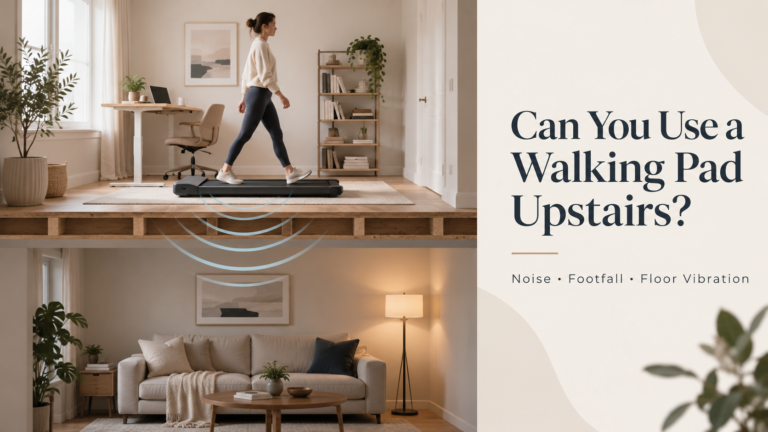
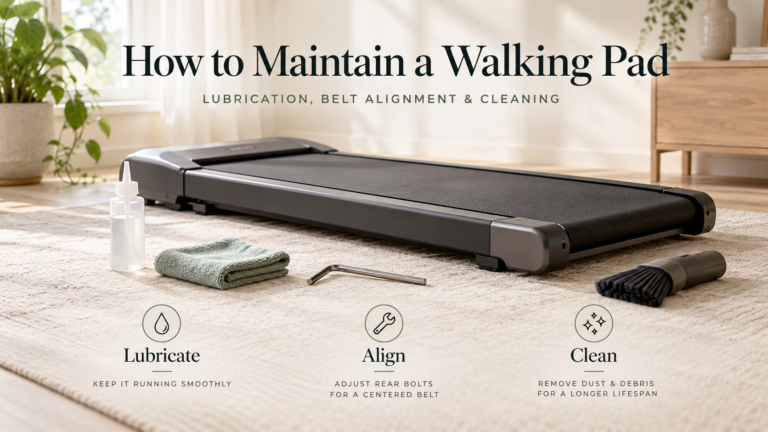
If your existing machine has become noticeably louder, start with our walking pad maintenance guide for cleaning, lubrication, belt-care checks, and the warning signs that call for manufacturer support.
Handrails Are More Important Than They Look
A missing handrail is an advantage when you’re typing.
It’s less attractive when you’re trying to run at 8 mph.
This is one of the clearest physical differences between the categories.
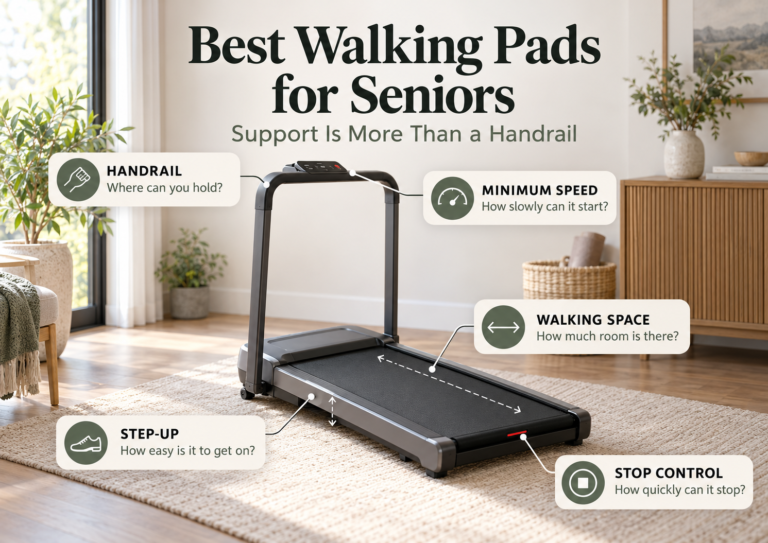
Standard walking pads often omit rails entirely.
Hybrid machines use folding or removable rails.
Treadmills generally build the support structure into the machine.
The WalkingPad MX3, for example, adds an adjustable handrail, side support structure, a 47.2 × 17.3-inch running area, and a 7.5 mph top speed.
It also weighs 90 pounds.
Compare that with the 48.5-pound Egofit M1.
More support tends to mean more machine.
That’s not bad.
It’s simply another trade you’re making.
Need something to hold while you walk or jog? See our best walking pads with handrails.
The Setup-Friction Question Nobody Puts on the Spec Sheet
Suppose Machine A takes thirty seconds to roll under your desk.
Machine B requires you to:
- unfold the deck
- raise the rail
- attach the safety key
- reposition furniture
before you can start.
Neither process sounds terrible.
Repeat it 200 times a year and suddenly the difference matters.
We can’t assign a universal “setup score” because homes and routines differ.
But this is worth considering before getting seduced by capability you’ll rarely use.
A useful rule:
Buy for the hardest activity you genuinely expect to do regularly, not the hardest activity the machine is technically capable of doing.
If you’re going to run three times per week, buy something built for running.
If you vaguely imagine maybe jogging someday but mainly want steps during work, a simpler machine may fit your actual life much better.
The Egofit M1T is another example of that middle ground: our M1 vs M1T comparison shows how a folding rail can turn a desk-focused walking pad into a more versatile machine.
Walking Pad, Hybrid, or Treadmill?
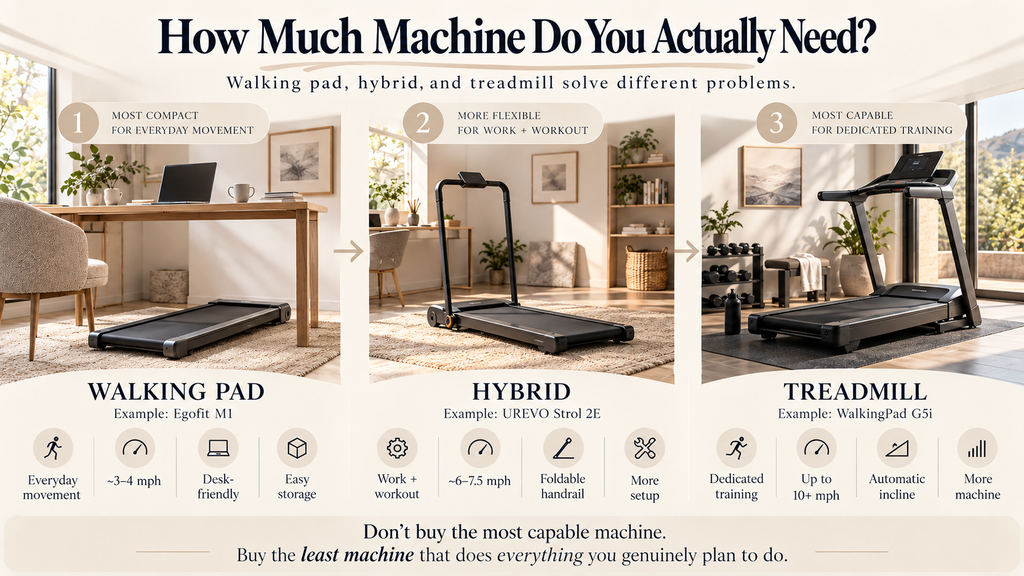
Instead of declaring a universal winner, I’d divide the market into three lanes.
Choose a Walking Pad When Movement Needs to Disappear Into Your Day
A walking pad makes the most sense if you:
- work at a standing desk
- want more daily steps
- live in a small apartment
- expect to move or store the machine frequently
- mostly walk at low speeds
- don’t need a handrail
- value convenience more than workout progression
An Egofit M1 or WalkingPad Z1 is a good example of the format.
Choose a Hybrid When You Hate Choosing
Hybrid machines exist for the buyer who genuinely wants both modes.
The UREVO Strol 2E and WalkingPad MX3 illustrate two versions of that idea.
The Strol 2E is relatively light and inexpensive, with desk walking plus 6.2 mph use when the rail is raised.
The MX3 is much more substantial, reaching 7.5 mph with a larger 47.2 × 17.3-inch deck.
You give up some of a walking pad’s simplicity in exchange for avoiding a second exercise machine.
Choose a Treadmill When Training Is the Point
A treadmill makes sense if you know you’ll use:
- running speeds
- automatic incline
- longer structured sessions
- a larger running deck
- fixed handrails
- interval training
- progression beyond walking
The G5i is an extreme compact-home example, reaching 10 mph and 18% incline while still folding for storage.
You’re giving the machine more room and more money because you’re asking it to do more.
So, Which One Should You Buy?
Try this question:
What would make you regret your purchase six months from now?
If the answer is:
“It’s huge and I never want to pull it out.”
Buy the walking pad.
If it’s:
“I wish I could actually run on this thing.”
Buy the treadmill.
If it’s:
“I need both, but I absolutely do not have space for two machines.”
Look at a hybrid.
The walking pad wins at reducing friction.
The treadmill wins at expanding capability.
The hybrid tries to keep both, while accepting some compromise in weight, size, or complexity.
That’s the real walking pad vs treadmill decision.
Not which machine has the bigger motor.
Which machine asks the right amount from your room and your routine?
A Few Common Questions
Is a walking pad the same as a treadmill?
Not quite. A walking pad is generally optimized for lower-speed walking, compact storage, and often under-desk use. Treadmills typically support higher speeds, larger running surfaces, handrails, and broader workout options. Hybrid machines increasingly blur the boundary.
Can you run on a walking pad?
Only on models specifically designed for higher-speed use. Standard models commonly top out around 4 mph, while hybrid machines can reach jogging or running speeds. Check the exact manufacturer’s speed rating and operating mode.
Is a walking pad better for a small apartment?
Usually for pure space efficiency and under-desk use, yes. But some modern treadmills now fold dramatically, so compare both operating and stored dimensions rather than category names alone.
Is a treadmill better if I want incline?
If you want adjustable automatic incline and higher-speed training, usually yes. Fixed-incline walking pads do exist, including the Egofit M1, while full treadmills such as the G5i can provide much broader incline ranges.
Do I need a treadmill if I only plan to walk?
Not necessarily. If you don’t need running speeds, a large deck, or adjustable incline, a walking pad can deliver the part of the treadmill experience you’ll actually use while taking up less space.