
Adding a handrail sounds like a simple upgrade.
In practice, it changes the whole machine.
A rail can give you something to hold during faster walking or jogging, but it can also make a walking pad heavier, taller, harder to store, or less convenient under a standing desk.
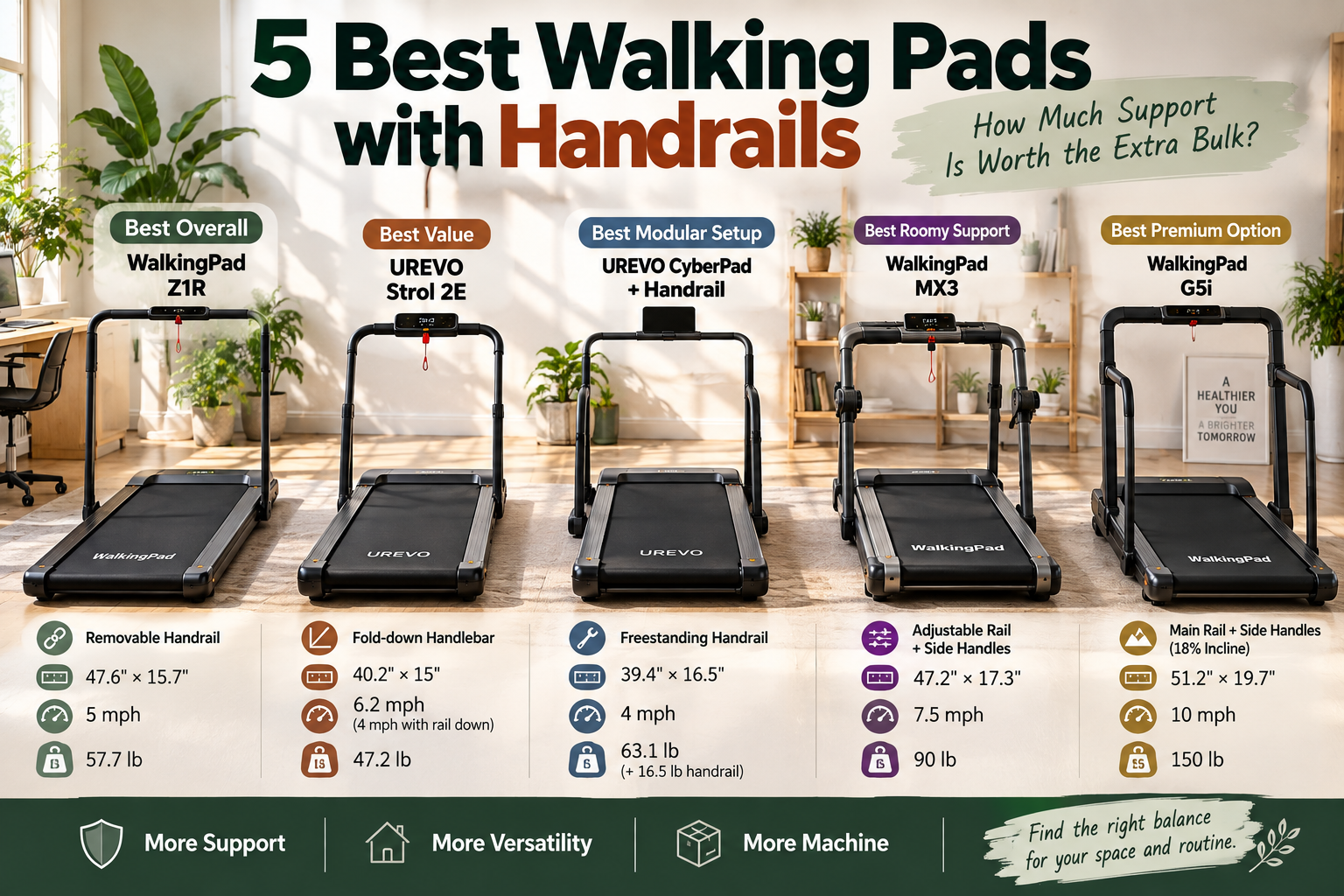
Some models use a removable rail. Others fold the entire handlebar down for under-desk walking. Premium models add adjustable side handles. And UREVO even sells a freestanding handrail that doesn’t attach to the walking pad at all.
So when choosing the best walking pad with a handrail, we wouldn’t simply ask which one gives you the biggest piece of metal to hold.
Disclosure: This article contains affiliate links. If you purchase through these links, we may earn a commission at no additional cost to you. As an Amazon Associate I earn from qualifying purchases.
We’d ask:
How much support do you want, and how much compactness are you willing to give up for it?
Quick answer: The WalkingPad Z1R is our best overall pick because it adds a removable handrail to a long 47.6-inch walking surface without turning into a full-size treadmill. The UREVO Strol 2E is the better budget 2-in-1 choice, while the WalkingPad MX3 gives you a wider belt, adjustable handrail, side handles, and 7.5 mph capability if you want something closer to a compact running treadmill.
How we chose: We have not personally tested the stability, rigidity, or feel of these handrails. Our selections are based on current manufacturer specifications, rail design, walking-area dimensions, speed, machine weight, storage dimensions, and current pricing. We therefore describe the type of support each design provides without claiming one rail is physically safer or sturdier than another.
The Best Walking Pads with Handrails at a Glance
| Model | Best for | Handrail design | Walking area | Top speed | Weight | Current price* |
|---|---|---|---|---|---|---|
| WalkingPad Z1R | Best overall | Removable main rail | 47.6 × 15.7 in | 5 mph | 57.7 lb | $359 |
| UREVO Strol 2E | Best value | Fold-down handlebar | 40.2 × 15 in | 6.2 mph | 47.2 lb | $169.99 |
| UREVO CyberPad + Handrail | Best modular setup | Freestanding removable accessory | 39.4 × 16.5 in | 4 mph | 63.1 + 16.5 lb | ~$469.98 combined |
| WalkingPad MX3 | Best roomy adjustable setup | Adjustable rail + side handles | 47.2 × 17.3 in | 7.5 mph | 90 lb | $599 |
| WalkingPad G5i | Best premium incline option | Main rail + folding side handles | 51.2 × 19.7 in | 10 mph | 150 lb | $1,899 |
*Direct manufacturer pricing checked September 25, 2026 and may change. The CyberPad combination uses the current $409.99 CyberPad checkout price plus UREVO’s $59.99 standalone handrail.
1. WalkingPad Z1R
Best Overall Walking Pad with a Handrail
The WalkingPad Z1R is probably the cleanest answer if you want a handrail without moving all the way into traditional treadmill territory.
It uses a removable handrail, reaches 5 mph, and keeps the same generous 47.6 × 15.7-inch walking area as the standard Z1 family. WalkingPad rates it for 242 pounds and lists a current price of $359.
The removable design is the important part.
You can attach the rail when you want additional support, then remove it when you’d rather use the machine more like a conventional walking pad.
That gives the Z1R more flexibility than a treadmill whose front rail permanently defines how and where you can use it.
There is, however, a real storage penalty.
The Z1R folds to 49.2 × 23.2 × 5.5 inches and weighs 57.7 pounds. The standard Z1 folds to just 31.8 × 22 × 5.4 inches and weighs 51 pounds.
We’ll come back to what that difference means in a minute.
The catch: adding the rail makes the overall package substantially larger when stored.
Our take: The Z1R makes the strongest case if you primarily want a walking pad, but occasionally want something to hold without buying a much heavier hybrid treadmill.
2. UREVO Strol 2E
Best Value 2-in-1 Option
The UREVO Strol 2E takes a more traditional approach.
Raise the handlebar and it operates as a treadmill up to 6.2 mph.
Fold the handlebar down and the speed is limited to 4 mph, allowing the Strol 2E to work alongside an existing standing desk.
That 2-in-1 arrangement makes it especially interesting if you want both:
- workday walking
- dedicated walking or light jogging with a rail
without owning two machines.
The running area measures 40.2 × 15 inches, published capacity is 265 pounds, and product weight is a relatively manageable 47.2 pounds.
UREVO’s current US comparison and small-space collection pages list the Strol 2E at $169.99, although its individual product page recently showed a higher promotional price. That kind of movement is exactly why we recommend checking the live price rather than relying on an old MSRP.
Its biggest compromise is storage geometry.
With the handlebar down, UREVO lists it at 51.2 × 22.6 × 4.6 inches.
So although the rail folds flat, the walking deck itself does not fold in half like WalkingPad’s Z1R.
The catch: long stored footprint despite the folding handlebar.
Our take: At current pricing, the Strol 2E is an unusually inexpensive way to get both under-desk walking and a supported faster-walking/jogging mode.
3. UREVO CyberPad for Office + Walking Pad Handrail
Best Modular Handrail Setup
This is the wildcard.
The CyberPad for Office does not include a handrail as standard.
Instead, UREVO sells a separate $59.99 freestanding walking-pad handrail that surrounds compatible machines without being drilled or permanently attached to them.
That’s a fundamentally different approach.
The handrail itself folds, has wheels, includes a tablet holder, weighs 16.5 pounds, and supports walking pads up to 23.62 inches wide. UREVO explicitly shows the accessory paired with products including the CyberPad for Office.
The CyberPad itself measures 42.9 × 22.8 × 6.3 inches, provides a 39.4 × 16.5-inch walking area, supports up to 400 pounds, and includes 0–14% automatic incline. Current checkout price is $409.99.
So at today’s direct prices, the combination costs roughly:
$409.99 + $59.99 = $469.98
before any additional promotion.
What makes this setup different is that the handrail never becomes part of the walking pad itself. If you don’t need it, you can move the frame aside and use the CyberPad exactly as before.
That flexibility comes with a practical downside, though: you now have two pieces of equipment to store. The handrail weighs 16.5 pounds and folds to 46.46 × 28.35 × 7.87 inches, so “removable” does not mean it disappears when you’re finished with it.
For someone who already likes the feel of a conventional walking pad and only wants a support frame occasionally, that trade-off may make sense. For a small apartment where every stored object matters, the separate frame deserves almost as much consideration as the walking pad itself.
If office use matters more than the rail itself, see our best walking pads for under a desk.
4. WalkingPad MX3
Best for More Walking Room and Adjustable Support
The WalkingPad MX3 is where we start moving from “walking pad with a rail” into genuine compact treadmill territory.
It gives you a 47.2 × 17.3-inch running area, 265-pound capacity, and speeds from 1 to 7.5 mph.
The handrail is height-adjustable, and WalkingPad also adds folding side handles.
That’s a much more elaborate support structure than the removable single rail on the Z1R.
The MX3 can still switch between under-desk walking and faster exercise, and it retains WalkingPad’s folding deck.
Folded dimensions are 40.3 × 29.9 × 7.7 inches.
The trade-off shows up most clearly on the scale. At 90 pounds, the MX3 is more than 32 pounds heavier than the Z1R and almost twice the weight of the Strol 2E.
That changes who this machine makes sense for. The MX3 is less appealing if your main goal is a lightweight pad that you can regularly move around the room. Its extra weight is easier to justify if you specifically want the wider belt, adjustable handrail, side handles, and higher 7.5 mph top speed.
In other words, this is less about adding a handrail to a walking pad and more about accepting a heavier machine in exchange for something closer to a compact treadmill.
Need more walking room for a longer stride? See our guide to the best walking pads for tall users.
5. WalkingPad G5i
Best Premium Handrail Treadmill with Incline
The WalkingPad G5i sits at the extreme end of this category.
It provides an 18% adjustable incline, speeds up to 10 mph, a 51.2 × 19.7-inch running area, and a 300-pound published user capacity.
WalkingPad gives it a main front rail plus folding side handles for additional support during higher-intensity exercise.
Unlike the MX3, the handrail height itself is not adjustable.
The G5i is also designed to fold for both flat and upright storage.
That’s impressive for something approaching full treadmill capability.
But no one is going to mistake it for a lightweight walking pad.
It weighs 150 pounds.
Folded dimensions are 45.7 × 33.4 × 10.2 inches, and current price is $1,899.
WalkingPad’s official pages currently show slightly inconsistent availability states, with one product page showing pre-order and another offering an Add to Cart flow, so we’d verify availability immediately before publishing or buying.
The catch: dramatically heavier and more expensive than everything else here.
Our take: The G5i makes sense if “walking pad with a handrail” is really shorthand for “a compact treadmill I can walk, incline-walk, jog, and run on.”
If incline is the real priority, see our guide to the best walking pads with incline.
What Does a Handrail Actually Cost You?
This is the section I’d make the TQE original-value centerpiece.
The easiest comparison is the WalkingPad Z1 versus Z1R because they’re closely related products.
The standard Z1 has no rail.
The Z1R adds one.
Using WalkingPad’s current published specs:
| Z1 | Z1R | Difference | |
|---|---|---|---|
| Weight | 51 lb | 57.7 lb | +6.7 lb |
| Folded length | 31.8 in | 49.2 in | +17.4 in |
| Folded width | 22 in | 23.2 in | +1.2 in |
| Folded height | 5.4 in | 5.5 in | +0.1 in |
The weight increase is only about 13%.
The storage impact is much larger.
If we treat the published folded length × width as the horizontal footprint:
- Z1: 31.8 × 22 = about 700 sq in
- Z1R: 49.2 × 23.2 = about 1,141 sq in
That’s roughly a 63% larger folded floor footprint for the Z1R.
That’s not a manufacturer claim. It’s our calculation from WalkingPad’s published dimensions.
And that’s exactly why “just add a handrail” isn’t really a free upgrade.
The support structure changes the storage equation.
Four Different Ways to Add Support
These five products actually represent four distinct handrail philosophies.
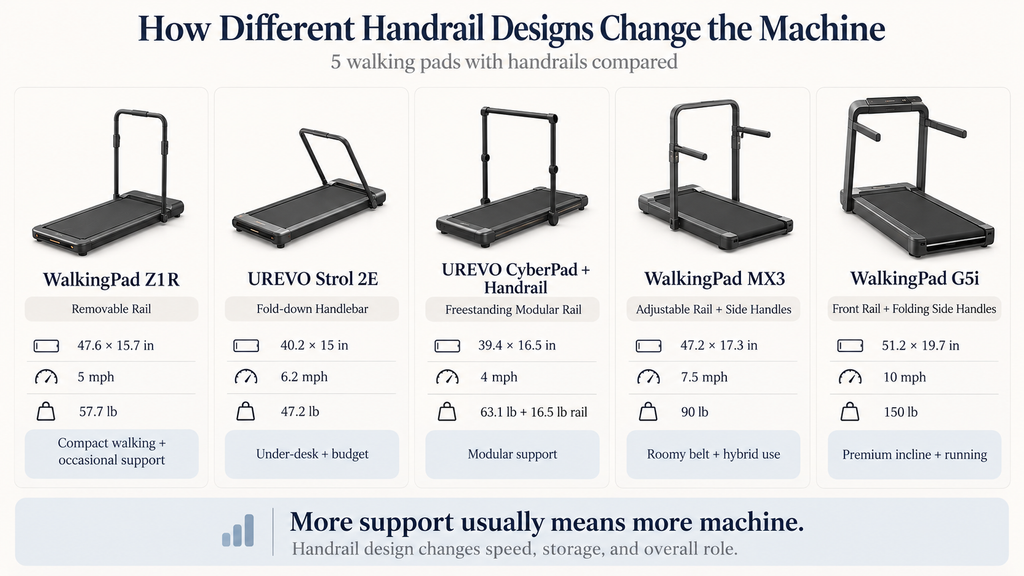
1. Removable rail
WalkingPad Z1R
Best when you want a conventional walking pad most of the time, but occasionally want a support point.
The advantage is flexibility.
The disadvantage is that the complete stored package is noticeably larger than the rail-free Z1.
2. Fold-down handlebar
UREVO Strol 2E
The rail stays attached but folds flat for walking-desk mode.
This is convenient if you regularly switch between workday walking and faster dedicated exercise.
3. Freestanding handrail
UREVO CyberPad + Walking Pad Handrail
Nothing attaches to the machine.
That’s arguably the most flexible design, but it gives you another piece of equipment to store.
4. Full hybrid support structure
MX3 / G5i
Main rails, side handles, faster speeds, and more treadmill-like layouts.
You gain more workout versatility.
You also gain a lot of weight and bulk.
Handrail Support vs Storage: The Real Trade-Off
This is where the five machines separate nicely.
| Model | Support style | Storage character |
|---|---|---|
| Z1R | Removable single rail | Compact-ish, but much larger than Z1 |
| Strol 2E | Fold-down front handlebar | Rail disappears, long deck remains |
| CyberPad + rail | Fully separate frame | Walking pad stays unchanged, second object to store |
| MX3 | Adjustable rail + side handles | Folds, but 90 lb |
| G5i | Front rail + folding side handles | Folds, but 150 lb |
There is no universal winner.
The more useful question is:
What kind of inconvenience are you willing to accept?
Longer storage footprint?
A separate accessory?
More machine weight?
Or less support?
Egofit takes a similar 2-in-1 approach with its compact M1 platform. See our Egofit M1 vs M1T comparison to see exactly what the folding rail adds.
Do You Actually Need a Handrail?
Not everyone does.
For low-speed walking under a desk, many conventional walking pads are intentionally designed without rails so your upper body remains free to use a keyboard and mouse.
A rail becomes more relevant when:
- you prefer having a fixed point to hold
- you plan to walk faster
- you also want to jog
- you dislike completely open-front walking pads
- you expect multiple household members to use the machine differently
But a rail shouldn’t be treated as a substitute for checking the manufacturer’s instructions, speed limits, user capacity, or safety key requirements.
And because we haven’t physically tested these products, we’re not going to claim that one design is “safer” than another based on photos or rail size alone.
TQE Handrail Decision Matrix
| Your priority | Start with |
|---|---|
| Compact walking + occasional rail use | WalkingPad Z1R |
| Lowest price | UREVO Strol 2E |
| Rail that doesn’t attach to the pad | CyberPad + UREVO Handrail |
| Wide belt + adjustable support | WalkingPad MX3 |
| Running + steep incline | WalkingPad G5i |
| Under-desk walking too | Strol 2E or Z1R |
| Least treadmill-like feel | Z1R |
| Most treadmill-like setup | G5i |
Which Walking Pad with a Handrail Should You Buy?
For most people specifically looking for a walking pad with a handrail, we’d start with the WalkingPad Z1R.
It keeps the long walking area and foldable architecture that make walking pads interesting in the first place, while letting you attach a rail when you want it.
For value, the UREVO Strol 2E is much harder to ignore.
At the current $169.99 price, it gives you a fold-down rail, under-desk walking mode, and speeds up to 6.2 mph.
The CyberPad plus freestanding handrail is the unusual modular choice.
Choose the MX3 if you want a larger walking surface and adjustable rail structure.
And choose the G5i only if you’re really shopping for a serious folding treadmill with incline and running capability.
The takeaway is simple:
A handrail isn’t just an extra feature. It changes the size, storage, and role of the entire machine.
Frequently Asked Questions
What is the best walking pad with a handrail?
For a balance of walking-pad design, long belt space, removable support, and price, our current overall pick is the WalkingPad Z1R. It has a removable rail, 47.6 × 15.7-inch walking area, and 5 mph top speed.
Can you add a handrail to a walking pad?
Sometimes. UREVO currently sells a freestanding walking-pad handrail for $59.99 that accommodates compatible pads up to 23.62 inches wide and does not permanently attach to the machine. Width alone does not guarantee compatibility, so UREVO recommends checking the full exterior layout.
Can you use a walking pad under a desk if it has a handrail?
Some models allow this. The UREVO Strol 2E operates up to 4 mph with its handlebar folded down for under-desk use, while other machines use removable or folding rail designs.
Is a removable handrail better than a fixed one?
Not universally. A removable design preserves more flexibility, while an integrated rail may be quicker to transition into faster exercise. Storage space and how often you use the rail matter more than the label itself.
Does a handrail make a walking pad safer?
A handrail provides something to hold, but we have not independently tested these products’ stability or safety performance. Follow the manufacturer’s instructions and operating limits for the exact model you choose.
Which walking pad with a rail has the biggest belt here?
The WalkingPad G5i has the largest running area in this comparison at 51.2 × 19.7 inches. It’s also much heavier and more expensive than the simpler walking-pad options.