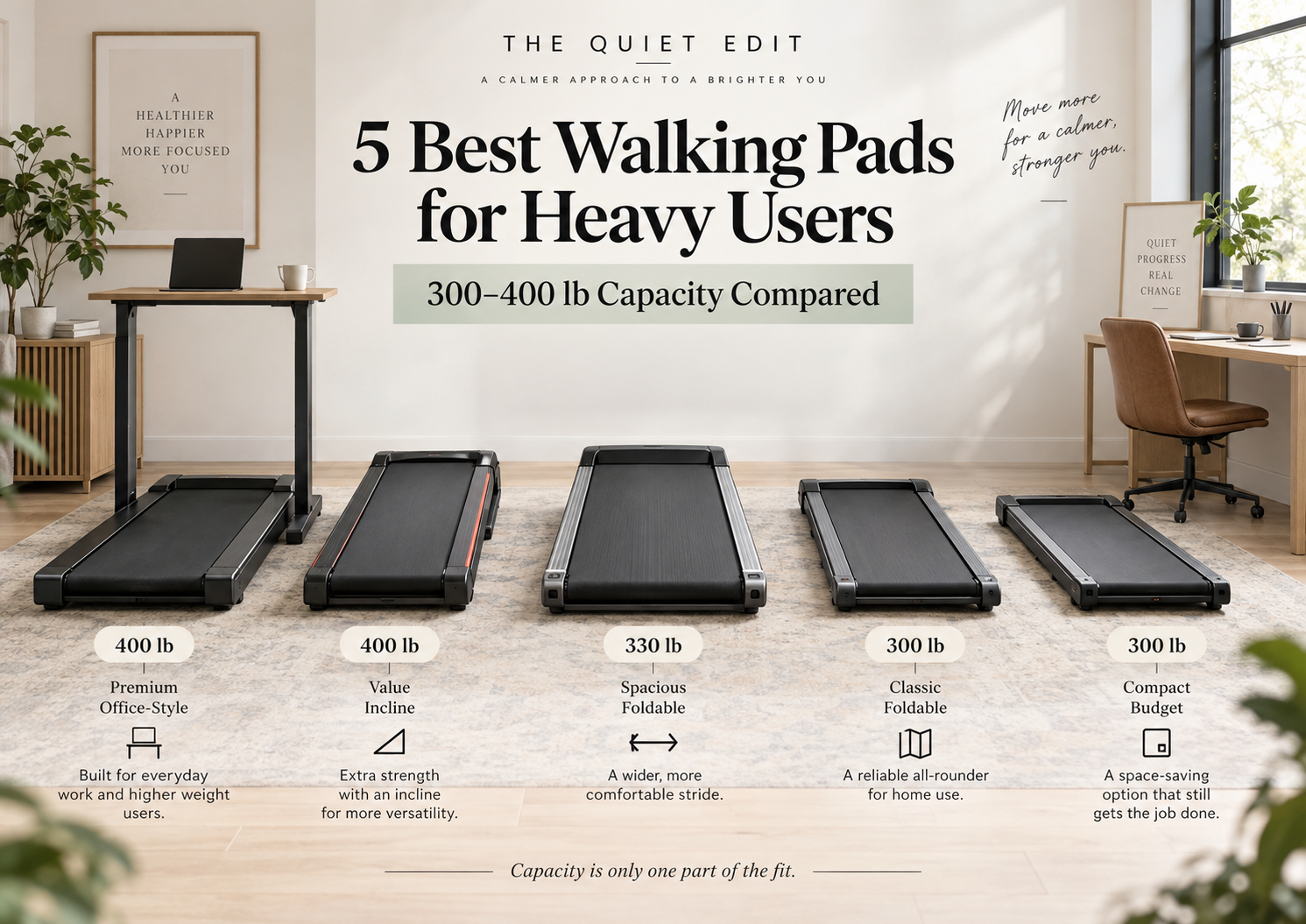
A higher weight-capacity rating is useful, but it doesn’t tell you whether a walking pad will actually be comfortable or practical to own.
A 400-pound model can still have a relatively short walking belt. A 300-pound model might give you much more room for your stride. And some higher-capacity walking pads weigh almost twice as much as others.
So for this guide, we looked beyond the headline capacity number.
We compared published user weight limits, walking-area dimensions, machine weight, incline, storage design, speed, and current price to see what each higher-capacity model actually gives you.
Quick answer: The UREVO CyberPad for Office is our best overall pick because it combines a 400-pound published capacity, 39.4 × 16.5-inch walking area, 14% automatic incline, and a relatively work-friendly footprint. The UREVO SpaceWalk 5L is the stronger value option, while the DeerRun Q2 Urban is dramatically lighter and cheaper if 300 pounds of published capacity is enough.
Disclosure: This article contains affiliate links. If you purchase through these links, we may earn a commission at no additional cost to you. As an Amazon Associate I earn from qualifying purchases.
How we chose: We have not personally tested these walking pads. Our selections are based on current manufacturer specifications, dimensions, published user weight limits, pricing, and the practical implications of those differences. Always stay within the manufacturer’s stated limit for the exact model and configuration you purchase.
The Best 300 lb+ Walking Pads at a Glance
| Model | Best for | Capacity | Walking area | Machine weight | Current price* |
|---|---|---|---|---|---|
| UREVO CyberPad for Office | Best overall | 400 lb | 39.4 × 16.5 in | 63.1 lb | $409.99 |
| UREVO SpaceWalk 5L | Best value / incline | 400 lb | 39.4 × 15.8 in | 50.7 lb | $279.99 checkout |
| WalkingPad R3 | Best spacious foldable | 330 lb | 47.2 × 17.3 in | 66.3 lb | $849 |
| WalkingPad A1 Pro | Best classic foldable | 300 lb | 47 × 16.5 in | 63 lb | $529 |
| DeerRun Q2 Urban | Best budget / lightweight | 300 lb | 35.43 × 14.96 in | 35.05 lb | From $119 |
*Direct US manufacturer prices checked September 23, 2026. Promotions and variants can change. WalkingPad’s R3 is currently offered in a 330-pound configuration; the A1 Pro has a 300-pound option.
1. UREVO CyberPad for Office
Best Overall for Higher Weight Capacity
The UREVO CyberPad for Office has the highest published capacity in this comparison at 400 pounds.
But capacity isn’t the only reason it leads the list.
UREVO gives it a 39.4 × 16.5-inch walking area, a 0.6–4 mph speed range, and up to 14% automatic incline. The machine itself measures 42.9 × 22.8 × 6.3 inches and weighs 63.1 pounds.
That combination matters because some high-capacity fitness equipment solves the load problem by becoming enormous.
The CyberPad is certainly not lightweight, but its body remains relatively short for a 400-pound-rated walking pad.
It is also specifically shaped around under-desk use.
Compared with UREVO’s CyberPad for Home, the Office model is shorter and lower, while actually carrying a higher published load limit: 400 pounds versus 350 pounds.
Current UREVO pricing is around $409.99.
The catch: 63 pounds is a lot to reposition every day, and its 39.4-inch belt is not the longest option here.
Our take: The strongest all-round option if higher capacity, automatic incline, and desk compatibility all matter.
2. UREVO SpaceWalk 5L
Best Value with 400 lb Capacity
The SpaceWalk 5L is arguably the most surprising model in the group.
It also carries a 400-pound published capacity, but currently costs only $279.99 at checkout.
Its walking area measures 39.4 × 15.8 inches, and the machine weighs 50.7 pounds, roughly 12 pounds less than the CyberPad for Office.
It also includes 0–9% automatic incline, app support, transport wheels, and a 6.1-inch profile.
That makes it a particularly interesting combination of higher capacity and relatively manageable everyday size.
UREVO says the 5L uses a high-strength alloy structure and 12-point shock-absorption system, but for our purposes the more useful numbers are simply the published load limit, walking area, and product weight.
Compared with the CyberPad, you’re giving up some belt width and maximum incline.
You’re also saving well over $100 at current direct pricing.
The catch: its 39.4-inch belt still isn’t especially long, and at 50.7 pounds it isn’t genuinely lightweight.
Our take: If you want 400-pound published capacity without moving into premium pricing, this is probably the strongest value proposition in the group.
Internal link
Want incline as well as higher capacity? See our guide to the best walking pads with incline.
3. WalkingPad R3
Best Spacious Foldable Option
The WalkingPad R3 demonstrates why weight capacity and walking space should be treated as separate specifications.
Its maximum published capacity is 330 pounds, lower than the two UREVO models above.
But its walking surface is substantially larger at 47.2 × 17.3 inches.
That gives you:
- almost 8 inches more belt length than the CyberPad
- 0.8 inches more belt width
- much more total usable walking area
while retaining WalkingPad’s folding deck.
When you’re finished, the R3 folds from 57.8 inches long to 33.5 inches long.
That’s the unusual part.
Higher capacity plus a roomy belt often means dedicating permanent floor space to a large treadmill. The R3 gives you a large walking surface and then compresses its storage length dramatically.
The penalty is both price and weight.
It weighs 66.3 pounds and currently costs $849 in the 330-pound configuration.
The catch: expensive and heavy.
Our take: If walking-area comfort matters as much as capacity, the R3 makes a much stronger case than its 330-pound number alone suggests.
Internal link
If belt size matters because you have a longer stride, see our best walking pads for tall users.
4. WalkingPad A1 Pro
Best Classic Foldable 300 lb Walking Pad
The WalkingPad A1 Pro is the more straightforward 300-pound choice.
WalkingPad offers it with a 300-pound maximum-load configuration, a 47 × 16.5-inch walking area, and a 0.5–3.75 mph speed range.
Like the R3, the deck folds roughly in half.
Its overall length drops from 56.5 inches to 32.5 inches when folded.
That makes it particularly relevant if you want more walking space but have limited storage length.
The A1 Pro also includes FootSense speed control in addition to app and remote control.
Machine weight is 63 pounds, so this isn’t exactly a featherweight walking pad either.
Current direct price is $529.
The interesting comparison is with the cheaper UREVO SpaceWalk 5L.
The A1 Pro has:
- a much longer belt
- a wider belt
- folding storage
But the UREVO offers:
- a higher 400-pound published capacity
- automatic incline
- lower current price
- lower machine weight
Those aren’t small differences.
The catch: expensive for a 300-pound-rated machine when 400-pound alternatives cost less.
Our take: Choose the A1 Pro because you specifically value its long walking area and folding deck, not simply because the spec sheet says “300 lb.”
5. DeerRun Q2 Urban
Best Budget and Lightweight Option
The DeerRun Q2 Urban proves that a 300-pound rating does not automatically mean a large, heavy machine.
DeerRun publishes a 300-pound weight capacity, yet the Q2 itself weighs just 35.05 pounds.
It measures only 42.62 × 19.69 × 3.94 inches and includes transport wheels.
That makes it by far the easiest machine here to move around regularly.
It also has a 7% manual incline, app and remote control, and a 0.6–3.8 mph speed range.
Current DeerRun pricing starts around $119, depending on color and promotion.
There is an obvious compromise.
The walking belt is only 35.43 × 14.96 inches, much smaller than the WalkingPad R3 or A1 Pro.
So you’re getting higher published capacity in a tiny package, but not the roomy walking area that often comes with larger machines.
The catch: shortest and narrowest belt in the group.
Our take: The strongest option if your priorities are 300-pound published capacity, low cost, and easy portability rather than maximum stride room.
Internal link
Shopping on a tighter budget? See our guide to the best walking pads under $200.
Higher Capacity Does Not Mean More Walking Space
This is the section I’d make the TQE original-value centerpiece.
It’s tempting to assume a higher-capacity walking pad must also be physically roomier.
These five products show why that’s not true.
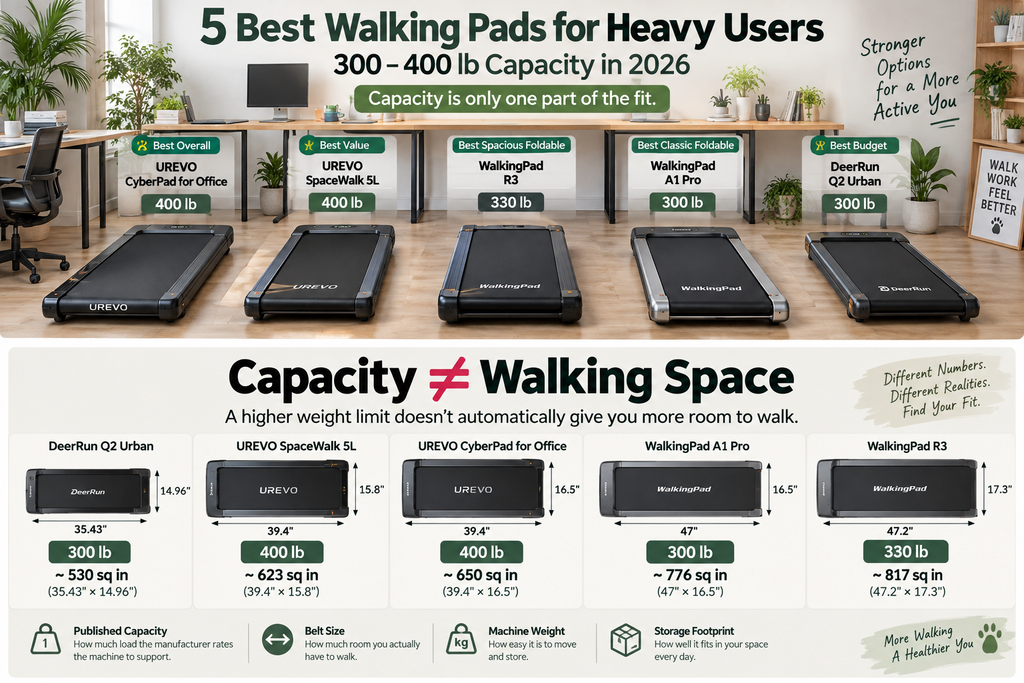
Using the manufacturers’ published belt measurements, the approximate usable walking areas are:
| Model | Published capacity | Approx. belt area |
|---|---|---|
| UREVO CyberPad Office | 400 lb | ~650 sq in |
| UREVO SpaceWalk 5L | 400 lb | ~623 sq in |
| WalkingPad R3 | 330 lb | ~817 sq in |
| WalkingPad A1 Pro | 300 lb | ~776 sq in |
| DeerRun Q2 Urban | 300 lb | ~530 sq in |
These are simple calculations from the manufacturers’ stated belt dimensions.
The difference is substantial.
The R3’s belt area is roughly 54% larger than the Q2 Urban’s, even though their published capacity differs by only 30 pounds.
Meanwhile the two UREVO models support a published 400 pounds but have smaller walking areas than both WalkingPad foldable models.
That gives us a useful rule:
Weight capacity tells you how much load the manufacturer rates the machine to support. Belt dimensions tell you how much room you have to walk.
They solve different problems.
A Higher Weight Limit Does Not Mean a Heavier Machine Either
Here’s another useful comparison.
| Model | Capacity | Machine weight |
|---|---|---|
| Q2 Urban | 300 lb | 35.05 lb |
| SpaceWalk 5L | 400 lb | 50.7 lb |
| A1 Pro | 300 lb | 63 lb |
| CyberPad Office | 400 lb | 63.1 lb |
| R3 | 330 lb | 66.3 lb |
Again, there is no simple relationship.
The 35-pound DeerRun and 63-pound A1 Pro both carry 300-pound published limits.
The 50.7-pound SpaceWalk 5L actually carries a higher published limit than the 66.3-pound R3.
That doesn’t mean the lighter machines are universally better.
It means machine weight is a portability specification, not a shortcut for durability or user capacity.
What Should You Check Besides Weight Capacity?
If you’re specifically shopping for a 300-, 350-, or 400-pound walking pad, we’d check four other things.
1. Walking-belt dimensions
A capacity rating tells you nothing about stride room.
Someone who fits comfortably within the published load limit may still dislike a short 35-inch belt.
That’s why the R3 and A1 Pro remain relevant even though higher-capacity UREVO models exist.
2. Machine weight
Ask how often you’re actually going to move it.
A 66-pound foldable pad may store beautifully once you get it there, but it still weighs 66 pounds.
A lighter rigid machine may be easier to roll out every morning.
3. Storage geometry
“Compact” can mean several things.
The R3 and A1 Pro are long while operating but fold dramatically shorter.
The Q2 Urban never folds, but its body is already only 42.6 inches long and 3.94 inches high.
Different rooms favor different designs.
4. Features you will actually use
The capacity number shouldn’t distract from everything else.
Do you need:
- automatic incline?
- a long belt?
- under-desk compatibility?
- folding storage?
- low machine weight?
- a handrail?
Buy enough published capacity for your requirements, then compare the machines like normal walking pads.
TQE 300 lb+ Decision Matrix
| Your priority | Start with |
|---|---|
| Highest capacity + office use | UREVO CyberPad for Office |
| 400 lb capacity at lower cost | UREVO SpaceWalk 5L |
| Most walking space | WalkingPad R3 |
| 300 lb + long belt + folding | WalkingPad A1 Pro |
| Lowest price / easiest to move | DeerRun Q2 Urban |
| Automatic incline | CyberPad Office or SpaceWalk 5L |
| Small-apartment portability | DeerRun Q2 Urban |
| Longer stride room | WalkingPad R3 |
300 lb vs 400 lb Capacity: Should You Automatically Buy More?
Not necessarily.
A 400-pound model can be useful if you need that higher published limit or simply prefer the rest of the machine’s features.
But capacity alone isn’t a reason to pay more if you’re comfortably within the rating of a different walking pad that fits your room and walking style better.
WalkingPad’s own FAQ advises shoppers to check the exact model’s maximum user weight and specifically points users above roughly 260 pounds toward its 300- and 330-pound options.
The important part is to verify the limit for the exact version you’re buying.
For example, WalkingPad’s R3 page lists different capacity configurations, while the A1 Pro page also references more than one load option.
Don’t assume every version with the same product name has the same rating.
Which Higher-Capacity Walking Pad Should You Buy?
For the broadest overall combination of capacity and features, we’d start with the UREVO CyberPad for Office.
It gives you 400-pound published capacity, a relatively wide belt, automatic incline, and a design aimed at standing-desk use.
If value matters more, the SpaceWalk 5L is extremely compelling at current pricing.
It still gives you a 400-pound published limit and automatic incline while weighing less and costing substantially less.
Choose the WalkingPad R3 if walking space is more important than chasing the highest capacity number.
Choose the A1 Pro if you want a long, foldable 300-pound-rated walking pad without stepping up to the R3.
And choose the DeerRun Q2 Urban if budget and daily portability are your priorities.
The key takeaway is simple:
Don’t buy a weight-capacity number. Buy a walking pad that meets your required capacity and still works for your stride, space, and daily routine.
Frequently Asked Questions
What is the best walking pad for heavy users?
For a high published load limit combined with office-friendly features, our current overall pick is the UREVO CyberPad for Office, rated up to 400 pounds by UREVO.
Are there walking pads with a 400 lb weight capacity?
Yes. UREVO currently rates both the CyberPad for Office and SpaceWalk 5L for up to 400 pounds.
What WalkingPad model supports 300 lb?
WalkingPad currently offers the A1 Pro in a 300-pound configuration. The R3 is available in a 330-pound configuration.
Is a higher weight capacity better?
Only if you need it. A higher published capacity does not automatically give you a longer belt, wider walking area, lower weight, or easier storage.
What is the lightest 300 lb walking pad in this comparison?
The DeerRun Q2 Urban is the lightest of these five at 35.05 pounds while carrying a published 300-pound capacity.
Is a 300 lb walking pad also better for tall users?
Not necessarily. User weight and stride space are separate issues. Belt dimensions matter more directly when comparing available walking room.